

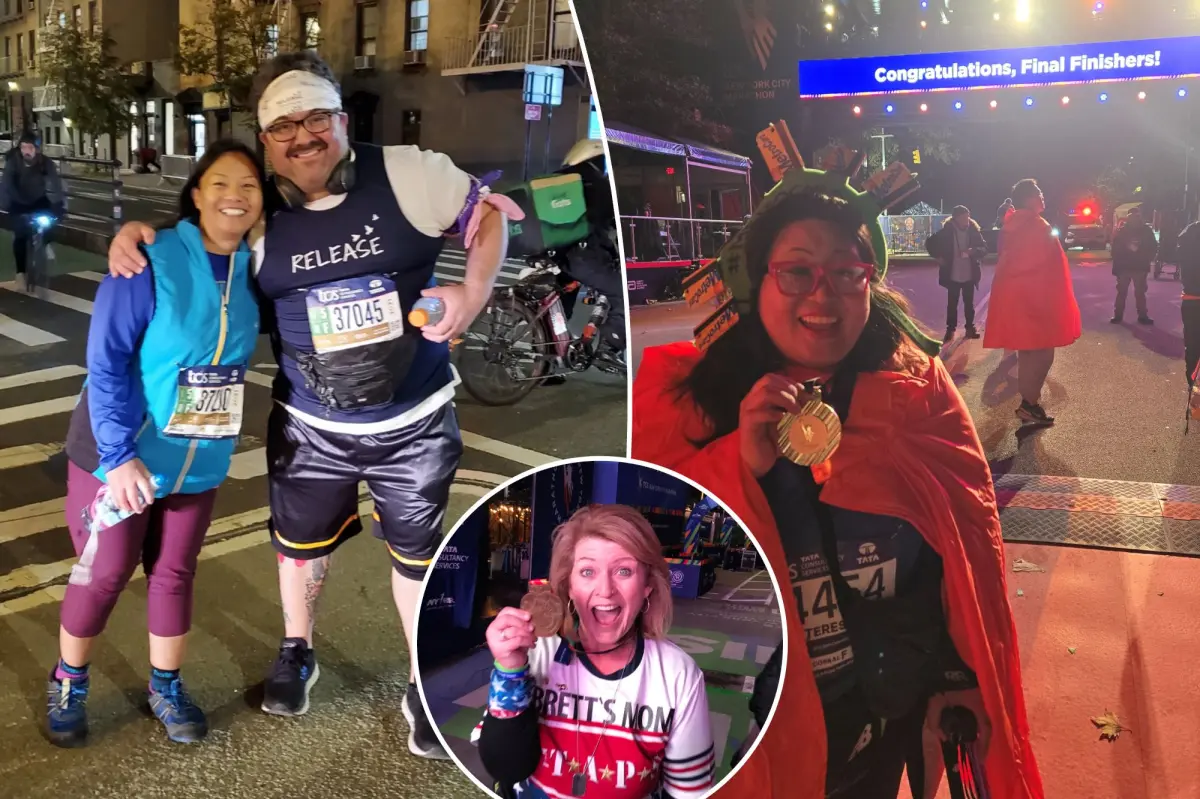
In the city that never sleeps, the last finishers of the New York City Marathon are the truest New Yorkers—people who refuse to let midnight, pain, or loneliness end their story. The race officially closes at 10 p.m., but the final runners cross into Central Park long after dark, sometimes nearly at midnight, to receive medals that mean something far more intimate than a top finisher’s trophy. Last place may not sound like something to celebrate, but at the TCS New York City Marathon, it can feel like winning. Teresa Hui knows this ritual well. When a spectator shouted “Congratulations!” as she walked along the sidewalk wearing her race bib, she smiled and clarified: “There’s no medal around my neck, so I’m still in it.” Hui, a 45-year-old actor and singer from Brighton Beach, has completed 18 New York City Marathons since her 2006 debut; the race became the emotional anchor of her autumn, especially as it celebrates a half-century since expanding to five boroughs. Though she was not athletic as a child, she took up distance running in college and eventually clocked a personal best of 4 hours and 34 minutes in 2011. “And I was the kid who couldn’t go down half a block,” she marveled. “The marathon is in my blood. It’s in my DNA. It’s what gives me joy.” But a cascade of chronic diagnoses—fibromyalgia, severe osteoarthritis, and other conditions—eroded her joints and nervous system, turning her brisk stride into a 20-minute-per-mile shuffle with a cane. Last year, she was the penultimate runner to cross the finish line, arriving in Central Park just before midnight, roughly 15 hours after starting on Staten Island. Most of the 50,000 runners were already asleep; the grandstands had thinned. Yet the tail end of the race vibrated with its own energy. “All these folks are still there. They’ve got their glow sticks, and there was a walking DJ,” she said. “Your goal is never to be a final finisher… but anything can happen.” She plans to return this year, swapping her cane for forearm crutches. “I would love to finish before they turn off the official timing clocks at 10 p.m.,” she says. “But I will crawl, I will roll to that finish line—I don’t care. I’ll do anything to finish.”
New York native Danielle Grimley had three simple rules for her first marathon: have fun, finish the race, and don’t get hurt. She managed two of the three. The 43-year-old human resources executive, who now lives outside Boulder, Colorado, had been a casual runner before deciding to attempt 26.2 miles, and she resolved to do it in the greatest city in the world. “It was New York or nothing for me,” she said. Even when she was diagnosed with a cluster of autoimmune disorders during training, she refused to abandon the dream. “I talked to a couple of doctors and they cleared me, but looking back, I think I overtrained.” Trouble announced itself almost immediately. During the opening mile across the sweeping Verrazzano-Narrows Bridge, she sensed her body breaking down; a deep, persistent ache throbbed in her hip joint. She pressed through Brooklyn and Queens, but by the time she reached mile 20 in the Bronx, she could no longer put any weight on her leg. At the aid tent, medical personnel gently informed her that her race was effectively over. Grimley had other plans. She asked whether they had any crutches she could borrow. “It became a much more visceral thing. I wanted to do it to prove it to myself,” she said of the solitary, grueling six-mile march southward through the darkening roads of upper Manhattan. “I’d been dreaming of this finish, this experience,” she recalled. “Other people have done it with far more challenging adversity than I had in that moment. I just had a cool new way to get to the finish line. It’s just you against yourself out there.” Ten and a half hours after starting, she crossed the line dead last—hobbling on crutches, with a literal broken hip. The morning after her finish, she visited NYU Langone and was rushed into emergency orthopedic surgery. She hasn’t run another marathon since, at least not yet. “Part of me looks at 2027 being the year I go back to New York,” she says.
Fredilyn Bangwa’s path to the final medal was about unfinished business. The 47-year-old civil engineer from Bergen County, New Jersey, had lined up for her fifth New York City Marathon in 2019 and experienced the heartbreak of a DNF when dizziness overwhelmed her near mile 18. Unwilling to leave her goal incomplete, she returned to the streets two weeks later and ran the remaining distance on her own. After the 2020 race was cancelled due to Covid, she set her sights on 2021, determined to finish the marathon as she had planned. Unexpectedly, she found a running buddy along the route: a struggling first-time marathon hopeful named Mario Diurno, who was just as determined to finish and just as flailing. Seeing each other’s flagging energy, the two banded together for the long push southward. “It took my mind off the pain—it was just having someone to talk to,” Bangwa said. As a four-time finisher, she assumed the role of route guide, navigating them through areas like the Bronx where road barriers were already being dismantled and local traffic was beginning to encroach on the course. As they approached Central Park, Diurno experienced a sudden rush of vitality. “It was his first marathon, and he was so excited,” she recalled. “We had walked together for 15 miles or whatever, and then he got this second wind and ended up going way ahead of me once we entered the park.” Their finish times came down to mere seconds; the difference was a minute or so, and he could easily have been the last one. But Bangwa felt no competitive urge to chase him down. Graciously, she let her newfound partner push ahead to claim his moment, and she became the official last finisher with a time of 10 hours and 54 seconds. As for Diurno, he is no longer a total stranger. “We still text a little here and there,” she noted. “He’s someone I would definitely love to meet up with again at some point.”
Shellie Warren’s final-finisher story began with unbearable grief. In 2014, her son Brett, a former Navy officer and a high school cross-country star, died by suicide. In the aftermath, she discovered a devastating piece of mail in his personal inbox: an acceptance notice. “Congratulations on qualifying for the New York Marathon,” the email read. “He had broken records as a cross-country runner in high school—it gave him a lot of joy,” Warren recalled. “And something stuck in my heart.” Five years later, the 66-year-old family therapist traveled across the country and walked onto the staging grounds in Fort Wadsworth with the words “Brett’s Mom” emblazoned across her chest in heavy duct tape. She had never considered herself an athlete, but in the wake of her bereavement, she had taken up walking as a path toward emotional healing, and honoring Brett’s qualifying spot became an essential pilgrimage. “Not finishing was not an option,” she said simply. “You do what you need to do for your kids.” Her physical preparation had been modest: accumulating 10,000 steps a day and walking a half-marathon event in Fresno. “I thought I was prepared,” she admitted. “I’ll be very honest with you: I was not.” Yet an unspoken spiritual obligation propelled her through the boroughs. Early on, knowing there was always someone behind her gave her hope. But eventually, severe back spasms, muscle fatigue, and punishing blisters slowed her to a crawl. There was also the emotional toll: Brett had jumped to his death from the George Washington Bridge, making every bridge crossing an intensely painful hurdle. Reaching the Verrazzano-Narrows Bridge proved especially poignant. “I had to pause and talk to him, say goodbye in a way I couldn’t have anywhere else,” she said. “I asked for his blessing.” As darkness enveloped the city, Warren found herself isolated. Water stations were being dismantled, trash crews were clearing paper cups, and the city’s ordinary hum was returning. “It started making me feel a little bit lonely. Does anybody remember I’m out here? I was afraid I was forgotten.” She was not. More than 12 hours after starting, at approximately 11:15 p.m., Warren emerged onto the brightly illuminated finish line in Central Park. “People with physical disabilities? Ninety-year-olds? I was after all of them, but it didn’t matter,” she said. “I’ll proudly wear the last place. To me, that spoke of resilience and stubbornness and a fitting ending.”
What unites these four runners is not speed but stubbornness—a refusal to let the clock, or the body, or the city itself decide when the race is over. They represent a side of the marathon that never appears on leaderboards: the long, lonely, dark hours when the event has become something else, a test of whether you can keep moving after the world has moved on. Teresa Hui’s marathon was transformed by moments of unexpected inspiration; during her 2024 race alongside Achilles International, an organization supporting athletes with disabilities, she reached mile 10 or 11 just as crews began reopening streets to traffic. Rather than surrender to the sweep vans, she dug in. “Someone who had one leg was going faster than I was,” she recalled. “I started crying because I was so inspired.” For Grimley, the final miles were a private reckoning with pain and pride. For Bangwa, they were an unexpected lesson in companionship, proof that even the loneliest stretch of road can be shared. For Warren, they were a bridge between this world and her son’s memory, a way to say goodbye with her feet. These are not athletes chasing personal records; they are people chasing something more difficult to name. They see the course at its most vulnerable, the barriers coming down, the streets opening back up to traffic, the volunteers packing away the tables, the city returning to itself. They finish not in triumph but in tenacity, often with no crowd to witness. Yet their medals are no less earned, and their stories are no less true.
At midnight, Central Park is quiet. The finish line gantry may be packed away, the clocks dark, the streets open again to taxis and buses. But for the last finishers, the moment is just as vivid as the morning cannon. They cross with canes, crutches, aching hips, blistered feet, and hearts full of the people they carry with them—Hui’s endurance, Grimley’s broken hip, Bangwa’s chance friendship, Warren’s lost son. Their stories remind us that victory is not the absence of failure but the refusal to be erased by it. The New York City Marathon celebrates its fastest runners with champagne and headlines; it honors its last finishers with something quieter: a medal, a memory, and the knowledge that, in a city that never sleeps, there will always be someone still out there, still moving, still believing that the finish line is worth reaching. The official closing time of 10 p.m. is only an administrative detail, not a moral judgment. The real race ends when the last runner decides it ends. As Warren put it, last place is not a consolation prize. It is a badge of resilience, stubbornness, and a fitting ending—for those who understand that arriving last is simply arriving on your own terms, with your own story, and with the whole city as witness.