



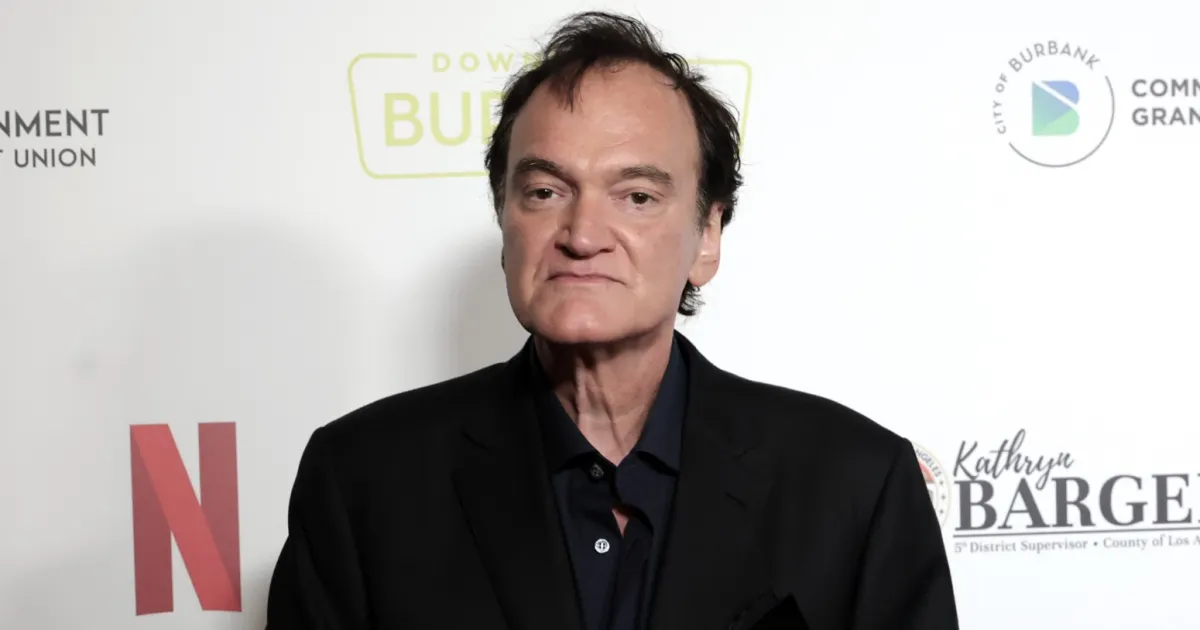
Quentin Tarantino stands as one of the most distinctive and financially successful filmmakers of his generation, with a net worth estimated at around $150 million and a filmography that includes Pulp Fiction, Kill Bill, and Once Upon a Time in Hollywood. Yet behind the dazzling success and the iconic dialogue lies a personal story that is far more complicated—a story of a young boy whose artistic dreams were dismissed by the person who was supposed to be his biggest supporter. According to Tarantino, his mother, Connie Zastoupil, mocked his writing ambitions when he was just twelve years old. In response, he made a quiet but ironclad vow to himself: no matter how rich and famous he became, his mother would never see a penny of his fortune. That promise, as Tarantino revealed in a 2021 appearance on the podcast The Moment, has been kept for decades. There would be no house, no vacations, no luxury gifts—just a cold, resolute distance born from a single sarcastic remark.
The roots of this estrangement lie in a fundamental clash between a mother’s anxieties and a son’s passion. Tarantino’s mother was often frustrated by his lack of interest in formal education, and she frequently complained about his tendency to write screenplays instead of doing homework. As he recalled, she would accuse him of wasting time, and one particular incident became a turning point. She launched into what he described as a “little tirade” about his work ethic, and then, with finger quotes dripping with disdain, she declared, “This little writing career that you’re doing? That s**t is over.” For a twelve-year-old who had found something he truly loved, those words were not just dismissive; they were devastating. Tarantino later said that in that exact moment, he made a private pledge: “OK, lady, when I become a successful writer, you will never see one penny from my success. There will be no house for you. There’s no vacation for you, no Elvis Cadillac for mommy. You get nothing because you said that.”
What makes this story so compelling is not just the vow itself, but the fact that Tarantino has kept it for a lifetime. When podcast host Brian Koppelman asked directly whether he had followed through, Tarantino confirmed with a simple, unambiguous “Yeah.” There was, however, one small caveat. He acknowledged that he had once helped his mother out of a financial jam with the IRS—a practical rescue that did not contradict his refusal to share his wealth in any meaningful way. But no grand gestures, no tokens of gratitude, and no attempts to heal the rift with money. Tarantino’s reasoning is as sharp as his dialogue: “There are consequences for your words as you deal with your children,” he said. “Remember there are consequences for your sarcastic tone about what’s meaningful to them.” This is not just a grudge; it is a principle, a belief that words can wound in ways that money cannot erase.
Some might argue that his mother’s harshness inadvertently fueled his ambition, that her skepticism only made him more determined to prove her wrong. Koppelman even suggested this interpretation, but Tarantino rejected it outright. He refused to give his mother credit for his success, explaining that her disapproval did not drive him; it merely taught him a painful lesson about the kind of parent he did not want to be. Now a father himself, with a young son and daughter, Tarantino’s perspective on this childhood episode has deepened. He understands that children are profoundly shaped by the things their parents say, and that a casual, dismissive tone can leave scars that last. His vow was not about revenge so much as it was about boundaries—about drawing a clear line between his own worth and the person who had belittled it. It is a powerful reminder that even our most successful and creative among us are not immune to the wounds of childhood.
Tarantino’s journey from that disheartened twelve-year-old to a celebrated director is a testament to his resilience, but it also reveals the unconventional path he carved for himself. After his mother’s rejection, he kept writing, penning a screenplay titled Captain Peachfuzz and the Anchovy Bandit by the age of fourteen. Two years later, he dropped out of high school with his mother’s permission, agreeing to get a job. That decision led him to a series of meandering jobs, including an usher at a Torrance movie theater, before he found his true education at a video store in California. He spent five years there, watching films, talking about them, and absorbing the language of cinema in a way that no classroom could have provided. When asked about film school, he famously said, “No, I went to films.” This self-directed education paid off spectacularly, resulting in two Academy Awards and a body of work that has influenced countless filmmakers. Yet one cannot help but wonder what might have been different if his mother had shown a modicum of faith in his early dreams.
In the end, this story is not simply about money, nor is it a tale of a son seeking petty revenge. It is a meditation on the weight of parental approval and the irreversible power of words. Tarantino’s success allowed him to make a point that most of us can only imagine: that the person who doubted him most would never benefit from his triumph. But there is a bittersweet edge to this victory. The same fortune that could have provided his mother with comfort, security, and even a lavish lifestyle was instead withheld as a statement of principle. Tarantino has spoken about the consequences of sarcastic dismissals, but his own actions also show that those consequences can extend far beyond a momentary hurt. They can shape a lifetime, define a relationship, and turn a parent’s careless remark into an unbridgeable chasm. In a world where many successful people go out of their way to support their families, Tarantino’s story stands out as a reminder that love, respect, and validation cannot be bought—and that even the most talented among us sometimes need to be cruel to be kind to themselves.