


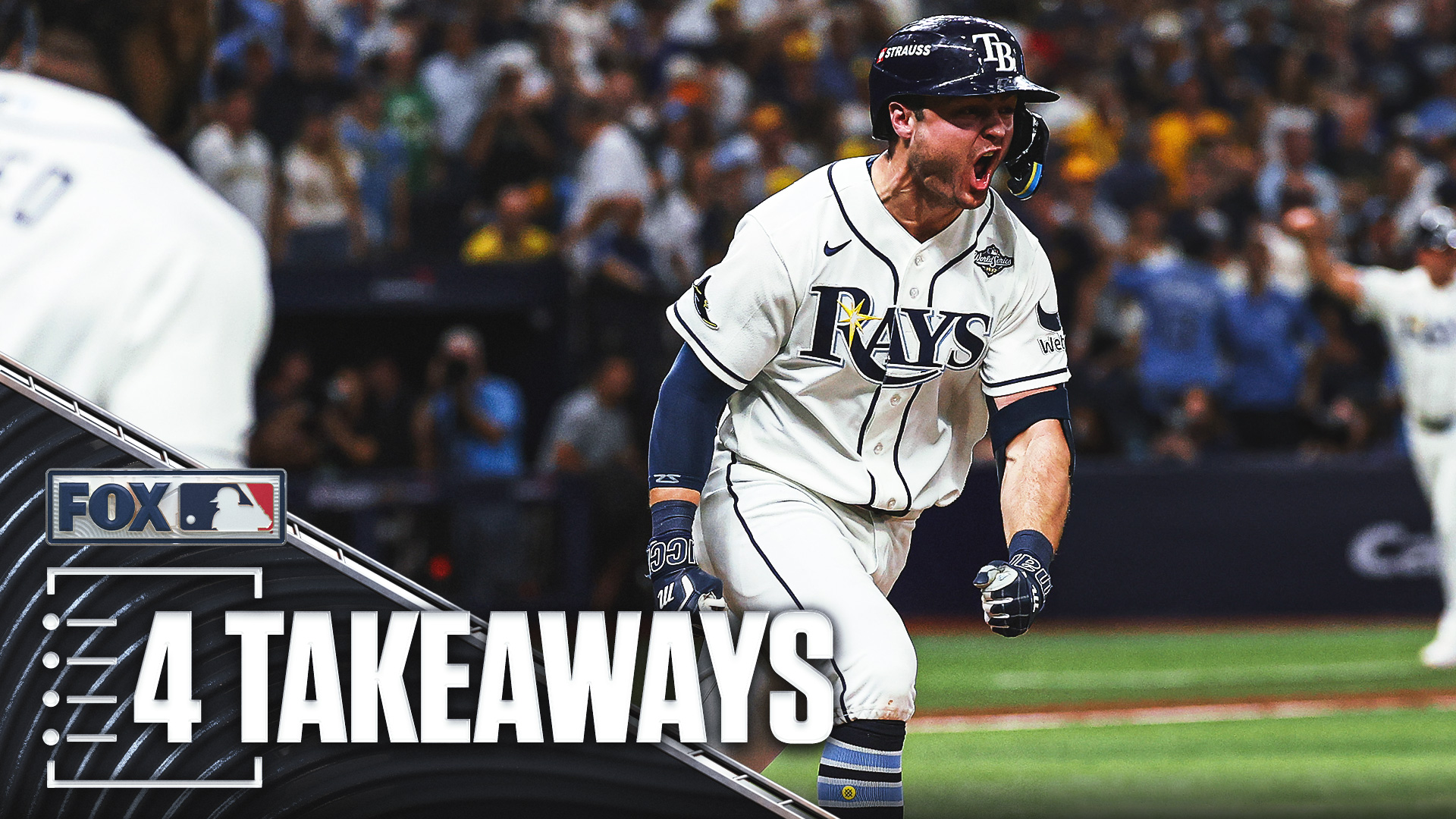
For most of one swing, Tuesday night at Tropicana Park felt like an ending. The ball left the bat of Brewers rookie Cooper Pratt and traveled 396 feet into the left-field bleachers in the 12th inning, a shot that seemed less like a harmless, floating souvenir and more like a darting dagger aimed at the heart of Tampa Bay’s entire season. In any ordinary World Series, a visiting team taking a three-games-to-none lead and then watching a rookie launch a go-ahead blast into the stands would be the cue for everyone to start packing up. But these Rays, embarrassed 10-1 the night before and teetering on the edge of elimination, refused to behave ordinarily. They answered the Brewers’ punch in the bottom of the 12th, forced the kind of chaotic, high-wire baseball that had been beating them all October, and turned Tuesday night into Wednesday morning with a 4-3 victory that kept their season breathing. They did it with a fielding error, four straight base hits, and a celebration that spilled into shallow right field as if the trophy had just been won. The numbers say the feat is rare: only four of the previous twenty-five teams that faced a 3-0 World Series deficit had managed to force a fifth game. After this one, the Rays became the fifth—and proved that a team can be down, counted out, and still, somehow, never fully gone.
Tampa Bay made their intentions plain from the very first pitch. When Chandler Simpson reached first on an RBI single in the early innings, it was a small statement, but a statement nonetheless: we are not lying down, and we are not waiting for the season to end. The Brewers, as they have done all year, tied the game in the fourth, and for a moment it looked like the same old script would play out again. But this time the Rays answered back with a fury of their own. Junior Caminero singled, moved to second on a groundout by Liam Hicks, and then scored when the Brewers blinked under their own pressure. On a grounder by Jonny DeLuca, Milwaukee third baseman David Hamilton tried to tag Caminero, missed, and then made a wild, off-balance throw across the diamond that sailed past first baseman Jake Bauers. Caminero was able to make it home, and the go-ahead run was on the board. The Brewers challenged the play, arguing that Hamilton had gotten the tag, but the moment did not survive review. Officials ruled that Caminero’s drift onto the infield grass was not a baseline violation, and the call stood. Oddly, the normally sure-handed Brewers had committed more errors than any other team this postseason—more than twice as many, in fact. They had spent the entire autumn finding ways to redeem themselves. On this night, Tampa Bay countered every punch, and none landed harder than the one in the 12th. A second error by a Brewers third baseman, this one by Joey Ortiz, put Caminero on base to start the inning. Brewers manager Pat Murphy summoned Shane Drohan, but the dam finally broke. Liam Hicks singled, Jonny DeLuca singled to tie the game, Chandler Simpson loaded the bases with a single, and then Ben Williamson chopped a grounder over the infield to clear the home dugout. The Rays mobbed him in shallow right field, right where his chopper landed. It wasn’t just a rally. It was a resurrection.
For most of the night, though, the biggest story wore Milwaukee laundry. Cooper Pratt was a gamble in April, when the Brewers gave him an eight-year contract extension despite the fact that he had never played an inning in the majors and owned only a handful of Triple-A at-bats. Manager Pat Murphy practically promised the fan base they would fall in love with him. Six months later, the rookie nearly won them a World Series. His game-tying RBI double in the fourth inning started the scoring for the Brewers, and the loud “COOOOP” chants from the Milwaukee contingent echoed through Tropicana Field. They grew even louder in the 12th, when he launched a 396-foot, game-winning solo home run off Ian Seymour, a shot that looked, for a few beautiful and terrible minutes, like the decisive blow of the entire series. For the night, Pratt finished 4-for-5, and he had knocked in runs in each of the last three games of the series, clearly unintimidated by baseball’s biggest stage. He stood in the middle of the sport’s brightest glare as if he had been waiting his entire life for those exact swings, and the Brewers trusted him exactly as much as he trusted himself. It is no wonder their fans already serenade him. If Game 5 gives him another crack, the baseball world may see the end of Tampa Bay after all.
The same game also offered another lesson in the Brewers’ favorite theme: redemption. David Hamilton, after his embarrassing misfire in the fourth inning, found an answer before the crowd had even settled. The very next inning, with the Rays still ahead and starter Griffin Jax dealing about as well as any Tampa Bay pitcher could against the unrelenting Brewers order, Hamilton came up to bat first. Manager Kevin Cash had every reason to believe Jax could get one more out, especially against the ninth hitter in Milwaukee’s lineup. Hamilton saw it differently. He connected on an 0-2 four-seamer at the top of the zone and sent it 391 feet into the stands for a game-tying home run, making himself the latest Brewer to erase a personal sin within a single inning. It was the same pattern that had played out in Game 2, when rookie Cooper Pratt’s error started a disastrous Rays first inning, and then Pratt atoned for himself later by finishing off the Brewers’ comeback with the game-winning RBI single. Hamilton’s own history made the moment even richer. In the clinching Game 4 of the National League Championship Series, he was the unlikely home-run hero with a solo shot off Dodgers closer Edwin Díaz. At that point he had hit only four home runs all season, including just one in the second half. But when the bright lights came, he kept swinging like the moment belonged to him. On Tuesday, Hamilton and Pratt both showed what the Brewers are made of: they stumble, they bleed, and then they refuse to go away.
Perhaps no factor shaped Game 4 as quietly as the Brewers’ bullpen. After the gaudy 10-1 blowout in Game 3, Milwaukee could rest its most precious relief arms, and they arrived Tuesday night with fresh legs and old reputations. A bullpen that had come into the evening posting a 1.34 ERA with eight saves and an 8-1 postseason mark only added to its legend as the game grew late. JoJo Romero threw a scoreless fourth. Abner Uribe, pitching for the tenth time this October, followed with two clean frames. DL Hall added another scoreless inning and two-thirds. Trevor Megill ended his outing with a strikeout. Then came Aaron Ashby, the shutdown lefty, who retired all seven batters he faced and stretched his October run to eighteen consecutive relief innings without allowing a score. For eight full innings, Milwaukee’s bullpen was a wall, and if that wall had held one more inning, the story would have been entirely different. But the best-laid plans have limits. The Rays waited them out, and when the high-leverage weapons were gone in the 12th, the train finally came off the tracks. The bullpen’s brilliance made the fall feel crueler, but it also proved why the Brewers have been so hard to kill this October: they almost always have another wave ready, and the only real question is whether that wave can arrive before the last pitch.
Now comes the deepest unknown of the series. Milwaukee saved Jacob Misiorowski, the NL Cy Young favorite, for Game 5. He is coming off his most productive outing of the postseason, although he has not yet quite recaptured the unhittable form that made him the most feared starter in the sport. The Brewers intentionally never touched him in Tuesday’s marathon, choosing to roll the dice in the 12th rather than burn their best asset early, and now he stands one start away from delivering the franchise the championship it has chased for decades. On the Tampa Bay side, the immediate celebration did not come with a public plan. Manager Kevin Cash and his staff went quiet after the win. Nick Martinez threw two innings of relief in Game 4, so the Rays may turn to Drew Rasmussen on three days of rest, sending the series back to Milwaukee with all the pressure shifted. If they can win Game 5, they will be making history in the most literal way: of the four earlier teams who forced a Game 5 from a 3-0 World Series hole, none had ever managed to force a Game 6. But history meant nothing on Tuesday. It meant nothing before Tuesday either. Now the series is a real series again. The Rays will take the field in Game 5 with nothing to lose and everything to prove, while the Brewers will lean on a rested ace and the stubborn belief that a team that has refused to go away all autumn still has one more push. That is the beautiful and terrifying part of sports: no amount of statistics, no perfect inning, no heroic bullpen can guarantee tomorrow. Only the game itself decides.