



Old Masters, New Money: Lucho Poletti’s “Ten Decrees” Reimagines Bosch and Bruegel for the Bitcoin Era
At Bitcoin Amsterdam this November, the Argentine-Italian artist unveils a monumental series that fuses Renaissance allegory with a scathing critique of fiat money, turning six centuries of painting into a visual argument for the monetary revolution.
There is a curious pattern emerging in the world of Bitcoin art: a growing number of contemporary artists are looking back to the 16th century to make sense of the 21st. None has embraced that impulse more fully than Lucho Poletti, who has been producing bitcoin-related work since 2017 and describes his practice as “visual propaganda for the monetary revolution.” His latest project, Ten Decrees, premiering on the main stage at Bitcoin Amsterdam on November 5–6, 2026, dives headfirst into that historical echo chamber. The series reimagines ten paintings — four by Hieronymus Bosch and six by Pieter Bruegel the Elder — through the lens of money, borrowing compositions that were themselves born during an age of extraordinary financial upheaval. Both masters worked in what is now Belgium and the Netherlands as Antwerp emerged as a global financial center and the Habsburgs debased their coinage; silver from the Americas flooded into Europe, prices rose sixfold across the Continent, and Philip II’s default in 1557 sent shockwaves through the entire Western economy. Two years later, Bruegel painted Netherlandish Proverbs, a village where everyone is absorbed in something foolish and nobody can see the whole. Poletti sees in that moment a mirror of our own. “They had already solved the problem I was stuck with,” he says. “How do you draw a whole society going wrong at once?” Bosch and Bruegel packed hundreds of people into a single frame, each busy with their own concerns, so the system shows up in the sum of it. “You don’t look at a Bruegel, you search it,” he explains. “It’s a great way to depict the effects of money, which nobody really sees and everybody feels.” The four Bosch pieces, he adds, are about appetite — the temptation and the bill that arrives afterward — while the six Bruegels are about the crowd and how society behaves once the rules stop making sense.
The conceptual engine of Ten Decrees is a linguistic revelation. “Fiat,” Poletti notes, was never merely a noun, a dismissive label for government-issued money — in Latin it is a verb meaning “let it be done,” the same word God speaks in the Vulgate Genesis before the light comes on: fiat lux. Someone with authority says so, and it happens. That, he argues, is a literal description of how fiat currency comes into existence, and it gives the series its organizing principle. Nine of the ten titles issue commands: Fiat Furia (“Let there be fury”), Fiat Lucrum (“Let there be profit”), Fiat Palea (“Let there be chaff”), Fiat Ludus (“Let there be a game”), Fiat Moria (“Let there be folly”), Fiat Fames (“Let there be hunger”), plus decrees for refuge, collapse, and ash. The tenth, Ultima Fiat, reverses that authority entirely — “Let it be the last.” The series was unveiled on August 15, 2026, the anniversary of Richard Nixon’s 1971 announcement closing the gold window, and follows a biweekly release schedule concluding January 3, 2027, the anniversary of Bitcoin’s Genesis Block, which also happens to be Poletti’s birthday. “Nine of the decrees are issued to you, in the flat voice an institution uses,” he says. “The tenth is the only one we get to say back.” Ultima Fiat is closer to a plea than an order, and closes the series with a kind of quiet resolve: “Every one of us has been living under the first nine since 1971, whether we noticed or not, and Bitcoin is how we issue the tenth.” The scale of the work matches its ambition. Each drawing is 18,000 pixels wide, populated by hundreds of figures and hand-drawn Satoshi masks, with inscriptions and references visible only at close range. The 30-by-20-inch prints, produced in editions of ten, form a composition spanning roughly four meters when arranged in two rows of five. Five drawings have been released so far, most recently Fiat Moria on October 24, with Fiat Fames following on November 7.
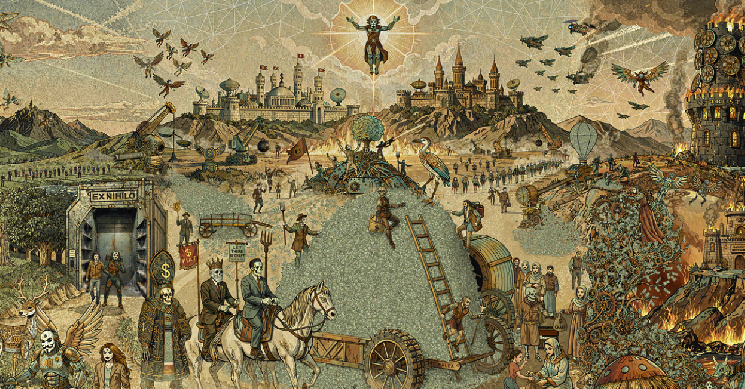
Among the pieces unveiled to date, Fiat Lucrum — Poletti’s reimagining of Bosch’s Garden of Earthly Delights — offers the most striking visualization of the monetary system as a physical landscape: a vast waterworks of pipes, reservoirs, and flowing liquidity. Water starts clean in the mountains, pours out of a machine in Eden, and settles in a reflecting basin with an inspection window cut into its wall, fish swimming behind the glass. “Somebody built a viewing port into the reservoir so you could check it,” Poletti says, “and every full node on the Bitcoin network is that window.” Downstream, the water opens into a lake dominated by a glass tank lettered “FRESH LIQUIDITY” with “BOTTOMLESS” engraved on its bowl; inside, eight bathers enjoy the party of their lives while the valve that controls the flow sits on top of the dome, outside the glass, where none of them can reach it. “Monetary policy gets set by someone who isn’t at the party,” Poletti observes. And the tank leaks, the water running orange over a waterfall into a pool where a tick with a dollar sign drinks through a hose. It is a precise visual translation of the Cantillon effect — the observation, dating to around 1730, that new money helps whoever gets it first and costs whoever gets it last. Poletti draws it as a watercourse because “everybody already understands water: whoever’s upstream drinks first, and everyone downstream gets what’s left.” His approach balances allegory against explicit message more deliberately than his Old Master sources ever did. Bosch’s garden contains not a single word; Fiat Lucrum carries more than fifty lettered objects, some as blunt as a protest sign: four money presses marked QE-1 through QE-∞, and a hand-lettered card on a broker’s desk reading “genius, we print, you pay, have a nice day.” The words carry the message, Poletti says, so the people don’t have to. The ambiguity is reserved for the figures — the crowd cheering a woman who lifts a golden dollar sign beneath an “ETF” banner wears the artist’s own Satoshi mask, as does the man signing the leverage contract and the woman taking the mortgage. “Knowing the money is broken doesn’t make one a saint,” he says. “These pieces show the exit while not promising a way out.”
The true richness of Ten Decrees reveals itself only at close range, and Poletti is generous in directing viewers toward what they might overlook. He urges attention to the plain faces — the people the system is happening to — rather than the loud iconography. In Furia Fiat, a line of bald men crawl on hands and knees with red tubes plugged into their skulls, draining the same substance that fills a nearby bowl marked “TIME.” In Fiat Palea, Adam and Eve stand beneath a serpent with a dollar sign for an eye, wearing masks but no bitcoin mark — yet. Characters connect across distances: in Fiat Ludus, a sack lettered “STIMULUS” rests beside an older figure while a child walks away carrying the same sack, now lettered “THE BILL,” and a blindfolded boy gropes through the scene while a man lunges past holding dollar-sign balloons he cannot see. The historical references are layered with precision: a broken crate stenciled “EXECUTIVE ORDER 6102” — Roosevelt’s 1933 gold confiscation — sits in the straw, while a plate bolted across a vault reads “WINDOW, NO REDEMPTION,” marking the 1971 Nixon shock; closer still, a figure in a mask with “WHOOPS” across his vest pours gasoline on a burning bank. Even the enrollment forms are signed by “Seymore Debt” and “Max D. Out.” Bubbles get dated: a sphere with tulips growing from its top is marked 1637 and 1720; a hen sitting on a “WALL STREET” egg marks 1929 and 2008, recalling the Variety front page the day after the crash. Prices tell their own stories — a dollar-denominated hot dog stand crosses out 5¢ and charges $9, while sat-denominated stalls keep falling: 4000 crossed out, then 2000, now 1000 SATS. The Latin rewards patient reading: “MORITURI TE SALUTANT” rings the arena in Fiat Ludus; “EX NIHILO” is cut over an empty vault; “MUNDUS VULT DECIPI” — the world wants to be deceived — flanks a dollar skull in Fiat Moria. And in that same piece, a small round time machine marked “NO RETURN” with a dial reading 1944–2026 disgorges a man who stares at the village in disbelief, a silent witness to the decades since Bretton Woods tied the world’s money to the dollar. None of it comes with a caption. “You find it by standing close for a long time, the way you would with a Bruegel,” Poletti says. “The finding is the whole point.”
In an era when artificial intelligence can convincingly imitate the Old Masters, Poletti’s working method amounts to a deliberate counterstatement. He describes the series as “crafted, not generated,” a phrase he coined to sum up where the real labor resides. A machine-learning model trained on years of his own output produces a rough first pass at each composition — “I think of it as an apprentice,” he says, invoking the workshop system Bosch himself relied on. But the apprentice only lays the groundwork. What follows is weeks of grueling manual work in Photoshop, drawing in hundreds of figures, objects, symbols, and phrases by hand until the art says exactly what he means. “AI can imitate the look of a Bosch or a Bruegel pretty convincingly now. What it can’t do is mean anything.” It won’t decide that the valve on the liquidity tank belongs outside the glass, where the bathers cannot reach it. It won’t decide that the slop on the ground should be piggy banks wired into the money presses, each bearing its own name — SAVINGS, PENSION, NEST EGG. It doesn’t make jokes, either, like the fool in a jester’s cap perched on a platform lettered “TAKE IT AT FACE VALUE” while a dollar skull applies his makeup. Poletti’s philosophy is unambiguous: “If I don’t do the majority of the work, it’s not my art. I hold myself to that, and anyone who looks at these up close can see a person made the decisions that matter.” In a culture increasingly comfortable with the simulated, that insistence on human authorship carries weight. For collectors and curators alike, it stakes a claim that these images are not pastiches but arguments, every element placed with intention.
For the main stage of Bitcoin Amsterdam, Poletti has adapted this dense, intimate work for monumental scale. Each released piece receives fifteen seconds in release order: the central LED wall carries the heart of each composition in a slow left-to-right pass, giving the room its overall shape; a screen on the right presents the original Bosch or Bruegel with its name and date before wiping across to Poletti’s version; and a third screen pulls out lateral details no one could catch from the floor — the ship of fools riding a mast in Fiat Moria, pigs feeding at the “DEBASED” trough. Old masters and new money run side by side, one continuous loop. The venue is freighted with historical resonance. Bosch spent his entire life in ’s-Hertogenbosch, about an hour south of Amsterdam by train, and echoes of Bruegel’s proverbs still surface in everyday Dutch — including the saying about hanging one’s cloak to the wind, which Poletti references in Fiat Moria with a masked man leaping from a mountain, cloak in hand. Amsterdam itself has a cautionary monetary chapter: the Bank of Amsterdam, founded in 1609 to give merchants a debasement-proof currency, traded its guilder at a premium for over a century because depositors trusted the silver was in the vault. But it had quietly been lending to the Dutch East India Company, and when that became public in 1790, the premium vanished and the bank declared itself insolvent. “I can’t think of a better city to show a series about monetary decrees and trust,” Poletti says, “two months before the last one lands on the Genesis Block anniversary.” As part of the Bitcoin Museum & Art Gallery programming, Ten Decrees offers visitors a rare opportunity to experience Bitcoin not merely as a technology but as a rupture in cultural and monetary history — and to search, as one would search a Bruegel, for meaning hidden in the crowd. Those who do may find, amid the masks and dollar signs and dated bubbles, a lit doorway marked “MONEY ₿ BETTER WORLD,” and a plain-faced man on the step, looking back at the square. Whether he steps through is, like so much in these drawings, left deliberately, and beautifully, unresolved.