

At Villanova University, the old proverb has never felt more true: all roads lead to Rome. The Augustinian university just outside Philadelphia has always been a place where faith and learning meet, but since Pope Leo XIV—a Villanova graduate with a degree in mathematics—ascended to the papacy, the school’s connection to the Vatican has become something closer to a family reunion. “We certainly have a bigger footprint there now than we used to,” said the Rev. Peter Donohue, Villanova’s president. “People do know who we are, just because it’s the pope’s school.” The footprint is not merely symbolic. Villanova recently hosted a sustainability conference in Rome and awarded a cardinal the inaugural Pope Leo XIV Sustainability Medal. The university’s celebrated basketball programs are preparing to open their season in Rome, with thousands of fans traveling across the Atlantic. And applications to the school jumped more than 10 percent in the first admissions cycle after the pope’s election. Donohue laughs at the sudden international spotlight. “It’s crazy,” he said. “We’re taking over Rome.” For a university founded in 1842 by the Augustinian order—the same order that shaped the pope’s religious life—the moment feels both extraordinary and deeply natural. Pope Leo graduated in 1977, and his ties to campus have never been forgotten. When he was elected, the campus erupted in joy. There were tears, cheers and a collective sense of wonder: one of our own is now the spiritual leader of more than a billion Catholics. That sense of wonder has only grown as Villanova has found new and inventive ways to celebrate its most famous alumnus, from academic conferences to basketball tip-offs to the quiet pride that now seems to pulse through every stone walkway on campus.
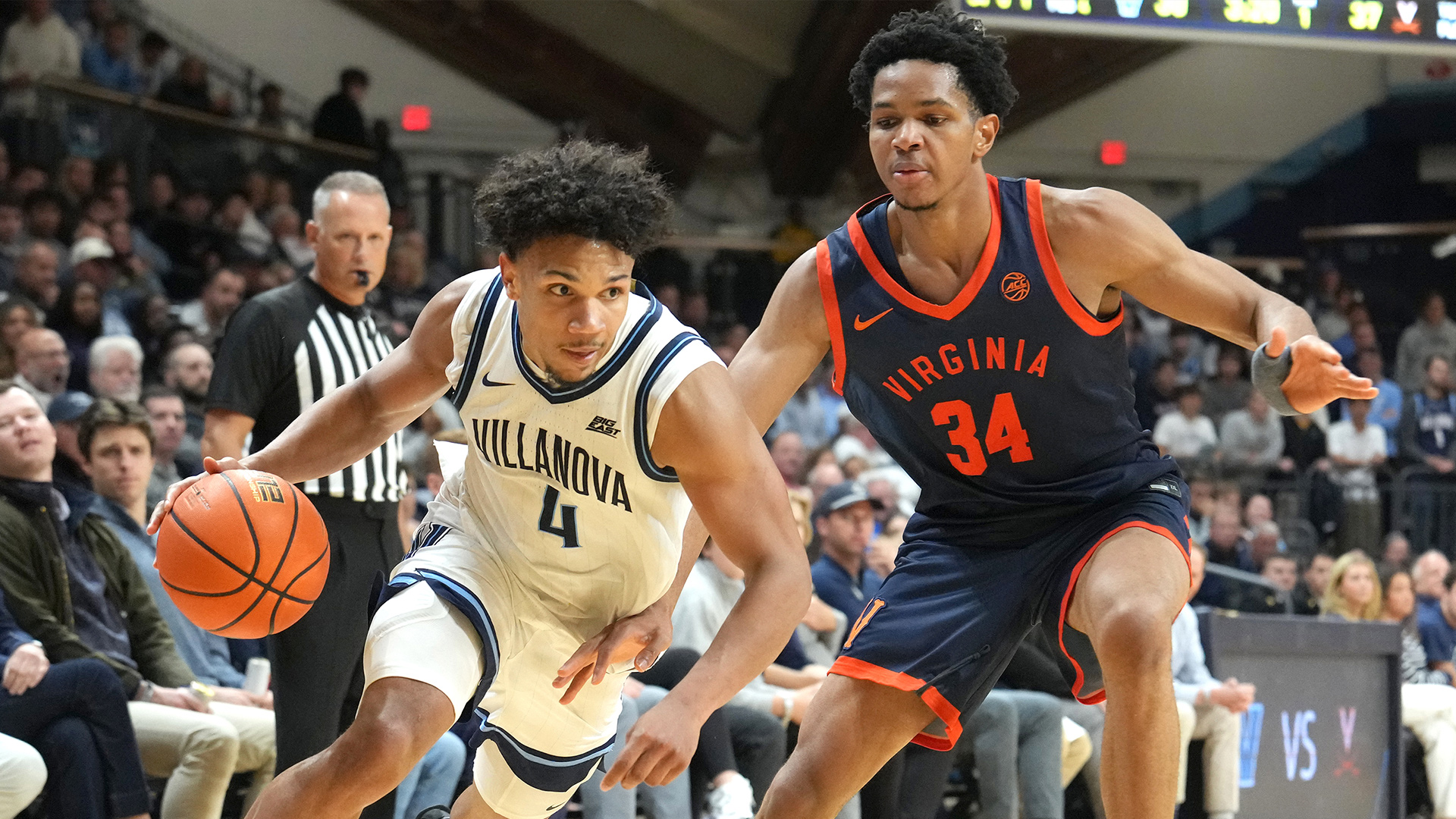
The most visible expression of that bond will unfold on Sunday, Nov. 1, when Villanova’s men’s and women’s basketball teams take on Notre Dame in Rome, about six miles from the Vatican. Organizers have branded the doubleheader the Eternal City Tip-Off. The men’s game will air on FOX and FOX One at 9:30 a.m. ET, and the women’s game follows at noon. It is a fitting stage for a program that has become a Catholic basketball powerhouse, with NCAA men’s championships in 1985, 2016 and 2018, and a trio of alumni known as the ’Nova Knicks who helped New York win the NBA title this year. The trip was planned months before the world learned of the pope’s cancer diagnosis and surgery, and while the pontiff’s schedule remains dependent on his health, he is expected to hold a private audience inside the Vatican on Saturday for the teams and traveling fans. Philadelphia Archbishop Nelson Perez will celebrate a private Mass for them in St. Peter’s Basilica. The scene promises to be a colorful blend of faith, sport and school spirit: 6,000 Villanova fans and 1,000 Notre Dame fans are expected to make the journey. Pope Leo, who loves sports, seemed to anticipate the blue-and-white takeover. “The voice of the people of God will be very strong on the Villanova side,” he said in September. Among those making the trip is Ed Hastings, a member of Villanova’s 1971 team that lost the national championship to UCLA and now teaches at the university. He will appear on a sold-out panel in Rome about sports and spirituality, bringing together what he calls “the passions of my life.” Hastings, who has spent decades thinking about the lessons of competition, points to St. Augustine, the spiritual father of the Augustinian order, who wrote about self-knowledge. “And I learned a lot about myself through sports,” Hastings said. For him, and for many others, the Rome trip is not just a basketball game. It is a pilgrimage that connects the discipline of athletics to the deeper search for meaning—an idea that feels right at home at a university named for a saint and rooted in a religious order that values reflection.
On campus, the Pope Leo effect has been felt in ways that go far beyond basketball. The Rev. Bernie Scianna, Villanova’s vice president for mission and ministry, has been friends with the pope for nearly three decades, ever since they met through the Augustinian order. He has watched interest in Catholicism grow at the university, which enrolls about 10,000 students and has a large Catholic population. Last year, 24 people entered the Catholic Church on campus—a significant jump from the fewer than 10 who typically join each year. This year, 56 people are in the current class of potential new members. “It’s really a great feeling for us to be in this moment,” Scianna said. Students, too, feel the connection in intimate ways. Senior Mike Whaley recently returned from a fall break trip to Rome with his humanities class. On an earlier student trip, he served as an altar server at a private Mass for Villanova students celebrated by then-Cardinal Robert Prevost. “So, my fun fact at parties is that I served Mass for the now Pope Leo XIV,” Whaley said with a smile. Senior Megan Zuzarth, who was in Rome recently with her business school class, said the pope’s Villanova connection makes him feel surprisingly close. Once you realize he walked the same halls, sat in the same classrooms and probably worried about the same exams, “he’s one of us,” she said. That sense of familiarity has transformed the way many students think about the papacy. The pope is no longer a distant figure in a distant city; he is a Villanova graduate, a fellow Augustinian, a man who once ate in the same dining hall. It has made faith feel more personal, more approachable and more alive. The university has long sent students to Italy and the Vatican for internships and study abroad, but those opportunities are expanding. Now, with the pope’s election, the flow of students, faculty and ideas between Philadelphia and Rome has intensified. The relationship is no longer just institutional; it is woven into the daily life of the campus, from dorm-room conversations to classroom discussions to the simple thrill of saying, “I go to the pope’s school.”
Long before the world knew him as Pope Leo XIV, he was Bob—a Chicago-born kid with a math degree from Villanova. The Rev. Peter Donohue, a fellow Augustinian who was two years ahead of him at Villanova, was at a restaurant in Chicago when he heard the news of the conclave. “It’s Bob!” he screamed. A manager, catching the excitement, brought out Champagne to celebrate. Donohue, who served as chair of Villanova’s theater department before becoming president, has a performer’s sense of timing and a natural gift for storytelling. As a child, he recalled, “other people were playing basketball and football, I was taking tap dancing classes.” That unlikely background has proved surprisingly useful in his role as president, especially when it comes to fundraising and donor relations. “I tell everybody it’s the biggest acting job I’ve ever had,” he said, “and the longest run I’ve ever had.” His personal connection to the pope has made the past months feel almost surreal. He remembers the night of the election with vivid clarity: the phone calls, the text messages, the sudden realization that his old friend and classmate would now lead the Catholic Church. On campus, the reaction was electric. Cathleen Kershner, now a junior, was finishing her final exams when her phone buzzed with a text from her grandmother. “Your pope! He’s your pope!” her grandmother wrote. For Kershner and countless other students, the news was both astonishing and thrilling. For many students, the news arrived during exam season, but nobody seemed able to concentrate. Church bells rang for hours. Strangers hugged in the quad. Professors scrapped lesson plans to talk about what it meant. The “Pope Leo effect” quickly became a catchphrase, and it was more than just a marketing slogan. Applications jumped by more than 10 percent in the first admissions cycle after the election. High school seniors, many of them drawn by the idea of attending a pope’s alma mater, began to see Villanova in a new light. But for those already on campus, the effect was less about statistics and more about a shared sense of identity. The pope was one of them. He had walked the same paths, worn the same colors, and carried the same Augustinian values into the wider world.
The attention has come at a pivotal time for Villanova. Like many universities, Villanova has faced financial pressures, changing demographics and the need to adapt. But the school is faring better than most. It has undertaken renovations and expansion projects, and recently opened a new campus at a nearby shuttered Catholic college. The Pope Leo effect certainly hasn’t hurt. The university’s growing profile in Rome has opened doors, strengthened relationships and reinforced its reputation as a place where Catholic intellectual life and academic excellence go hand in hand. The sustainability conference in Rome and the creation of the Pope Leo XIV Sustainability Medal are just the latest examples of how Villanova is leveraging its Vatican ties in meaningful ways. The medal, awarded to a cardinal, recognized work in sustainability—a theme that resonates with the pope’s public priorities and with Villanova’s Augustinian mission. At the same time, the university has been careful not to let the excitement overshadow its core purpose. Donohue and other leaders emphasize that the pope’s connection is a gift, not a gimmick. It is a chance to live out the school’s values on a global stage, to remind people that faith and reason can work together, and to support the pope’s ministry in whatever way they can. “We’re very proud of him, and very proud that he’s an Augustinian, and very proud that he is leading the church,” Donohue said. “Whatever we can do to help him, we’re trying to do that.” That sense of service is evident in the university’s expanding programs in Rome, its growing network of alumni and friends in the Vatican, and the genuine warmth that students and faculty feel toward the man they still think of, at least a little, as Bob. The Rome basketball doubleheader is perhaps the most joyful expression of that bond—a moment when a university’s athletic prowess, Catholic identity and papal connection all converge in a single, unforgettable weekend. For the 6,000 Villanova fans expected to fill the stands, it will be a chance to cheer for their team, to walk in the footsteps of saints and popes, and to feel, even for a moment, like the whole city of Rome is wearing Villanova blue.
In the end, the story of Villanova and Pope Leo XIV is not really about basketball or applications or even the Vatican. It is about belonging. It is about a community that raised a young man named Bob, watched him become a priest, an Augustinian, a cardinal and eventually the pope, and now finds itself in the extraordinary position of celebrating his journey while also sharing it with the world. The trip to Rome, the sold-out panels, the sustainability medal, the surge in applications—these are all outward signs of an inward reality: Villanova is proud of its son, and it wants to be worthy of him. For the students walking the campus today, the pope’s presence is both inspiring and oddly comforting. He is proof that a Villanova education can lead anywhere, even to the Chair of St. Peter. He is also proof that the values taught at this university—humility, service, contemplation, community—are not abstract ideals but a way of life. St. Augustine, the spiritual guide of the Augustinian order, wrote about the restless human heart and the search for God. Villanova’s moment in the papal spotlight is a reminder of that search. It is also a reminder that faith can be joyful, that sports can be sacred, and that a university can be both a launching pad for NBA stars and a home for future popes. As Donohue and the Villanova community prepare for a weekend of basketball, Mass and papal audience, there is a sense that they are not merely taking over Rome. They are bringing something of themselves—their faith, their spirit, their blue-and-white joy—to the heart of the Catholic world. And they are doing it with the blessing of a pope who once sat where they sit, studied what they study, and dreamed dreams that turned out to be far bigger than he ever imagined. Donohue, for his part, seems to be enjoying every minute of it. Villanova has always been a place where roads lead to Rome. Now, for a blessed moment, Rome is leading right back.