

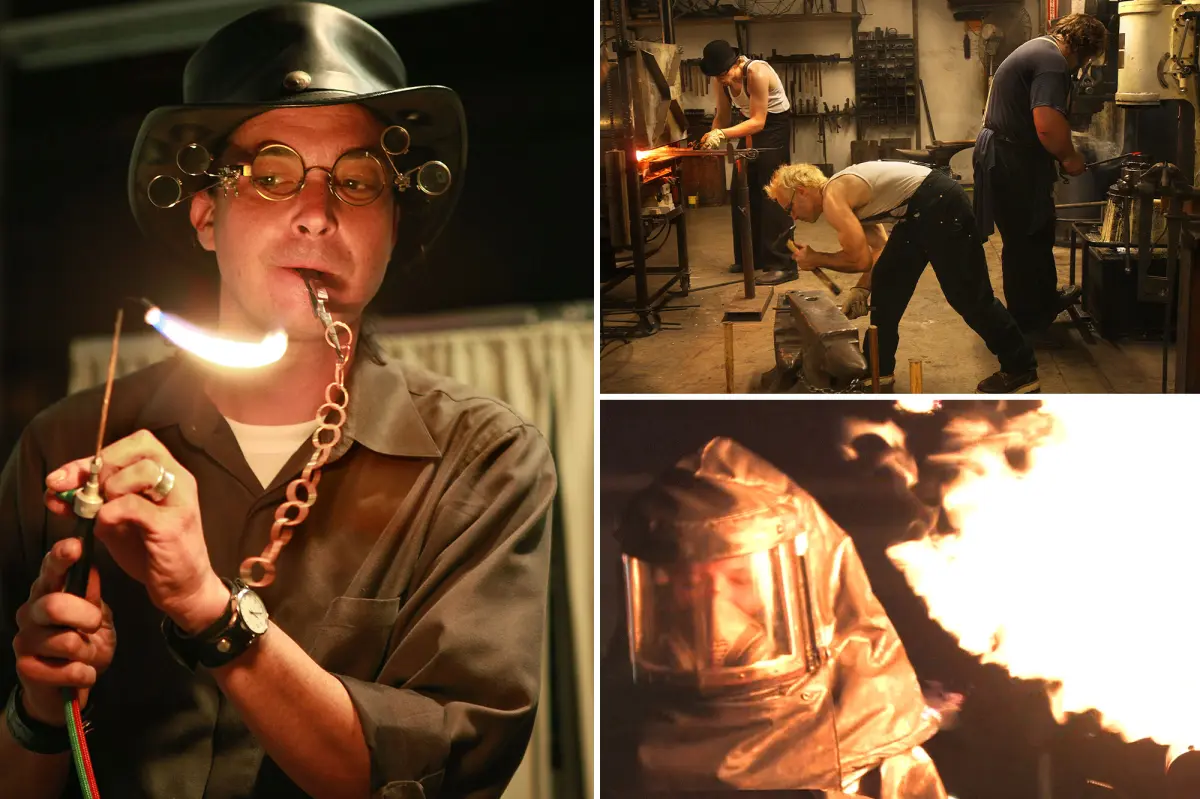
On a normal morning, the sounds coming from The Crucible in West Oakland are unmistakable: the rhythmic clang of hammers meeting hot steel, the hiss of blowtorches, the low roar of kilns, and the laughter of students discovering they can shape fire into glass and iron into art. But this week, that building at 1260 Seventh Street has gone eerily quiet. School’s out—but not for summer, and not with any sense of celebration. The Crucible, an Oakland industrial arts school long beloved by makers, teachers, families, and the broader Bay Area creative community, has abruptly closed its doors and canceled all classes and public events. Artists, staff, faculty, and students have been left in a state of shock and uncertainty, unsure whether the nonprofit institution will ever reopen. According to the San Francisco Chronicle, the temporary shutdown comes after years of financial difficulties at the organization, which has offered classes in blacksmithing, welding, glassblowing, ceramics, and a range of other hands-on crafts, along with youth programs that introduced thousands of young people to the transformative power of building with their own hands. Since moving to West Oakland in 2003, The Crucible has operated from a sprawling 56,000-square-foot facility that felt less like a classroom and more like a cathedral of creation. It was a place where the digital Bay Area could unplug and make something real, where fire and metal and clay taught patience, courage, and collaboration. For many, the sudden silence of that space is not just an inconvenience; it is a genuine cultural loss, and the hardest part is not knowing whether the forge will ever be lit again.
The financial picture makes the shutdown even more baffling. On paper, at least, The Crucible’s recent annual report told a rosier story than the one now unfolding. The organization’s 2025 annual report listed $4.07 million in revenue against $3.85 million in expenses, along with the arrival of long-overdue federal tax-credit funds that were supposed to help stabilize the budget. By January 2026, according to local news reports, the nonprofit had surpassed $1 million in fundraising after meeting a $500,000 matching challenge from the Kelson Foundation—a sign, to many, that the community was rallying to keep the institution alive. Yet, despite that apparent momentum, the financial circumstances still left no choice but to close, at least temporarily. This is not the first time The Crucible has found itself in crisis. Olivia Hara, the organization’s development manager, told KTVU FOX 2 that donors have been asked to rescue the institution before, and the repeated cycles of fundraising and near-collapse have left even loyal supporters exhausted. “If you’ve been donating for years to save the Crucible—that’s always the narrative—you’d get tired,” she said. “It’s like, ‘how many more years do we have to keep saving the organization?’” That fatigue helps explain why the latest announcement, despite the encouraging revenue numbers and matching gifts, still sent the organization into shutdown. Numbers on a page cannot capture the cash-flow pressures, the deferred expenses, the debt, or the slow erosion of reserves that eventually caught up. But for those who gave their money and their hearts to The Crucible, the discrepancy between the reassuring annual report and the locked doors is deeply confusing, and it raises difficult questions about how an institution can look so healthy on paper and still be so fragile in reality.
Nowhere is that confusion more painful than among the students who paid for upcoming classes and have been left without refunds, at least for now. Samantha Espinoza, who manages youth programs at The Crucible, told KTVU FOX 2 that one of the hardest parts of the closure is that no one has been able to personally contact every student who paid for courses that will no longer take place. Families, after-school groups, professional artists, hobbyists, and teenagers who had enrolled with excitement are now in limbo, clutching receipts and confirmation emails for experiences that have vanished. Espinoza said the messaging around the closure has been particularly upsetting for the staff and union members who care deeply about the community they serve. “It’s something that we all feel really upset about, that this is the message being sent to our student community,” she said. “They deserve more. They’re makers and artists, but they’re also paying customers, and we at the union feel very strongly about how the messaging makes The Crucible look to the community.” Her words speak to a larger truth: for many students, a class at The Crucible was never merely a transaction. A blacksmithing course might have been a birthday gift from a partner, a welding workshop a step toward a new career, a glassblowing session a family adventure. When those promises are broken without clear communication, the harm is both practical and emotional. The organization says it is working on a plan to issue refunds, but for now, people are left to wonder when—or if—their money will come back, and what will happen to the projects, friendships, and skills that were supposed to grow inside those walls.
Behind the financial crisis, however, lies a story of deep labor unrest and safety concerns that had been building for a long time. Employees at The Crucible did not simply wake up one morning and decide to unionize; they organized because of what they saw happening around them. About 60 employees unionized as Crucible Workers United, also known as The Dedicated Cru, with support from AFSCME Council 57 and Cultural Workers United. Their demands were straightforward and human: better pay, fair discipline, safer staffing levels, and a meaningful voice in decisions that affect their work. A letter signed by more than 70 employees, faculty, and staff described budget cuts that led to unsafe studio maintenance, material shortages, and inadequate training. Workers said they were forced to teach and create in environments that did not meet basic safety standards, while concerns raised to management were ignored. They also accused top leadership of intimidation, harassment, retaliation, and unfair suspensions and firings, saying that appeals to human resources and the board resulted in little or no relief. The American Federation of State, County and Municipal Employees Council 57 issued a press release that pulled no punches: “All suggestions by the union staff have to date been ignored, or rebuffed by management and the Board. Instead, management has pressed for reductions in community engagement, services, and classes—offering no hourly or salary reductions to non-union, non-public-facing staff.” In other words, workers say they were asked to do more with less, while the pain of budget shortfalls fell disproportionately on the public-facing programs and the people who worked most closely with students. For the employees, the closure is not just a financial tragedy; it is the culmination of years of feeling unseen, unheard, and undervalued by the very people entrusted with the organization’s future.
For its part, The Crucible’s leadership has acknowledged the gravity of the moment. In a press release forwarded by interim executive director Douglas Yeiser, the organization said it is working on a plan to issue refunds for canceled classes and expects to pay staff as scheduled this week. Yeiser’s statement struck a grateful and somber tone: “It is inspiring to see how much The Crucible means to this community and in the broader Bay Area. Please know the decision to close was not taken lightly, but financial circumstances left no choice.” Those words offer some comfort to those worried about immediate payroll, but they do little to answer the larger questions hanging over the institution. If the financial books looked so solid, why did the closure feel so sudden? If the community had just given more than a million dollars, why was that not enough? And even if refunds are issued and workers are paid this week, what happens next? Is The Crucible merely pausing to restructure, or is this the beginning of the end? The phrase “temporary shutdown” offers a sliver of hope, but the organization has not provided a timeline, a reopening plan, or a clear explanation of what would need to change for the doors to reopen. Employees who had been sounding alarms for months now find themselves in the strange position of saying “we told you so” while also hoping desperately that they are wrong. The union’s frustration is real, but so is its love for the institution and its mission. No one who works with their hands in that building wants to see it become a vacant warehouse. They want it saved—but they want it saved honestly, safely, and in partnership with the people who make it run.
The shutdown of The Crucible is also the latest blow to a Bay Area arts scene that has been struggling to stay upright in the wake of pandemic losses, rising rents, and shifting cultural habits. The closure of California College of the Arts’ Oakland campus in 2022 already sent ripples through the creative community, and the 2026 closure of Clay By The Bay took away another beloved space for hands-on making. Now The Crucible, a destination known far beyond Oakland for its fiery spectacles, educational programs, and community events, joins that list. Each loss chips away at the region’s identity as a place where art is not just displayed in galleries but made in communal spaces, where working-class crafts meet fine art, where young people can learn to weld and to shape glass and to believe that they can build something extraordinary. The irony is that The Crucible has always been about resilience—about taking raw, difficult materials and turning them into something beautiful and useful. That ethos is exactly what the community will need in the coming weeks and months. Whether donors will have the energy to step forward again, whether management will truly listen to workers, and whether the institution can emerge from this moment stronger, remains unknown. But one thing is certain: the people who love The Crucible are not giving up easily. They are angry, tired, and heartbroken, but they also remember what it felt like to hold a hammer, to shape fire, and to create something with their own hands. That memory does not disappear just because a door is locked. The silence in that big West Oakland building may be the loudest thing in the Bay Area right now—a reminder that art institutions are built by people, powered by trust, and sustained by more than money alone. Until that lesson is truly learned, the fate of The Crucible remains a warning, and a question, for every community that claims to value creativity.