

Beneath the surface of Yellowstone National Park’s steaming geysers and iridescent hot springs lies a story not of nature’s untouched majesty, but of the quiet, unglamorous labor required to keep it that way. As of early October, a dedicated team within the park has hauled out more than 23,000 individual pieces of trash from geysers, hot springs, boardwalks, and the surrounding backcountry—a staggering figure for a single season, and one that tells a deeply human story about our complicated relationship with wild places. The list of recovered items reads like a bizarre archaeological dig of modern life: international coins from distant countries, stray golf tees, a discarded inhaler, five AirPods, three Delta flight pins, a single orphaned Uno card, dental retainers, rubber ducks, camera lens caps, hair ties, and pacifiers. Beyond these peculiar relics, the Yellowstone Geology Program also retrieved roughly 10,700 rocks and sticks that had been tossed or fallen into sensitive thermal areas, plus more than 360 hats lost to wind or carelessness. Each object represents a small moment of human presence—a souvenir dropped, a child’s toy forgotten, a mistake made in a gust of wind—but collectively, they form a cautionary tale about what happens when four million visitors brush up against one of the earth’s most fragile wonders.
This has been a record-setting year for trash collection, a milestone that speaks both to the park’s enormous popularity and to the hidden burden that popularity places on its protectors. The work is managed by the park’s geology team, whose members must be trained in safe hydrothermal navigation practices—a specialized and hazardous skill, according to the Yellowstone Volcano Observatory, because the thin, unstable crust surrounding boiling thermal features can give way without warning, and the water beneath can cause severe burns or worse. It is not glamorous work; it is meticulous, patient, and often dangerous labor, performed by people who understand that the greatest threat to Yellowstone’s thermal wonders is not natural decay, but the steady accumulation of human debris. The scale of the challenge becomes clearer when you consider the numbers: in 2025, Yellowstone welcomed over 4.7 million visitors, according to the National Park Service, a figure that pushes infrastructure and human resources to their limits. The bulk of the trash gathers in high-traffic areas like Old Faithful and the Midway Geyser Basin, where visitors crowd together on boardwalks, adjust hats and cameras, snack between eruptions, and unintentionally shed the flotsam of daily life into the steaming pools below. What the public rarely sees is the army of specialists who, once the crowds disperse, descend cautiously into these delicate zones to undo the damage, one wrapper and one lost hat at a time.
Not all of the litter is the result of deliberate carelessness. Much of it appears to be accidental, stolen by the park’s famously strong winds, which can snatch a map from a hand, a food wrapper from a picnic table, or a ball cap from a head and send it spiraling into a vividly colored spring. “We believe that most of those are accidental,” Margery Price, a physical science technician with the Yellowstone National Park Geology Program, told National Geographic—a gentle, forgiving reminder that many visitors are not malicious but simply unaware of the consequences of a stray gust or a fumbled item. Yet intention matters little to a hydrothermal system. Whether a foreign object is dropped deliberately or blown in on the wind, its presence can have outsized, even devastating, consequences. The Yellowstone Volcano Observatory explains that any type of foreign material can harm a hydrothermal feature by clogging its water supply, polluting the water itself, or blocking the runoff channels that allow thermal water to flow properly. Even natural materials like rocks and sticks—items that one might assume belong in the wilderness—must be removed, because they can obstruct the narrow, delicate plumbing that feeds the geysers and pools, potentially altering their behavior or even silencing them entirely. The harmless-looking twig that falls into the wrong opening could, in time, change the very character of a cherished landmark, all because no one thought to pick it back up.
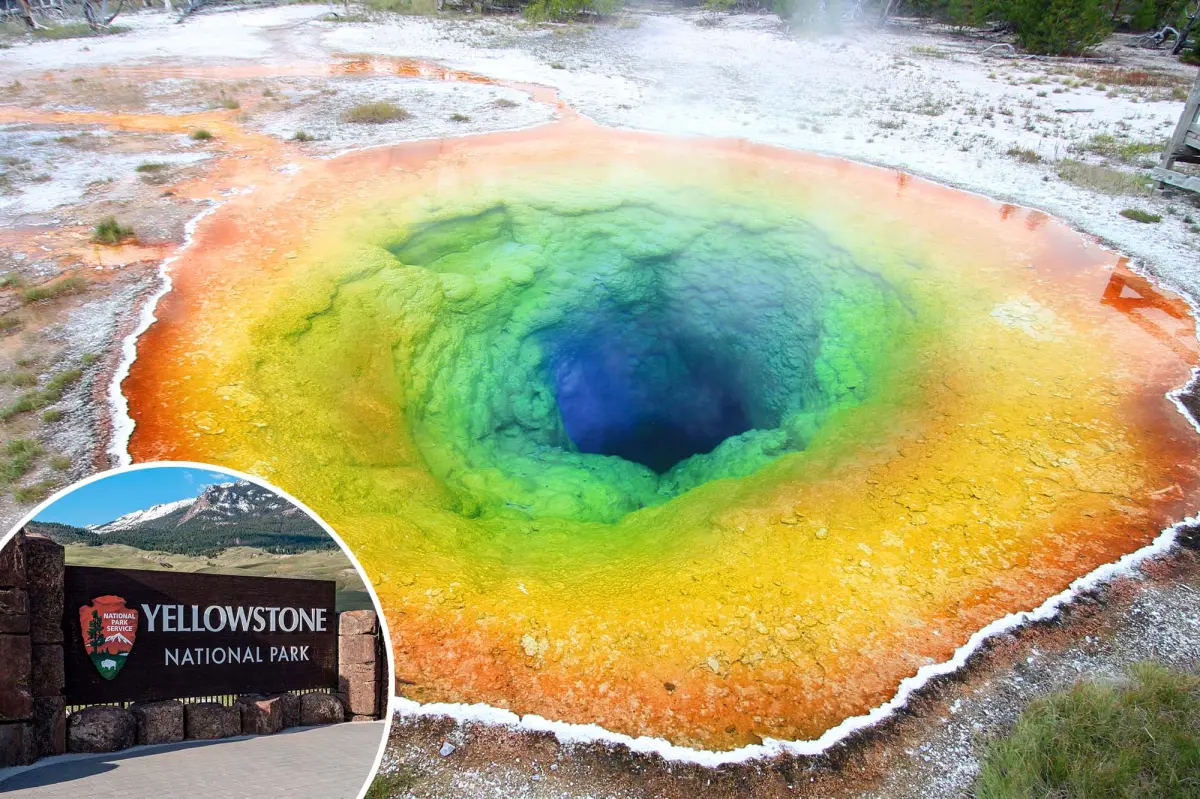
The invisible damage goes even deeper than physical clogs. Trash can alter the chemistry of the springs themselves, and scientists are increasingly concerned about the slow leaching of chemicals from microplastics beneath the surface. These microscopic pollutants can enter the water and disrupt the communities of heat-loving microbes that live in the pools and lend them their extraordinary, jewel-tone colors—the oranges, greens, blues, and reds that draw photographers from around the world. We have already witnessed what happens when this delicate balance is disturbed. The famous Morning Glory Pool, named for its brilliant blue, flower-like center, is a living monument to the harm that trash can inflict. Beginning in the 1950s, park staff reportedly referred to it as the “garbage can” because visitors habitually tossed coins, bottles, and other objects into its shimmering depths. The debris cooled the water’s temperature, and the cooler conditions allowed orange and yellow bacteria to flourish where blue had once reigned. Slowly, over the decades, the pool’s iconic color shifted, transforming from a perfect, brilliant sapphire into a murky medley of green, yellow, and rust. It was a profound and visible demonstration of how small, thoughtless acts can accumulate into lasting environmental damage.
In the 1970s, park rangers took drastic action in the hope of restoring Morning Glory’s original appearance. They partially drained the pool, exposing its floor so that workers could carefully extract the coins, bottles, pebbles, and other debris that had accumulated there over years of visitation. It was a remarkable undertaking—a risky, delicate operation on a living thermal feature—and it reflected a genuine institutional remorse for the damage that had been done. But the pool’s original, crystal-clear blue did not fully return. Nature, it turns out, is easier to wound than to heal, and the change in temperature and chemistry had already rerouted the microbial ecology into a new equilibrium. Even after the physical trash was removed, the orange and yellow hues lingered, a permanent reminder that some harm is essentially irrevocable. The episode stands as a parable for our time: an acknowledgment that the footsteps we leave behind, the small objects we drop, and the tiny disruptions we cause can compound into transformations that no amount of cleanup can fully reverse. The pool’s story remains embedded in the park’s memory, a quiet warning written in bacterial color.
As Yellowstone looks toward the future, the work of the geology team grows ever more essential, and their toll of collected trash—23,000 pieces and counting, alongside nearly 11,000 rocks and sticks—serves as both a badge of honor and an indictment of our collective footprint. Fox News Digital reached out to Yellowstone National Park for further comment, but the story hardly needs an official statement. It is written in the rows of recovered pacifiers and retainers, in the lonely Uno card sitting alongside five AirPods, in the dozens of rubber ducks reclaimed from boiling water. What these items reveal is not malice but distraction, not villainy but ordinary human forgetfulness multiplied by the millions. The park’s staff, trained to navigate the thin crust between life and scalding death, continue their quiet vigil, collecting what we leave behind and urging us gently to leave nothing at all. Their work reminds us that stewardship is not a passive state but an active, ongoing choice—and that the true measure of our love for places like Yellowstone is not found in the photographs we take, but in the footprints we leave, and in the things we manage to carry back out with us. The springs will keep steaming, the geysers will keep erupting, and the microbes will keep painting their subtle masterpieces, as long as we learn, at last, to honor the fragile world that holds them.