

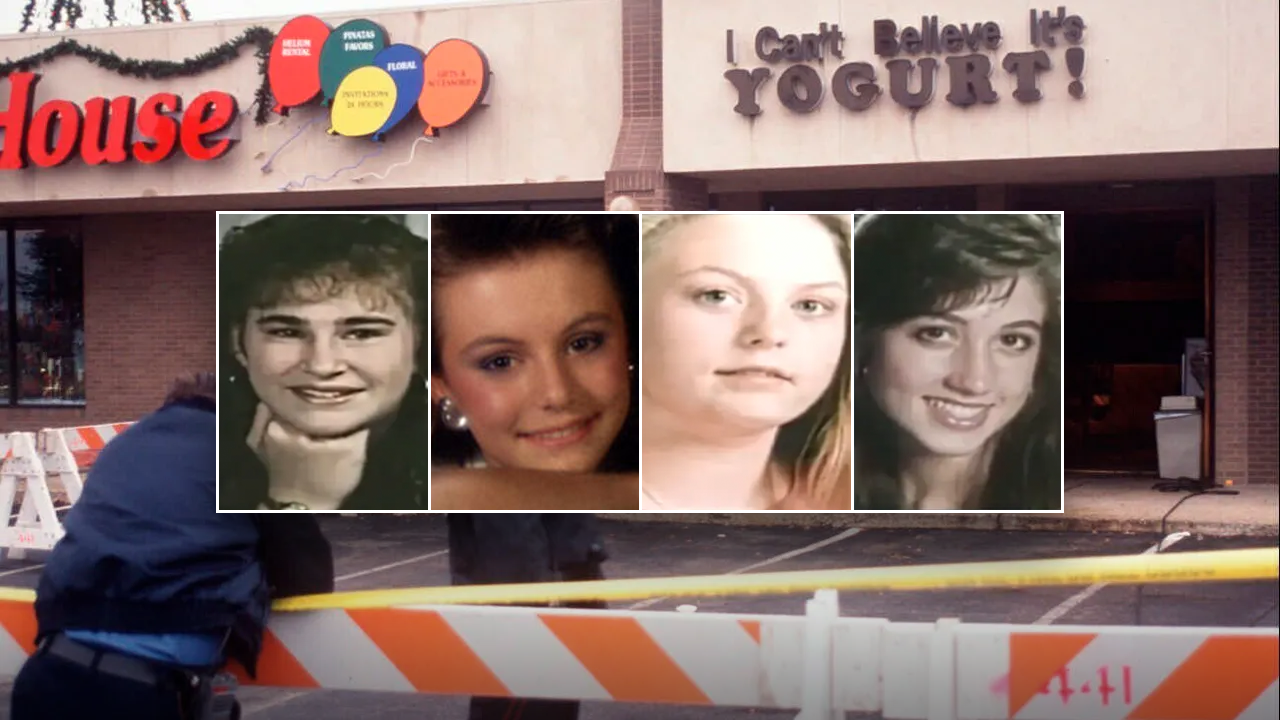
For Shawn Ayers and his wife, Angie, the name of a frozen-yogurt shop on West Anderson Lane in Austin, Texas, will always carry the weight of a gravestone. More than three decades after Shawn’s 13-year-old sister Amy was murdered during the 1991 massacre at I Can’t Believe It’s Yogurt!, the couple is still searching for the whole truth. Along the way, they have turned their private grief into a public mission. Together with former prosecutors Mindy Montford and Anne Marie Schubert, who worked major cold cases including the Golden State Killer investigation, the Ayers have founded the National Cold Case Center. It is a nonprofit with an ambitious reach: it aims to pay for unsolved homicide investigations when agencies lack the resources, provide advanced training in DNA and forensic genealogy, compile accurate data on America’s cold cases, connect investigators across jurisdictions and, perhaps most importantly, give families a peer network of people who truly understand what they are living through. Angie told Fox News Digital that the center had been years in the making. She and Shawn had heard too many stories from other families about the same chaotic and lonely experience they had gone through: being uncertain about where a case stood, waiting months or years for updates, and learning painful details through leaks and whispers instead of from officials who should have told them first. That is still happening today, Shawn said. He recalled how often he learned about his sister’s case from outside sources, and how deeply that added to the wound. The center is now up and running, but the couple acknowledges that funding is the immediate challenge. They want to get the first cases underway and prove that a coordinated, compassionate approach can make a difference. Their own story—stretching from a burning yogurt shop to a national nonprofit—is a testament to how long a family can keep fighting, and how much can be accomplished even after a case has gone cold.
The night that changed everything began as a normal teenage plan. On Dec. 6, 1991, Jennifer Harbison and Eliza Thomas, both 17, were working the closing shift at the yogurt shop. Jennifer’s younger sister Sarah Harbison, 15, and Amy Ayers, 13, had come to wait for them so the four could go to a sleepover. It should have been a night of laughter, frozen yogurt and innocent chatter. Instead, shortly before midnight, authorities received a report of a fire at the store. The blaze and the water from the sprinklers would become the central villains of the investigation’s early years, altering the crime scene and diluting crucial evidence. Inside, police discovered Sarah, Eliza and Jennifer in the storage room, stacked together, stripped, gagged and bound with their own undergarments. Each had been shot in the back of the head with .22-caliber bullets. They found Amy in a separate area, with a ligature around her neck and burns covering up to 30 percent of her body. Court documents and FBI records would later describe two gunshot wounds on Amy: an initial .22-caliber bullet that missed her brain, and a second shot from a .380-caliber pistol through her cheek and jawline. Investigators recovered a .380-caliber cartridge casing in a floor drain, and during autopsies, they found four .22-caliber bullets in the girls’ bodies. The horror of the scene was compounded by the destruction of evidence: the fire and sprinklers had washed away fingerprints, footprints and biological traces that might have led somewhere. For the families, the unanswered questions became a second trauma. Was this a random attack? A targeted killing? And most terrible of all: who could do something so brutal to four girls? The fact that they were so young, and that their plans had been so innocent, made the crime feel almost unbearable. The Ayers family would spend the next thirty-four years measuring time not in years but in meetings, phone calls, and disappointing dead ends.
For years, the city’s investigators didn’t know. They eventually turned to four local teenagers—Robert Springsteen, Michael Scott, Maurice Pierce and Forrest Welborn—and built a story that would collapse with time. In 1999, Austin police arrested all four. Springsteen and Scott confessed during questioning, but both later recanted, saying they had been pressured and that the statements were false. Prosecutors charged Springsteen with capital murder, and a Travis County jury convicted him in 2001, sending him to death row. Scott was convicted in 2002 and sentenced to life in prison. Then the Texas Court of Criminal Appeals overturned both convictions, Springsteen’s in 2006 and Scott’s in 2007. DNA testing linked none of the four men to the crime scene. A judge released Springsteen and Scott in June 2009, and prosecutors moved to dismiss the charges that October. Pierce had been arrested in 1999, spent more than three years in jail, and saw his charges dismissed in 2003 because of insufficient evidence. His life did not end peacefully: in 2010, after a traffic stop, Pierce fled on foot and stabbed an Austin police officer in the neck with a knife; officers fatally shot him. Welborn, meanwhile, had proclaimed his innocence and implicated Pierce. In 1991, Pierce wore a wire and tried to coax Welborn into confessing; an Austin police officer later reported Welborn denied involvement. Welborn passed a polygraph test, never went to trial, and was released after two grand juries failed to indict him—but only after spending months in jail. He told Texas Monthly that he was angry: if the others hadn’t confessed to something they didn’t do, maybe none of this would have happened. He lost his auto repair business, endured public suspicion and years of ostracism. The injustice done to these four young men is now part of the yogurt shop case’s terrible legacy, a warning about the danger of false confessions and tunnel vision. It also made the true resolution even more painful for the Ayers family, because so many years were spent chasing the wrong people while the real killer remained unknown.
The true break in the case came decades later, in September 2025, when DNA and ballistics evidence finally identified the killer as Robert Eugene Brashers. Brashers was a violent criminal with a lengthy record, and authorities had previously connected him to other killings, including homicides in South Carolina and Missouri. He had never been a suspect in the yogurt shop case. Instead, he was discovered through the kind of forensic genetic genealogy that has transformed cold case investigation—the same approach that helped expose the Golden State Killer. But Brashers was already beyond the reach of the law. In January 1999, nearly two years before the Austin teenagers were even arrested, Brashers killed himself during a police standoff in Missouri. According to Austin police, he used the same .380-caliber handgun in the yogurt shop murders to take his own life. That connection offered the Ayers family a name, but not peace. They could not confront Brashers in a courtroom. And for Angie, one gnawing question refused to go away: Brashers was linked to two guns used that night, but his other known crimes, as far as she could tell, involved only a single weapon. Why would he use both a .22 and a .380 in Austin? Did someone else pull a trigger? “I may be incorrect, but I don’t think that I am,” Angie told Fox News Digital. “There’s never been an instance where he used both of those guns in his other cases.” She added, “There has been absolutely no definite answer on whether or not he was by himself, or had an accomplice. So, to us, we still don’t have all the answers, and knowing that this case is still ongoing, I don’t think anyone can say that they know exactly what happened because we can’t ask.” The identification, which should have closed the case, instead opened a new chapter of uncertainty. For the Ayers family, the killer has a name—but the full truth still doesn’t.
After Brashers was identified, the legal machinery slowly began to acknowledge what the four accused men had always maintained. In February 2026, Travis County Judge Dayna Blazey declared Robert Springsteen, Michael Scott, Maurice Pierce and Forrest Welborn innocent. Months later, the Austin City Council approved a $35 million settlement that covered the three surviving men and Pierce’s family. For Welborn, the official apology was not enough. He rejected the city’s apology outright, telling Texas Monthly, “Their apology is not accepted. Their apology means nothing to me.” He acknowledged later that it “felt good” to have closure, but he also said he wanted some of the detectives who worked the case “to go do some prison time.” None of the detectives have faced criminal charges in the case, according to Texas Monthly. The settlement was an admission, in legal terms, that an innocent family had been shattered by the investigation itself. But for the Ayers family, the stain of the wrongful convictions is part of a larger tragedy. They have not reached out to the men who were wrongly accused, and the men and their families have not reached out to them. “We haven’t reached out, and they have not reached out,” Angie said. That silence is understandable: the two groups share an extreme and painful history, but they are bound to the same crime from opposite angles. The Ayers cannot celebrate the collapse of the old case without remembering Amy. The four men cannot see the Ayers family without remembering the accusations that upended their lives. Even after a $35 million settlement and a judge’s declaration of innocence, the shadow of Dec. 6, 1991, still falls across everyone connected to it. The legal system did everything it could to correct a wrong, but no amount of money can give back lost years, lost reputations, or the sister who was taken too soon.
It was exactly that complicated, layered suffering that moved the Ayers to action. Their partnership with prosecutor Mindy Montford began in 2017, when they met with her about the yogurt shop killings while she served as a Travis County assistant district attorney. She made a promise to the family. “She made it a point to tell us that she was going to stick with us no matter what until the end,” Angie said. Montford later connected them with Anne Marie Schubert, whom they met at a 2023 cold case conference, and the idea for the National Cold Case Center came into focus. The center is meant to provide what the Ayers often lacked: transparent communication, proper funding, scientific expertise, and a network of families who can support one another. Angie described an organization that not only funds training for law enforcement and gathers accurate data on unsolved cases but also connects investigators around the world and gives families a seat at the table. Shawn has spread awareness at cold case conferences across the country, from California to Florida, Missouri to North Carolina. Their motivation isn’t just to bring closure to the grieving—it’s to prevent future harm. There could be killers still walking among us, Shawn said. He put it simply: “There could be a killer living, right next to somebody. You can walk right past them and never know.” That is the urgency that drives them now. They know that a cold case is not just an investigation sitting in a drawer. It is a family waiting by a phone, a killer living in the open, and a community that deserves answers. By turning their own decades of frustration into a national resource, the Ayers hope to be the investigators’ ally, the family’s advocate and, eventually, the reason some other child’s sister gets to be remembered.