



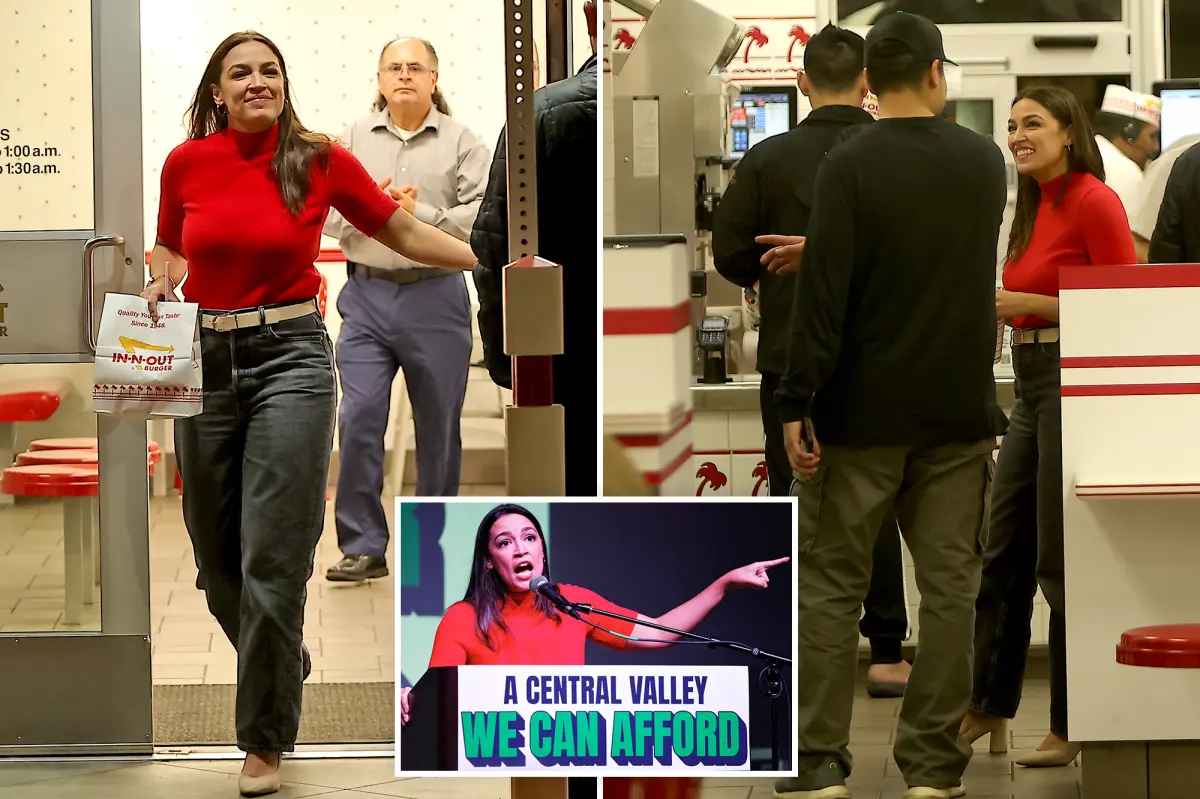
Campaigning is hungry work. There is no way around it: hours of handshakes, speeches, chants, and the unrelenting California sun can leave even the most disciplined politician rummaging for a quick reward. That is precisely where Representative Alexandria Ocasio-Cortez found herself on a Friday afternoon in Delano, California, emerging from an In-N-Out Burger with an unmistakable smile and a red, white, and yellow bag clutched in her hand. The bag’s iconic logo faced outward, almost like a trophy. She had just wrapped up an event in Bakersfield as part of her nationwide tour to try to flip the U.S. House back to Democratic control, and the road ahead was long. But for a few minutes, none of that seemed to matter. There she stood inside the restaurant with her arms crossed, waiting in line like any other customer, while a security detail kept an eye on the scene. When photographers outside caught a glimpse, she offered a quick wave before disappearing back into her day. It was a small moment, but a deeply human one: the congresswoman, the movement leader, the political phenomenon, just another person chasing a burger after a long day on the trail.
The political stakes behind that burger run, however, were anything but ordinary. AOC had stopped in Bakersfield to stump for Randy Villegas, a progressive Democrat waging a long-shot campaign to unseat Representative David Valadao, the Republican incumbent from California’s Central Valley. The district is heavily Hispanic, and Democrats deliberately redrew its boundaries to give themselves a better shot in this cycle, just as Republicans have done in Texas and other states. For Democrats, this district represents a rare opportunity: a seat that could realistically flip with the right candidate, the right message, and enough energy on the ground. Villegas, who spoke for about fifteen minutes before AOC took the stage, is trying to turn that redrawn map into a tangible victory. But Valadao is not an easy opponent. He has spent years positioning himself as a different kind of Republican, one willing to break with his party when convenient. He voted to impeach President Trump after the January 6 attack in 2021, a decision that made him a pariah in some corners of his party but also gave him a veneer of independence in a district where Trump’s margins are tight. Yet in 2025, he backed Trump’s signature legislative achievement, the so-called Big Beautiful Bill, a move that Democrats were quick to highlight. The political calculation is delicate, and AOC’s visit was designed to remind voters that Valadao’s independence has limits.
The Central Valley is not a place where national Democrats sweep in easily. Trump carried the district by only two points against Vice President Kamala Harris in 2024, a razor-thin margin that suggests it is winnable but far from certain. Valadao has worked hard to keep his distance from the president, understanding that his constituents are not reliably red. He has touted his willingness to break with his party and emphasized local issues, trying to stay afloat in a district that Republicans once took for granted. But AOC’s presence changes the conversation. When a political star of her magnitude shows up in Delano, the cameras follow, and the national narrative starts to shift. She is not just campaigning for Villegas; she is signaling that Democrats are willing to invest time and energy in places they too often ignore. The same forces, she argues, are rigging the economy against working people, and the only answer is to show up and fight for them. The crowd that gathered in Bakersfield reflected that hope: farmworkers, teachers, nurses, small-business owners, people who see the congresswoman as a voice for the struggles they live every day. For fifteen minutes, Villegas had their attention. Then AOC did what she does best: she connected the local race to a bigger fight, and the energy in the room rose.
The burger stop was necessary, because the schedule did not let up. After Delano, AOC was headed to Las Vegas for a “Get Out the Early Vote Rally” on Saturday, where she would join Representative Steven Horsford, a Nevada Democrat who represents parts of the Las Vegas Strip and surrounding communities. Horsford’s campaign framed the rally in stark terms: “The same forces rigging the economy against working people are betting we stay home this November. But the people who make Nevada work will never fold — we’re going all in!” The message is quintessential Horsford, and AOC was there to amplify it. Nevada is a battleground state, and early voting is critical. The rally was designed to energize the base, especially working-class voters who have historically been the backbone of the Democratic coalition but have shown signs of drifting away. AOC’s appeal goes beyond traditional political demographics. She draws crowds of young voters, Latino voters, and progressives who might otherwise stay home. Her appearance in Las Vegas was an acknowledgment that Democrats cannot afford to lose another election by assuming people will turn out on their own. They need to be inspired, organized, and reminded that the stakes are real. For AOC, that means a relentless schedule of events, flights, handshakes, and sound bites. And for someone who gives that much to the campaign trail, a burger is not a luxury. It is fuel.
Food, in fact, has become an unexpectedly recurring theme in AOC’s campaign travels. A short time before the In-N-Out visit, she made her first-ever stop at Culver’s in Michigan, alongside Abdul El-Sayed, a progressive Senate candidate who has become one of her allies. The fast-casual Midwestern chain is famous for its ButterBurger and cheese curds, and AOC leaned into the experience with the kind of unguarded enthusiasm that makes people forget she is one of the most recognizable politicians in America. She ordered the ButterBurger and cheese curds, and afterward, she gushed about the meal with an almost childlike delight: “My life has changed!” The moment was pure AOC: a Bronx-born elected official discovering the joys of Wisconsin-style comfort food in the middle of a campaign swing. It also made her seem more relatable, the kind of person who gets genuinely excited about local culinary landmarks. The contrast to her In-N-Out visit was stark, not just because of the different fast-food chains, but because of the different contexts. At Culver’s, she was a tourist, an explorer, someone tasting something new for the first time. At In-N-Out, she was a seasoned traveler grabbing a familiar meal on a long journey. Both moments, though, revealed a politician who understands the power of shared experience. Food is a universal connector, and in the middle of heated political battles, sharing a meal with voters is a way to bridge the divide between the capitol and the kitchen table.
Yet there was a delicious irony in AOC’s In-N-Out visit, because she has not always been a fan of the West Coast chain. Back in 2022, during another hard-fought midterm cycle, she sat down with Jon Lovett, one of the hosts of the popular political podcast Pod Save America. Lovett, ever the provocateur, asked her bluntly what she thought about the quality of In-N-Out’s fries. AOC did not hold back. “Thank you for saying this because every time I come out here, everyone’s like: ‘Oh my god, In-N-Out, In-N-Out.’ And I’m like, my controversial, nonpolitical opinion is that it’s overrated,” she admitted. She was quick to clarify that her criticism was not aimed at the burger itself, which she seemed to respect. Her beef was with the fries, which she called “dry.” It was a minor moment in a podcast interview, but it stuck with people because it was so disarmingly honest. Politicians are trained to be anodyne, to avoid taking sides on anything, even something as trivial as fast-food fries. AOC’s willingness to offer a contrarian take made her seem human, even when it risked angering West Coast loyalists. So when she emerged from the Delano In-N-Out three years later, gripping that iconic bag with a smile, it was impossible not to wonder if she had changed her tune or if she had simply decided that the burgers were worth the dry fries. Either way, the image was a reminder that people are not static. They grow, they change, they compromise. And sometimes, they just need a burger after a long day of trying to save democracy.
In the end, the burger run says more about the grind of American politics than it does about the fast-food industry. AOC’s schedule is punishing by design. She is crisscrossing the country, showing up in race after race, trying to build a coalition that can retake the House. She is fighting for candidates like Randy Villegas in California, standing with leaders like Steven Horsford in Nevada, and lending her voice to challengers like Abdul El-Sayed in Michigan. The work is relentless, and the stakes are enormous. Every rally, every handshake, every speech is meant to move the needle, to convince voters that their participation matters, that the government can work for them, that the economy can be rigged against them no longer. But she is also just a person, and people get hungry. They crave familiar tastes, they seek comfort in the middle of chaos, and they find small joys wherever they can. The sight of Alexandria Ocasio-Cortez walking out of an In-N-Out with a paper bag might seem trivial, another celebrity-politician moment in a news cycle full of them. But it is also a glimpse into the reality of public service: the long hours, the constant pressure, the need to keep going even when your voice is hoarse and your feet hurt. The fries might still be dry. The burgers might still be fast. But for a few minutes, in Delano, California, the congresswoman was just another road warrior, fueling up for the battle ahead.