


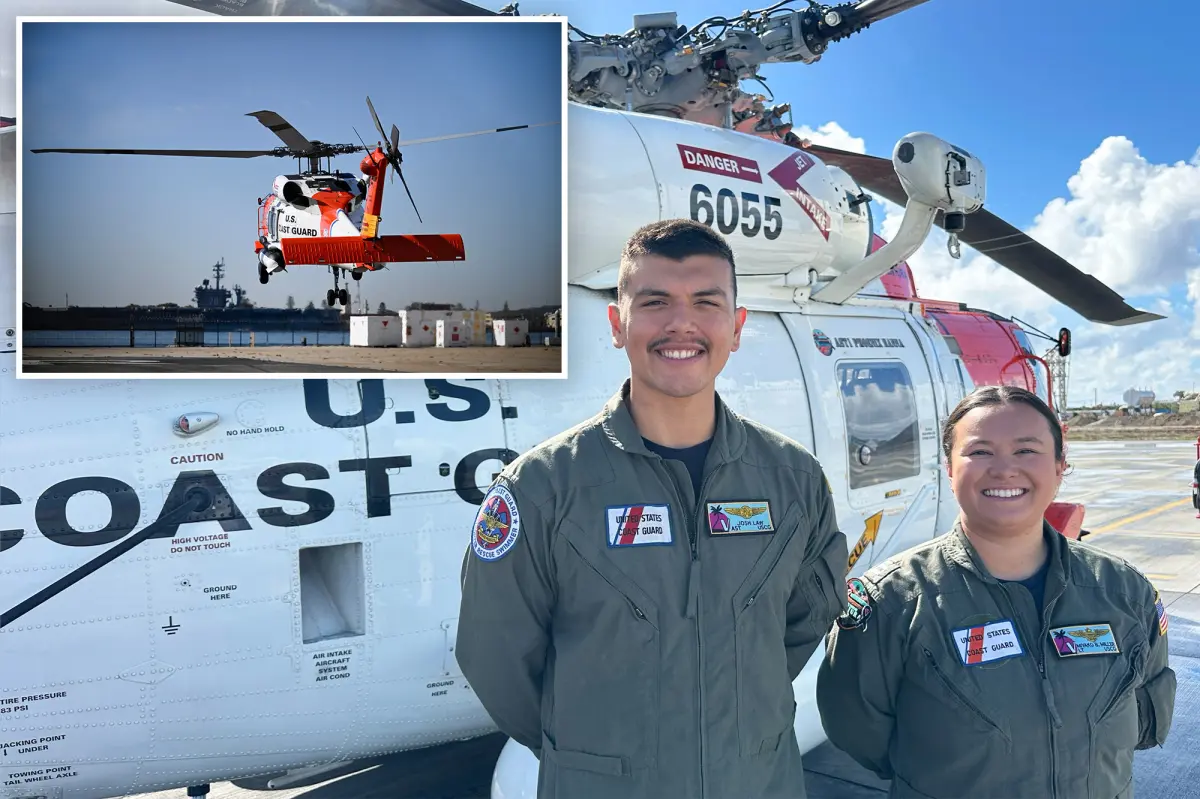
Josh Law could feel his heart hammering against his ribs as the helicopter doors slid open into the black Pacific night. Strapped into a rescue harness, he was lowered by cable from the hovering Coast Guard aircraft, descending into a churning ocean roughly 140 miles off Mexico’s Baja peninsula. The rotor wash pummeled the surface into a chaotic spray, whipping salt water into his face and drowning out every sound but the roar of engines and wind. The darkness was absolute, broken only by the helicopter’s searchlight, which sliced through the night and danced across the waves. Below him, 6-to-8-foot swells rolled in relentless rhythm, and he knew somewhere out there were more than two dozen people who had been thrown into the cold water when their boat capsized. He could not see them. He could not hear them. All he could do was trust the beam of light above and hope it would guide him to the survivors. Law, a 24-year-old rescue swimmer, later said he had never experienced anything like it. “I was experiencing exhaustion at that point,” he told the Associated Press in his first interview since the rescue. “We had very little sleep. But what I was experiencing was nothing compared to what they were at that point.” Over the next two hours, he would become the only person in the water pulling people to safety. He personally rescued 16. Eleven others would never be found.
The mayday call had come around 1 a.m., a frantic voice reporting a sinking boat in the open Pacific off Ensenada, Mexico. Within minutes, the alarm echoed through the Coast Guard Air Station in Ventura, northwest of Los Angeles, jolting Law and his crewmates from their bunks. There was little time to think, only to move. Law pulled on his dry suit, strapped on fins, loaded medical gear, and clipped himself into the harness that would carry him into the sea. Helicopter pilot Lt. Miyako Miller studied weather conditions and charted a course south across the border, into a vast stretch of ocean where smugglers increasingly ferry migrants north by night. By 2 a.m., the crew of four was airborne. What exactly had happened to the vessel remained a mystery. It was unclear whether it had lost power, drifted off course, been swamped by waves, or intentionally sailed so far out to sea. Only pieces of the boat were found. The survivors were all Mexican, according to the Mexican consulate, and U.S. Customs and Border Protection opened an investigation, interviewing them at hospitals while agents tried to determine whether the boat was part of a migrant smuggling operation. For Law, the investigation was distant. All he knew was that people were dying in the water, and every second mattered.
Miller flew through the dark with night vision goggles pressed against her eyes, relying on the stars because there was no moonlight to guide her. For more than an hour, the ocean below was an endless black void. Then, far ahead, she spotted a tiny flicker of light, weak and wavering, barely visible against the horizon. As the helicopter drew closer, it became clear that the flicker came from small lights on life vests, worn by people bobbing in the water. There were also pieces of debris scattered across the surface, wreckage from the capsized boat. Miller carefully maneuvered the aircraft lower, hovering about 40 feet above the swells, holding the helicopter steady against the wind and waves. “I’m doing my best to maintain my references externally by looking outside through the night vision goggles,” she said, “while the flight mechanic is telling me where to position the helicopter.” Some 250 miles southwest of Ensenada lies Guadalupe Island, a remote biosphere reserve known for its great white sharks, but Law did not let himself think about what might be below. There was no time. The survivors had already spent hours in water cold enough to rob them of body heat, and every minute meant a greater risk of hypothermia or drowning. He zipped down the cable and hit the water, ready to swim.
What Law found was a scene of scattering and desperation. The survivors were spread across a wide area, some clinging to each other, some holding onto buoys and pieces of wreckage, shivering and kicking to stay afloat. The water was rough, and the darkness made it nearly impossible to see more than a few feet. Law swam to the nearest person, flipped them onto their back, put his arm across their chest, and pulled them through the water using a technique called the buddy tow. Kicking hard with his fins, he towed each survivor to a spot where the helicopter crew could see him, then signaled for the basket to be lowered. “With one hand, I’m holding the survivor. With the other, I am signaling to the helicopter and working with the device,” he explained. One by one, he loaded the people into the basket. The crew hoisted them up, pulled them inside the aircraft, and sent the basket back down for the next rescue. All the while, Law’s dry suit slowly filled with water, pooling around his knees and dragging him down with every stroke. He pushed through heavy waves, back and forth, again and again, his muscles burning and his breath short. He did not count how many trips he made. He simply kept moving, because stopping meant someone might not be found in time.
Finally, with the helicopter nearly full and fuel running low, the crew made the call to head for the Coast Guard station in San Diego, where ambulances were waiting on the tarmac. The flight was packed with survivors, many suffering from severe cold and injuries. Law treated three people for what he called “bad” wounds, working to stop the bleeding. Some of the injuries, the Coast Guard said in a statement, were consistent with shark bites, and the crew provided life-saving first aid on board. Customs and Border Protection officers met the survivors at the hospital and said they would process them according to immigration laws once they were medically cleared. Nearly half of those rescued have since been returned to Mexico, U.S. officials said. The search for the missing continued for two more days, with the Coast Guard, the U.S. Navy, and Mexican authorities covering more than 2,441 square miles over 89 combined hours. They found nothing. Late Sunday, the Coast Guard officially called off the search. For Law, returning to Ventura that morning felt surreal. It had been by far the longest, most intense rescue operation of his career, but he carried with him the weight of those who had been lost, not just those he had saved.
Looking back, Law tried to put the experience in perspective. He had gone into the water exhausted, with very little sleep, but he knew that his discomfort was nothing compared to the terror and cold the survivors had endured. “I just had to keep that in mind,” he said. His calm under pressure, his willingness to dive into the black ocean and keep swimming until there was no one left to pull from the water, is part of a larger story unfolding along the Pacific coast. Migrants, desperate to reach the United States, are increasingly turning to the sea, paying smugglers to carry them north in small open boats called pangas, which often leave Baja at night and travel for hundreds of miles along remote routes. It is a dangerous gamble, and not everyone survives. The capsized boat off Baja was a reminder of the human cost hidden in the darkness. Law did not know the names of the people he rescued or the story of the boat that carried them, but he will never forget the moment he dropped into the water with nothing but a searchlight to guide him. In the end, 16 people came home because a young Coast Guard swimmer refused to slow down. Eleven others remained lost, their fate sealed somewhere beneath the Pacific, a quiet reminder of the risks migrants still take in search of a better life.