



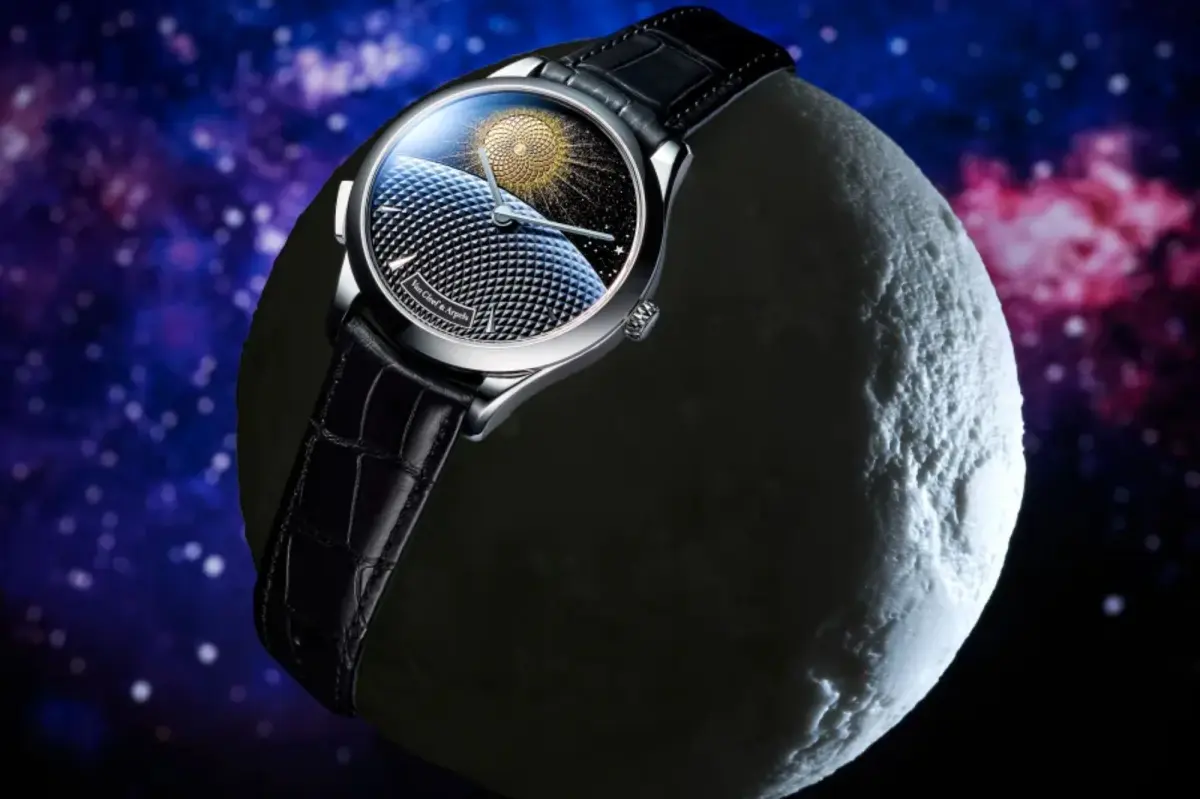
There are certain objects that stop reminding us what time it is and instead make us feel what time means. A mantelpiece clock ticks its hours away; a phone screen presents a cold and numbered world; but a truly exceptional watch performs a different, older magic. It turns the passage of time into a narrative of light and shadow, of seasons, tides and cycles, a quiet story that unfolds on our wrist without ever demanding our attention. It takes a certain kind of mystique to make time feel otherworldly, and few maisons possess that mystique as naturally as Van Cleef & Arpels. The house has always looked to the heavens for inspiration—stars, constellations, planets, the moon—and has treated horology not as engineering but as poetry. With its latest celestial offering, the Midnight Jour Nuit Phase de Lune, that poetry becomes wearable. The watch is an homage to the moon and to the ancient rhythm of day and night. On its dial, a tiny cosmic drama perpetually unfolds: a sparkling sun travels across the firmament, and as it descends, a serene mother-of-pearl moon rises to take its place. The name itself is a little poem: Jour/Nuit, day and night, and the phases of the moon. These complications were not chosen for practical convenience. They were chosen because they connect us to something primal in human experience. We have always counted time in mornings and moonrises; we have always felt the emotional difference between noon and midnight. This timepiece invites us to return to that older, mythic sense of time, where moments are not only numbers but luminous transitions. In an age of digital efficiency, it dares to slow down and to wonder. And in that quiet wonder lies the entire mystique of Van Cleef & Arpels.
At first glance, what captures the eye is the face, for there is no busy clutter of numerals and hands demanding comprehension. Instead, the dial is arranged as a small celestial scene, a jeweled sky meant to be read the way one reads a sunset. The sun is not a static symbol but a moving presence. It appears to glide across the dial as the hours pass, scattering glints of light from its polished surface, and gradually ceding its throne to the moon. The moon itself is shaped from mother-of-pearl, chosen for its translucency, its faintly changeable luster, and its capacity to look different at every angle. Just as the real moon seems to glow from within on a clear night, this little lunar disc seems lit by some hidden source. The effect is spellbinding. A simple day/night indicator would have been enough; instead, Van Cleef & Arpels has made the entire dial a sky that shifts in mood from morning to midnight. In the clear light of noon, the sun’s sparkle is crisp and bright; by late afternoon, the tone of the dial seems to warm; as evening falls, the mother-of-pearl moon takes control, soft and pale, surrounded by a deepening dark. The wearer does not need to set aside a moment to read the watch; the watch sets aside a moment for the wearer. It invites a pause. It invites upward glances and inward thoughts. There is a reason why so much of our oldest mythology is made of sun and moon stories—they are the first timekeepers, the first calendar, the first comfort against the dark. This watch puts that mythology on the wrist and makes it personal. You are not just aware of the hour. You are aware of the light outside, of the season, of your own small place in the turning of the sphere.
Beneath that dreamlike surface lies a finely tuned mechanism, and it deserves respect. The Jour/Nuit display is a complication in the full horological sense, not a mere decoration. It has to rotate in sync with the hours, advancing continuously or in steps, while still leaving room for the main timekeeping functions. And the moonphase is an astronomical complication: it is calibrated not simply to show a full moon occasionally, but to mirror the actual cycle of the moon with remarkable precision. A true moonphase tracks the synodic month—the period of about twenty-nine days, twelve hours, forty-four minutes, and three seconds between successive full moons. If the movement’s gear ratios are not exquisitely chosen, the display will drift visibly within months. In a piece like this, the engineering is done with such exactitude that the lunar disc will remain aligned with the real moon for many years, needing only the most occasional nudge. There is something deeply satisfying about that hidden accuracy. We live in an age where a phone can tell us the moonphase for any date on Earth, but that knowledge is disembodied, weightless, unrelated to us. Here, the moon is present in your own private watch. When you look at it, you are looking at the same cycle that pulls tides and poets. The complication becomes a kind of shared secret between the mechanism, the sky, and the person wearing it. It also reminds us that the moon is never still. It waxes and wanes, disappears, reappears, and always does so with a rhythm that predates human memory. A watch that carries that rhythm is not just a timepiece; it is an amulet of cosmic patience.
Van Cleef & Arpels is not first and foremost a watch company; it is a high jewelry house with a century-long tradition of transforming precious materials into fantasies. That jewel heritage is one of the reasons this watch feels so unlike an ordinary chronograph. The same hands that know how to make a rose bloom from gems and a necklace lie flat against the throat bring a jeweler’s sensitivity to the dial. Mother-of-pearl is not a standard-issue watch face; it is a living material, harvested from the inner shells of certain mollusks, whose luster depends on the thickness of each layer and the way it is cut. Master artisans sort through many shells to find a handful of pieces with exactly the right color, iridescence, and thickness for a dial. Then they shape it, place it, and set it so that it seems to float in the firmament. The sun likewise is designed to catch every ray, luminous and celebratory, the way a great jewel should be. The case itself is a study in curves and light, polished until it gleams against the skin. And open the caseback, and you will find the same obsession with beauty in the hidden places. The movement is not merely functional machinery; it is a private landscape of polished bridges, beveled edges, and hand-finished surfaces. The wheels are decorated, the screws are polished, and even the parts that will never be seen by anyone except a watchmaker are finished as if they were going to be framed. This is the philosophy of the maison: a thing can be truly beautiful only if it is beautiful all the way through. It is a rare and noble standard. It also means that owning such a watch is a relationship with the people who made it. You sense their patience in every detail, their care in every decision. The watch is an homage to the moon, yes, but it is also an homage to the human hand and to the long tradition of jewelers and watchmakers who have always used their skills to celebrate the stars. In a mass-produced world, such devotion is both anachronistic and heartening.
To wear the Midnight Jour Nuit Phase de Lune is to enter a different relationship with time. It is not for someone who needs to catch a train; it is for someone who wants to understand why the train matters. On the wrist, the watch does not shout. It has a quiet presence that catches light the way a piece of jewelry should, but it also has a secret life. A glance at the dial tells you more than the hour—it tells you whether the light outside is moving toward noon or toward midnight. It tells you if the moon is young and thin, or full and heavy. It connects your own routine to the larger routines of the sky. In that sense, it is almost meditative. Every time you check the wrist, you are reminded that you are part of a cosmos, not at its center. The day/night display unfolds with a golden sun that moves across the arc of the dial, and the mother-of-pearl moon rises softly in its place; there is no drama, only the calm certainty of change. This is the kind of watch that makes you want to look up at the night sky, or stand outside to watch the dawn. It turns a glance at the wrist into a breath of wonder. It is also a piece that rewards commitment. Because it is a mechanical object with moving parts, it is a living thing. You wind it or wear it, and as long as it is alive, the sun and moon continue their dance. Stop wearing it, and the little cosmos sleeps. But when you put it on again, it wakes and resumes its journey, patient as ever. There is something tender in that. It is a companion, not a machine. And in a world of notifications and alarms, a companion that simply reminds you of the moon is a gift beyond measure.
There are watches made to impress, watches made to measure, and watches made to be admired. And then there are watches made to make the ordinary passage of time a moment of quiet transcendence. The Midnight Jour Nuit Phase de Lune is one of those. It is the kind of object that a person might buy not because they need it, but because they felt some sudden recognition when they saw it—a glimmer of the universal lot of human life under a shared sky. It is for the dreamer who loves the moon, the collector who worships mechanical art, the man or woman who wants to carry a small piece of evening on their sleeve. The original description called it heaven-sent, and the phrase is difficult to avoid. As a jewel-set miniature sky, it is as close to a private firmament as a wristwatch can come. As a mechanical achievement, it is a masterpiece of restrained complication. As an emotional object, it is a reminder that our ancestors tied all their stories to the heavens, and that we have never entirely stopped doing so. To wear it is to keep an appointment with the sun and the moon every single day. To glance at it is to remember that time was always beautiful, long before it became useful. In the end, the watch is not about the hours or the minutes. It is about the mystery of duration, the slow turn of the earth, and the quiet, patient light of the moon. The passage of time becomes an otherworldly experience, just as any great object of desire can make us feel alive to the world’s wonder. For those few who find one on their wrist, this beauty is heaven-sent indeed.