

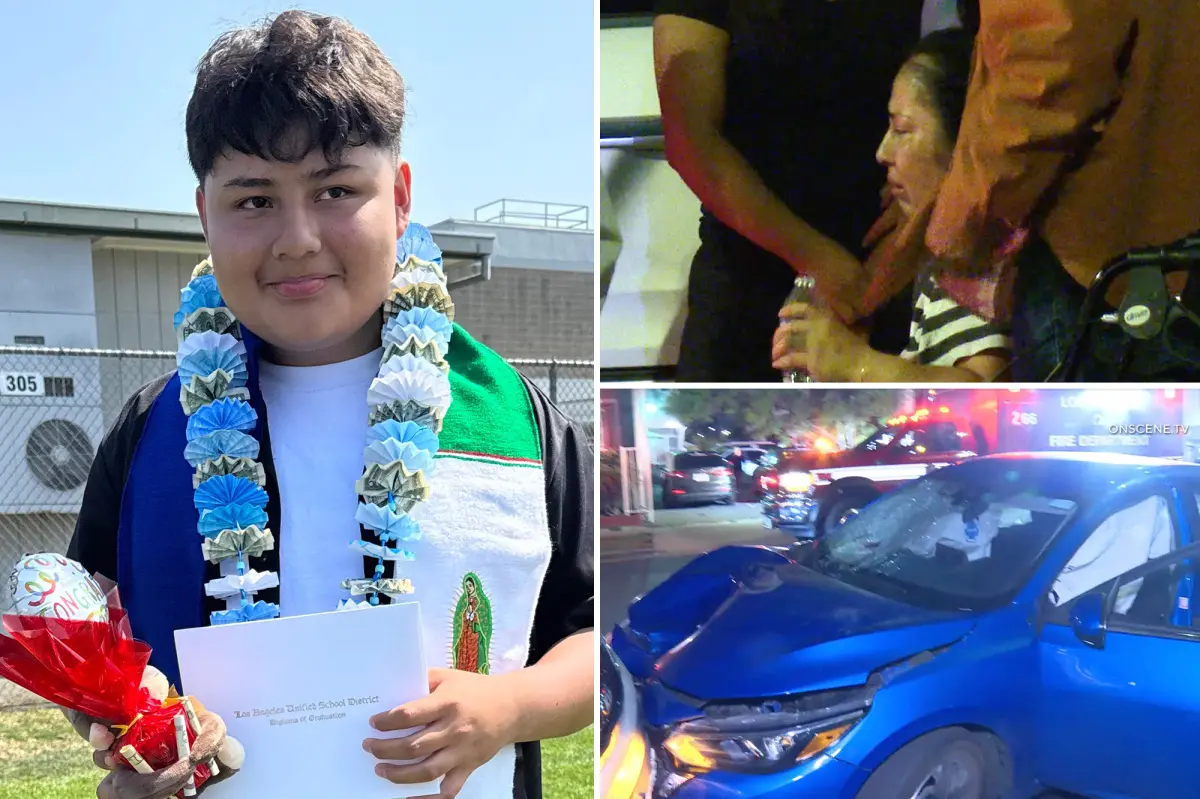
The tragedy unfolded on a Wednesday night in South Los Angeles, where the ordinary rhythm of a family walk was broken by the roar of an accelerating sedan. It was Sept. 22, just after 9:30 p.m., when 16-year-old Hernan Martinez, his 13-year-old sister Vicky, and their mother stepped into the crosswalk at 10th Avenue and 60th Street in the Hyde Park neighborhood. According to the Los Angeles Police Department, a blue Nissan Sentra driven by Raygine Glentasia Evans ran a stop sign at high speed and slammed into them. The force of the impact lifted Hernan into the air and threw him onto the car’s windshield; the driver did not stop, continuing down the street until the vehicle smashed into parked cars. By the time the mangled sedan came to rest, the teenager was already dying. Paramedics pronounced him dead at the scene. His younger sister, Vicky, suffered critical injuries and was rushed to a hospital, where she later underwent surgery. Her recovery is expected to be long and grueling. The children’s mother survived physically, but she had watched helplessly as the car bore down on her family. She had managed to pull Vicky out of the direct path, but she could not reach Hernan in time. Neighbors poured out of their homes after hearing what one described as an explosion-like crash. What they found was a scene of chaos and heartbreak: a crumpled blue car, debris scattered across the asphalt, and a mother screaming for her children. The impact was so loud that residents several houses away thought a building had collapsed. When they reached the street, they saw a 16-year-old lying motionless on the hood before rolling off onto the pavement, and his little sister pinned beneath a parked vehicle. In the seconds that followed, the alleged driver and her passenger fled on foot, leaving behind not only the wrecked car but also the dying boy and his frantic family. For the Martinez family, the evening began with simple hopes and ended with a devastating loss that will never be forgotten. A boy with a gentle spirit and a talent for baking and sewing was gone, and a community was left trying to make sense of a senseless act.
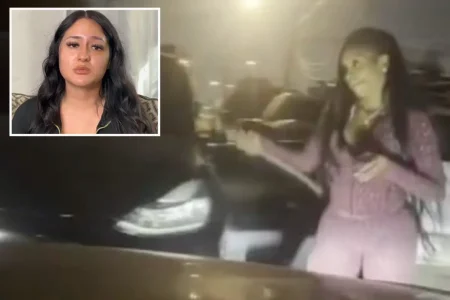
Days after the crash, investigators identified Evans as the suspected driver and revealed a troubling history. Raygine Glentasia Evans, who remains at large, had reportedly been cited nine times for reckless driving and running stop signs before the fatal collision. She was also wanted in connection with a series of 10 robberies across Los Angeles, according to the LAPD. The phrase “wanted” took on an even darker meaning when police disclosed that Evans was not alone in the car. Surveillance footage captured two women scrambling out of the mangled Nissan moments after the crash and sprinting into the night. Police identified the passenger as Joannae Shavon Rosby. The women were seen running down the street before another vehicle pulled up and picked them up. The surveillance footage provided a chilling glimpse of human nature in its worst form: instead of checking on the injured children or calling for help, the two women looked after themselves. They disappeared into the night, leaving behind a family in crisis and a boy who was already slipping away. The brazen escape left the Martinez family and the community with a bitter question: how could someone leave two children bleeding in the street and simply disappear? For those who knew Evans only through police reports, the pattern of behavior was chilling. This was not an isolated moment of panic or a single lapse in judgment; it was allegedly the latest act in a series of reckless and criminal choices. The family now faces the painful reality that the person responsible for Hernan’s death may have been behind the wheel of a car that had no business being on the road. For a community already on edge, the fact that the suspect was wanted for robberies raised deeper concerns about how someone with such a record could remain free and behind the wheel. Everyone now asks: how many warnings did it take before a child paid the ultimate price? The answer may never be fully clear, but the loss is permanent. The search for answers continues, and with each passing day, the hope grows that Evans will be held accountable for the devastation she has left behind.
One of the first neighbors to reach the scene was Jerome Alexander, who later described the horrifying aftermath in vivid detail. He told ABC7 that he heard an explosive crash, so loud that it sounded like someone had hit a building or a car. Rushing outside, he discovered a scene that will likely stay with him forever. Vicky, the 13-year-old, was partially trapped beneath a parked vehicle. At first, she was unconscious. Then her mother began talking to her, desperately calling her name and pleading with her to wake up. Alexander watched as the girl’s eyes suddenly opened—a moment that was equal parts miraculous and heartbreaking. He then saw Hernan lying on top of the suspect’s car. The teenager, who had been thrown onto the windshield by the impact, rolled off and landed on the ground. Alexander noticed that the driver and passenger had already fled, leaving the wrecked Nissan behind. But the most disturbing development came when a man returned to the vehicle. According to Alexander, the man opened the back door, moved airbags out of the way, and retrieved what appeared to be a baby from the back seat. Smoke was still pouring out of the car. When Alexander confronted him, telling him not to touch the car because someone’s child had just been killed, the man reportedly responded, “I don’t care about that.” The coldness of those words stood in stark contrast to the scene around them—a mother crying over her injured daughter, a boy’s body lying in the street, and a community gathering in shock. Alexander said the man left with the baby, and the incident has raised even more questions about what exactly happened in the minutes before and after the crash. The baby’s presence added another layer of incomprehensible tragedy to an already devastating night; no one knew whether the child was injured or whether the man had any connection to the speeding car. For the witness, the evening was a painful reminder that some people have lost their sense of humanity. The memory of the man’s dismissive response, and the image of that baby being carried away from a wreck that had just killed a teenager, will be impossible to forget.
For Hernan Martinez’s family, grief is intertwined with the struggle to remain strong. His older brother, Eliseo Martinez, described the devastating moment during the crash: their mother managed to pull Vicky away from the speeding car, but she could not save Hernan. “My mom, me and my sister are trying to pull it all together for one another,” Eliseo told KTLA. Those words capture the painful reality of a family forced to comfort each other while mourning a future that was stolen. Vicky has since undergone surgery, and her doctors have described a grueling road to recovery. The physical wounds may heal, but the emotional scars will remain. Hernan was remembered by his brother as a sweet, talented teenager who loved baking and sewing. He was only 16 years old, with his entire future ahead of him. The thought of all the milestones he will never experience—graduation, first job, falling in love, building his own family—is a wound that no amount of time can fully close. Eliseo also spoke about the bond between his siblings, a connection that was painfully severed in an instant. He described Hernan as someone who could make anyone smile, a young person who never hesitated to help others. The family has launched a GoFundMe campaign to help cover expenses following their devastating loss, raising more than $18,000 toward a $22,000 goal. In a message written through tears, Eliseo said, “He was only 16 years old and had so much life ahead of him. Losing him so unexpectedly has left a pain in our family that is difficult to put into words.” Those words speak to a truth that anyone who has lost a loved one can understand: grief is messy, complicated, and impossible to capture in a single sentence. The family now faces a long and difficult journey, one made even harder by the knowledge that the person responsible is still out there. They must wait for justice while also trying to heal, all while Vicky continues to fight. But in the midst of the darkness, they have found moments of light in the support of their community, in the stories they share about Hernan, and in the determination to ensure that his life meant something. Now the family must learn to live with an empty chair at the table and a silence that no amount of noise can fill.
In the days since the crash, the South Los Angeles community has wrapped itself around the Martinez family in a remarkable show of love and solidarity. Around 200 grieving relatives, friends, and neighbors gathered for a rosary to honor Hernan, filling the space with prayer and shared sorrow. The sight of so many people coming together served as a powerful reminder that even in the face of tragedy, no one has to grieve alone. At the intersection where Hernan was killed, volunteers painted a crosswalk and demanded stronger pedestrian protections. They turned a place of death into a symbol of advocacy, insisting that no other family should have to endure the same pain. The gesture was practical as well as symbolic: by marking the crosswalk more clearly, they hoped to prevent future accidents and force drivers to slow down. The community’s actions were driven by anger, but also by love—love for a boy they had lost, love for his family, and love for the neighborhood they call home. The GoFundMe campaign set up by the family has drawn donations from people far beyond Los Angeles, showing how a single tragedy can resonate across the country. Strangers contributed what they could, moved by the story of a 16-year-old who loved to bake and sew, and by the courage of a mother who tried to shield her children from a speeding car. The outpouring of support has helped ease some of the financial burden, but the emotional weight remains. Community leaders and residents alike have called for accountability, not only for the driver in this case, but for the broader issues of reckless driving and pedestrian safety that plague too many streets. They have asked why someone with Evans’ history of citations was still allowed to drive, and why a family walking home at night had to worry about a car barreling through a stop sign. These are questions that demand answers. The rosary itself became both a farewell and a call to action, as mourners said goodbye to a young man whose life was cut short by someone who never even paused. For now, the community continues to rally around the Martinez family, offering meals, prayers, and shoulders to cry on. They are showing what it means to be a neighbor: showing up, standing together, and demanding better.
As the family mourns and the community calls for change, law enforcement officers are still searching for Raygine Glentasia Evans. The LAPD announced that a reward of up to $50,000 is available for information leading to her arrest. Anyone with information is urged to contact LAPD South Traffic Division Officer Hurd at 213-321-9681 or submit an anonymous tip through Crime Stoppers at 1-800-222-8477. Despite the reward, the search has not yet ended, and every day that passes increases the pain of a family waiting for justice. This case has cast a harsh light on the consequences of reckless driving and the ease with which someone evades accountability. It has also revealed the strength of a community determined to protect its own. Hernan Martinez was not simply a victim of a hit-and-run; he was a boy with dreams, talents, and people who loved him. His sister Vicky will carry the scars of that night for the rest of her life, but she will also carry the memory of a brother who was kind, creative, and full of promise. The family’s suffering is immeasurable, but they have refused to let it define them. They have spoken publicly about Hernan, celebrated his life, and demanded that his death not be in vain. In doing so, they have given a face to a tragedy that might otherwise have been reduced to a statistic. The search for Evans is about more than punishment; it is about closing the loop on a terrible chapter and helping a family begin to heal. Justice will not bring Hernan back, and no verdict can erase the image of his mother screaming in the street. But holding Evans accountable may send a message that reckless drivers cannot ignore stop signs, abandon children, and flee into the night without consequence. The Martinez family has shown remarkable grace in the face of unimaginable pain. As they wait for answers, they continue to hold onto each other, supported by a community that refuses to look away. Hernan’s memory will live on in the crosswalk that now bears his story, in the prayers said in his honor, and in the hearts of everyone who heard his name.