

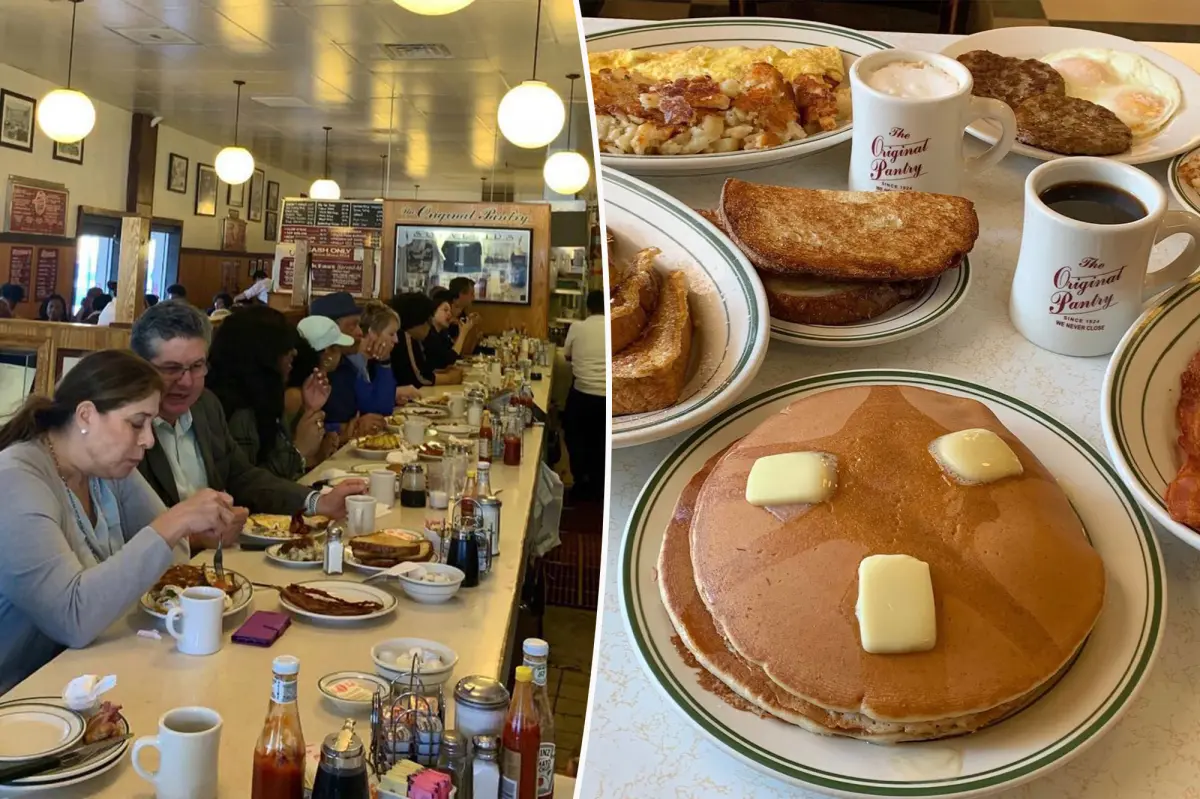
The griddles at the Original Pantry Cafe are firing back up, and in downtown Los Angeles, the sound is as close to a civic cheer as a kitchen can produce. For more than a century, this weathered 24-hour institution at 9th and Figueroa has been a strange and wonderful constant, a place where the city’s earliest risers, latest stragglers, hungriest tourists, and most exhausted shift workers could always find a booth, a cup of coffee, and a plate of something hot and reliable. It was open every day of the year, through holidays and heat waves, through civic triumphs and personal heartbreaks, and it became the kind of place that felt less like a restaurant than a public utility. Then, in early 2025, the unthinkable happened: the Pantry closed. The abrupt shutdown left a hole in the neighborhood and in the hearts of generations of regulars who had grown up believing the diner would outlive them all. Now, after what will be a nearly 20-month stretch of darkness, the old landmark is set to flip its lights back on Nov. 19. Real estate mogul Leo Pustilnikov holds the keys to a property that famously never needed them, and he is promising more than just a nostalgic reopening. There will be giant pancakes, veteran staff members, and the same unpretentious energy that made the place beloved. But there will also be a new purpose: every meal served will help fund Hope the Mission, a nonprofit working with Los Angeles’ enormous homeless population. For a city battered by restaurant closures, economic anxiety, and constant bad news about downtown’s future, the Pantry’s resurrection is a rare helping of good news — and a reminder that some landmarks refuse to stay down.
To understand why the news hit so hard, you have to understand what the Pantry was before it became a symbol of loss. It wasn’t slick or trendy, and it never tried to be. It was a no-frills diner with a long counter, worn booths, plates piled high with pancakes and eggs, and coffee that refilled itself in the imagination of anyone who ever sat there. For decades, it operated 24 hours a day, seven days a week, every day of the year, serving everyone from night owls and downtown office workers to tourists and politicians. It had no reservations, no velvet rope, no need for pretense. The Pantry was the rare place where a city council member and a construction worker could sit a few stools apart and exist in the same democratic glow. Its previous owner, former Los Angeles Mayor Richard Riordan, loved the place so much that he became its steward, and when he died in 2023, it felt like the end of an era even before the doors closed. His family trust eventually put the property on the market, and the chain of events that followed led to the restaurant’s sudden shutdown. What made the closure so jarring was not just the timing but the absence of any dramatic catastrophe. There was no fire, no health scandal, no collapse of the building. Instead, there was a bitter labor dispute with Unite Here Local 11, the union representing many of the restaurant’s workers, and a sense that somehow a deal couldn’t be reached before time ran out. The Pantry, famously open around the clock, went dark, and the corner of 9th and Figueroa became one more empty storefront in a city that already had too many of them.
Now comes the improbable comeback, orchestrated by Pustilnikov, who has made no secret of his belief that downtown Los Angeles still has a story worth telling. Rather than simply reopening the restaurant as a traditional, profit-driven business, he has turned it into a social enterprise with a direct line to one of the city’s most urgent crises. The Pantry’s new mission is baked into its business model: every meal served will help fund Hope the Mission, a well-known nonprofit that works with the estimated 75,000 Angelenos experiencing homelessness on any given night. The organization provides food, shelter, care, and a path forward, and the restaurant’s website frames the simple act of buying breakfast as a way to help someone else survive the day. “When you pay for your meal here, you’re also paying it forward,” the Pantry’s website reads. “Somebody else’s meal, somewhere down the line.” It is a small but profound shift for a restaurant whose old motto might as well have been “keep the coffee coming” and is now closer to “keep the kindness going.” The plan also includes job training and employment opportunities for people trying to get back on their feet, which means the Pantry won’t just feed the community; it will also be staffed, in part, by people who have known struggle firsthand. That makes the old greasy spoon something it has never been before: a place where the line between customer and neighbor, server and survivor, is deliberately blurred, and where a plate of eggs can mean more than breakfast.
For longtime Pantry devotees, though, the most emotional part of the resurrection is not the mission statement; it’s the faces. Pustilnikov says he was able to hammer out a deal with Unite Here Local 11 to welcome back many of the diner’s veteran staff members, and that resolution feels especially significant given the bitterness of the dispute that helped shutter the restaurant in the first place. The waitresses who remembered orders without writing them down, the cooks who worked through the breakfast rush with the precision of a jazz band, the busboys who moved through a crowded room with quiet grace — these were the people who made the Pantry feel less like a business and more like a neighborhood. Their return is a promise that the restaurant’s soul has not been lost in the transaction. After months of uncertainty and heartbreak, the idea of walking through the door and seeing a familiar face is enough to make even the most cynical Angeleno emotional. It also sends a message about dignity and continuity: the people who built the Pantry’s reputation are being treated as essential to its future, not disposable parts of its past. Pustilnikov has spoken about the Pantry as a mirror of Los Angeles itself, with all its ups and downs and stubborn refusal to disappear. “I feel like The Pantry is sort of the story of LA,” he said. “It’s had its ups and downs and, hopefully, much like LA and much like downtown, the reopening will boost the rebirth of downtown.” That kind of sentiment can sound like developer speak, but in this case, it is grounded in something real: a beloved institution coming back to life, with the same people standing behind the counter, ready to serve.
The Pantry’s return comes at a moment when the Los Angeles restaurant scene genuinely needs a win. Just this month, the city lost Sycamore Kitchen, a 15-year-old breakfast favorite on La Brea that had built a devoted following, and Sora Craft Kitchen, a Fashion District destination that had earned significant national acclaim before closing its doors. The reasons are familiar and painful: soaring operational costs, dwindling foot traffic, shrinking margins, and a dining public whose habits have been permanently reshaped by years of instability and uncertainty. Beloved neighborhood institutions are dropping like flies, and the losses are not just economic. Each shuttered restaurant takes with it a set of rituals and relationships, a place where first dates happened, where families marked milestones, where strangers became regulars and regulars became friends. The Pantry itself is a potent symbol of that precariousness, and its ability to return — not just as a ghost of its former self, but as a real functioning restaurant with a social mission — feels almost defiant. It is also a pointed reminder that downtown Los Angeles, recently ranked as one of the worst, least-attractive downtowns in the world, is not quite ready to give up. If the city’s core is going to revive, it will need more than office towers and luxury apartments. It will need places where people can gather around a table, look each other in the eye, and feel like they belong to something bigger than their own daily grind. The Pantry, with its worn counters and towering stacks of pancakes, has always provided that. The difference now is that it will also provide help to people who have nowhere else to turn.
And the Pantry is not the only old soul making a comeback. Cole’s French Dip, another downtown legend that claims to have invented the French dip sandwich, served its last meal in March after 118 years in business and is now poised to possibly reopen as soon as November under new ownership and with a revamped menu. For a neighborhood that has been down on its luck, the prospect of two historic institutions returning in the same season is something close to a double portion of positivity. It suggests that even in a city that often seems to prefer the new and shiny over the old and worn, there is still a hunger for continuity, memory, and the kind of authenticity that cannot be manufactured. The Original Pantry Cafe may no longer be the exact same diner that never closed, but it is close enough — and it is carrying a heavier purpose than it ever has before. For anyone who has ever sat in one of its booths at 2 a.m., or worried that they would never get to do so again, the reopening is more than a news item. It is an invitation to come back, to sit down, to order something hot and familiar, and to remember that in Los Angeles, even the most stubborn ghosts can find their way home. The griddles are firing back up. The coffee is on. The old diner that once never closed is finally ready to open its doors again — and this time, it will be feeding more than just its customers.