



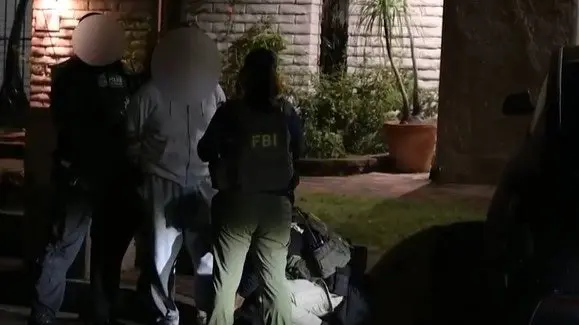
The sun had not yet risen over Southern California when federal agents moved in, fanning out across neighborhoods in predawn raids that would dismantle a web of alleged medical fraud stretching from Los Angeles rehab centers to operating rooms and even hospice beds. By the time the morning was over, 15 people—including six licensed medical professionals—were facing charges tied to a staggering $1.8 billion in fraudulent health insurance claims, a figure that represents not just lost money, but countless vulnerable patients exploited at their most fragile moments. The Justice Department described the schemes in blunt terms: one was the largest sober home fraud ever prosecuted by the department, another involved invasive surgeries performed on people who did not need them, and still others exploited the deeply personal, end-of-life and recovery experiences of patients. These were not victimless crimes hidden in fine print; they were alleged betrayals of trust by doctors, chiropractors, and rehab operators who took oaths to help people, then methodically drained government and private insurers while causing real harm along the way.
Among those charged was Dr. Harold Tabaie, a 78-year-old cardiothoracic surgeon from Anaheim, and his business partner, Hany Malek, a Tarzana chiropractor. Together, they were accused of orchestrating a $135 million scheme involving atherectomies, invasive procedures in which a bladed catheter is used to clear plaque from arteries. Prosecutors alleged that Malek, though not a medical doctor, posed as a physician to diagnose patients with arterial disease that they did not actually have, then referred them to Tabaie for surgeries. Tabaie allegedly went on to perform the operations, sometimes repeatedly on the same patients even when earlier procedures had already failed. Rather than restoring health, these unnecessary surgeries caused extreme pain and suffering, leaving patients worse off physically and emotionally. The greed did not stop in the operating room; Malek was also charged with filing fraudulent Paycheck Protection Program loan applications in 2021, inventing a 25 percent revenue loss to obtain funds that he then diverted to personal expenses, family credit cards, other business ventures, and even rare coins. The case paints a picture of medical care transformed into a profit-driven assembly line, where patients became dollar signs and the scalpel was wielded for financial gain rather than healing.
In a separate but even larger case, Nathan Young, 39, and his father David Young, 71, were charged with running a $1.6 billion substance abuse scam that preyed on people battling addiction. The younger and older Young allegedly trafficked drug addicts from across the country to dozens of Los Angeles rehab facilities, using what prosecutors call “body brokers”—Honey Phipps, 42, and Cody Phipps, 36, both from Greenville, Texas—to recruit insured individuals in exchange for kickbacks. This illegal practice, known as body brokerage, treats suffering people as commodities. Once patients arrived at these facilities, the promised treatment never materialized. Instead, the Youngs allegedly cycled patients through their programs to continuously bill insurance companies, and when patients tried to leave, staff were reportedly instructed to sedate them with drugs to keep them unconscious and compliant. The indictment alleges a chilling pattern of control: patients were offered drugs to stay, cut off from communication with family, denied access to their own belongings, and physically blocked from walking out the door. In one telling moment, when Nathan Young was told that a patient wanted to leave detox to smoke marijuana, he allegedly ordered that the patient be given what he wanted off-site from the detox unit—anything to keep the person there and the billing running. This was not treatment; it was captivity disguised as compassion, with addiction used as a lever to extract insurance dollars.
The raids also swept up schemes that preyed on the terminally ill and the elderly. Federal authorities charged defendants with stealing more than $140 million by falsely certifying patients who were not terminally ill for hospice care, a cruel distortion of a service meant to provide comfort and dignity in final days. Instead of easing the end of life, these fraudulent operators allegedly treated hospice certification as a billing code, enrolling people who did not qualify and collecting payments intended for genuine end-of-life care. Another defendant, Christina Mareik, 61, of Whittier, was charged with submitting thousands of bogus prescriptions for high-reimbursement generic drugs to Medi-Cal, California’s Medicaid program. Prescription drug coverage exists so that people can get the medicine they need; in her alleged scheme, it became a way to manufacture claims for drugs that were never legitimately prescribed. These schemes share a common thread: they exploit the most vulnerable and the most sacred moments of life, from the struggle to overcome addiction to the final days of illness, and turn them into opportunities for theft. The human toll is immeasurable, as families trusted caregivers and doctors only to discover that the care was a façade and the diagnoses were lies.
Additional charges against Dr. Hassan Badday, 48, of Los Angeles, and Dr. Robby Ayoub, 52, of Huntington Beach, highlight how far some medical professionals were willing to go for kickbacks. They were accused of accepting illegal payments from a Houston laboratory marketer in exchange for ordering unnecessary Medicare genetic tests. These tests may seem harmless compared to surgery or forced sedation, but they represent a different form of exploitation—using patients as billing vehicles for tests that were not medically justified, all while insurers footed the bill. The Justice Department emphasized that this case was detected through data analytics, a reminder that fraudsters are no longer operating in the shadows. Assistant Attorney General Colin McDonald of the Justice Department’s National Fraud Enforcement Division delivered a clear warning: “Our message is simple: if you steal health care dollars from the American taxpayer or abuse your position to harm patients, we are coming for you—and the data will lead us to you.” The phrase “abuse your position” is key, because so many of the defendants were not strangers in white coats; they were trusted professionals who leveraged their credentials to gain access to patients, then violated that trust in the most cynical ways imaginable.
At its core, this massive takedown is about more than the eye-popping dollar figures or the legal statutes that were broken. It is about the erosion of trust in a healthcare system that Americans depend on when they are sick, scared, addicted, or dying. The Justice Department’s press release noted that these charges include the largest sober home fraud scheme ever prosecuted, and the use of data analytics to uncover unnecessary invasive procedures is a hopeful sign that oversight is becoming more sophisticated. But the stories behind the charges are heartbreaking: patients who sought relief from addiction and instead were drugged and imprisoned; elderly people falsely told they were dying so insurers would pay; people who underwent surgeries they never needed and suffered lasting pain because a surgeon saw a billing opportunity. First Assistant United States Attorney Bill Essayli captured the moral outrage well: “It is especially egregious when doctors and other health care professionals, who pledged to do no harm, resort to petty greed and criminality. Every dollar drained out of our private and public health insurance systems is one less dollar available to those who truly need it.” As the legal process unfolds, the hope is that the defendants are held accountable, but the deeper lesson is for the rest of us: healthcare must never be treated as a playground for fraudsters, and protecting patients requires constant vigilance, data-driven detection, and a refusal to look away when the system is abused. These raids were a wake-up call, but the work of healing the damage, both financial and human, has only just begun.