


France Imposes Gathering Bans in Multiple Cities as Macron Moves to Prevent Repeat of Weekend Riots
French authorities have moved swiftly to ban public gatherings in several cities, a decision announced Thursday that extends into the coming days as President Emmanuel Macron seeks to head off further violence following last weekend’s devastating riots.
The preemptive measure, confirmed by the Élysée Palace, reflects a government on high alert as France reels from some of the worst civil unrest the nation has witnessed in recent memory. With tensions still simmering across the country, the administration is betting that a firm show of force and a tightening of public assembly rules will serve as a deterrent—though critics warn the move carries significant political and civil liberty risks of its own. The announcement marks a dramatic escalation in the government’s response to a crisis that has already shaken the foundations of Macron’s second term, turning French streets into a battleground of pent-up rage, economic frustration, and deep-seated anger at the country’s political establishment.
A Nation on Edge: The Fallout from Last Weekend’s Violence
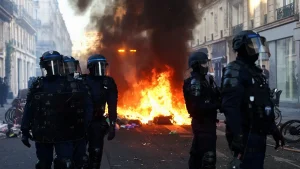
The decision to impose the bans comes in the immediate aftermath of riots that turned major urban centers into scenes of chaos, with burned vehicles, shattered storefronts, and running battles between demonstrators and security forces dominating headlines for three consecutive nights. Videos shared across social media painted a grim picture: plumes of black smoke rising over city skylines, lines of riot police advancing through tear gas, and looters hauling merchandise from ransacked shops. The violence, which erupted during what began as a series of protests over economic inequality and an increasingly unaffordable cost of living, quickly spiraled beyond the organizers’ control, evolving into a broader explosion of anger that caught both local authorities and the national government off guard.
Damage assessments from that weekend have been staggering. Preliminary reports from insurance companies and municipal governments estimate losses in the hundreds of millions of euros, with public buildings, schools, and transportation infrastructure suffering significant harm. In one particularly alarming incident, a police station came under direct assault, forcing officers to barricade themselves inside as projectiles rained down from surrounding streets. Hospitals across several regions reported treating dozens of injured civilians and security personnel, while firefighters struggled to contain blazes that seemed to erupt simultaneously in different parts of the affected cities.
Macron, who had remained largely silent during the initial hours of the rioting, broke that silence in a televised address that sought to project both resolve and restraint. The president framed the unrest not as a legitimate expression of political dissent but as an “unacceptable assault on the Republic’s values,” promising that those responsible would face the full weight of the judicial system. Yet even as he condemned the violence, the president acknowledged the underlying grievances that had driven so many onto the streets—high energy prices, stagnant wages, and a pervasive sense among middle- and working-class citizens that the political class in Paris has lost touch with their daily struggles. It was a delicate balancing act, and Thursday’s gathering bans represent the most concrete manifestation of his strategy: a determination to restore order while simultaneously attempting to address the root causes of a crisis that threatens to define the remainder of his presidency.
A Delicate Balance of Order and Liberty: The Mechanics of the Ban
In practical terms, the new restrictions prohibit demonstrations, protest marches, and any form of organized public assembly in designated zones across several of France’s largest metropolitan areas. While officials stopped short of imposing a full national state of emergency, the scope of the bans is substantial, affecting not only Paris but also regional capitals where the weekend’s violence was particularly intense. Municipal authorities in Lyon, Marseille, Bordeaux, Toulouse, and Strasbourg have all confirmed they will enforce the restrictions, with local police given explicit instructions to disperse any unauthorized gatherings quickly and decisively. The ban is scheduled to remain in effect through the weekend and into early next week, a critical window during which authorities fear a resurgence of violence if given the opportunity.
The legal framework underpinning the bans draws on existing French legislation that permits preemptive restrictions on assembly when there exists a “serious threat to public order.” However, the breadth and speed of Thursday’s announcement—coming just three days after the riots subsided—have raised eyebrows among legal scholars and human rights advocates who question whether such sweeping measures can be justified under the constitution’s guarantee of free assembly. Interior Ministry officials, speaking on condition of anonymity, defended the decision as a proportionate response to an extraordinary situation, noting that intelligence services had intercepted communications indicating plans for further unrest. They pointed to social media chatter and encrypted messaging groups where organizers were actively discussing the logistics of new protests, including the transportation of weapons and the identification of vulnerable government buildings as potential targets.
The operational deployment backing the ban has been massive. Thousands of additional national police and gendarmerie units have been redeployed from rural areas into the affected urban centers, joining local forces in what authorities describe as a “visible and overwhelming” show of presence. Armored vehicles, previously reserved for counterterrorism operations, have been spotted stationed at key intersections and public squares in several cities. In Paris specifically, the prestigious Place de la République and the Champs-Élysées—both sites of intense clashes during the weekend’s riots—have been designated as no-go zones for demonstrators, with checkpoints established at all major access routes. Officers conducting spot searches along the city’s outer ring roads have been authorized to confiscate any items that could be used as improvised weapons, from gardening tools to fireworks. The message from the government is unmistakable: the streets are not open for business as usual this weekend, and any attempt to gather for protest purposes will be met with immediate, forceful action.
Macron’s Calculus: Political Survival and the Weight of Expectation
For Macron, the stakes could not be higher. The president, who swept to power in 2017 on promises of reform and renewal, now finds himself presiding over a nation teetering between anger and instability, his approval ratings having plummeted to their lowest levels since taking office. The weekend’s riots exposed not only the depth of social division within France but also the limits of a governance style that opponents have long criticized as aloof, top-down, and insufficiently attentive to the concerns of ordinary citizens. By moving decisively to ban gatherings, Macron is signaling that he understands the immediate imperative of restoring public safety—that he is willing to take politically uncomfortable actions if they serve the broader goal of national stability.
His public comments on Thursday elaborated on this theme, casting the restrictions as both a necessity and a responsibility. “We have seen what happens when violence is allowed to take root,” Macron said in remarks delivered at the start of an emergency cabinet meeting. “We cannot allow a repeat of last weekend. The Republic must protect its citizens, and that means taking tough decisions even when they are not popular.” The president’s tone was noticeably firmer than in his earlier address, and observers detected a clear attempt to position himself as a decisive leader in a moment of national crisis—a sharp contrast with his perceived hesitation during the early stages of the unrest.
Political analysts note that Macron’s approach is being shaped by electoral calculations as much as by concerns for public safety. With European Parliament elections looming and his party facing the very real possibility of losses to both the far-right and the far-left, the president cannot afford to appear weak on law and order. The bans serve a dual purpose: they tighten security in the short term, and they project an image of executive strength to voters who increasingly rank public safety among their top concerns. Yet there is an inherent risk in this strategy. By elevating the visibility of the protests—even while prohibiting them—Macron risks fanning the flames of resentment among those who feel their legitimate grievances are being suppressed. The challenge he faces is navigating a path between overreaction, which could provoke further outrage, and underreaction, which would be read as weakness. Thursday’s announcement suggests he has chosen the former, betting that a show of overwhelming force will ultimately discourage the most violent elements from attempting another round of destruction.
Mixed Reactions and Civil Liberties Concerns
The bans have been met with a predictably mixed response, exposing yet another fault line in an already deeply fractured political landscape. On one side, business owners and residents of the affected cities have largely welcomed the government’s action, expressing relief that authorities are acting to prevent another weekend of destruction. Local chambers of commerce, still reeling from the economic toll of the riots, issued statements supporting the restrictions, noting that many small businesses were already struggling to survive and that another wave of violence could prove catastrophic. Tourism industry representatives, similarly, welcomed the move as a necessary step to protect France’s international reputation as a safe and welcoming destination.
On the other side, opposition politicians, civil liberties organizations, and protest organizers have condemned the decision as an authoritarian overreach that punishes all citizens for the actions of a violent minority. In an unusually united stance, leaders from across the political spectrum—from the far-left’s Jean-Luc Mélenchon to the far-right’s Marine Le Pen—criticized the bans either as a failure of governance or as an infringement on fundamental rights. “You cannot solve the problems of the street by banning the street,” one prominent opposition figure said during an impromptu news conference, voicing a sentiment shared by many who see the restrictions as an admission of the government’s inability to address the underlying causes of unrest. Human rights organizations have threatened legal challenges, arguing that the blanket nature of the bans violates constitutional protections and European Union standards on freedom of assembly.
Social media has become a battleground in its own right, with hashtags both supporting and condemning the restrictions trending on French Twitter throughout the day. Pro-government accounts have emphasized the importance of public safety and the rule of law, sharing footage of damaged properties and injured police officers as justification for the bans. Opposition voices, meanwhile, have circulated historical comparisons, drawing parallels with earlier periods of French history when governments resorted to heavy-handed measures—comparisons that have generated considerable emotional resonance among a public increasingly concerned about democratic backsliding. Some activists have already announced plans to challenge the restrictions through nonviolent disobedience, vowing to appear in public spaces with banners regardless of the legal consequences. The standoff, it appears, is far from over. Even as the bans take effect, the underlying anger that spawned the riots remains very much alive, and the weekend ahead promises to be a moment of truth for both the government and its critics.
The Road Ahead: A Test of Resilience for Republican Values
As France braces itself for the coming days, the deeper question looming over the gathering bans concerns the long-term trajectory of the nation’s social fabric. The violence of last weekend did not emerge in a vacuum; it was the product of years of accumulated frustration—over economic stagnation, over regional inequality, over a political system perceived by many as out of touch and self-serving. The bans, whatever their immediate efficacy, cannot address these structural grievances. They may prevent gatherings this weekend, but they will not erase the circumstances that drove thousands of citizens to confront the state in the first place.
French society finds itself at a crossroads, and the choices made in the coming weeks will shape its political landscape for years to come. The government’s immediate priority is security, and rightly so; no society can function amid unchecked violence. Yet the broader challenge is more profound: how to channel legitimate dissent into democratic processes rather than destructive confrontation, how to restore faith in institutions that a significant portion of the population no longer trusts, and how to bridge the widening gap between the country’s metropolitan elites and its struggling middle and working classes.
Macron’s presidency, once defined by youthful dynamism and ambitious reformist zeal, now stands as a test of resilience—not just for him personally, but for the model of governance he represents. The president has promised both firmness and listening, vowing in his Thursday remarks to “engage in dialogue with all those who are willing to respect the Republic’s laws.” Whether such an invitation can overcome the bitterness and distrust that have accumulated over years of confrontation remains an open question.
In the immediate term, all eyes will be on the weekend ahead. The bans will be tested: by hardcore rioters seeking confrontation, by peaceful protesters insisting on their rights, and by a government determined to demonstrate its control. Whatever unfolds, the images from French streets will send a powerful signal—not only to the French people but to the entire world—about the state of one of Europe’s foundational democracies. The coming days will reveal whether France can restore order without sacrificing its democratic soul, and whether the deep wounds exposed by last weekend’s riots can begin to heal. What is certain is that this moment marks a critical inflection point in the nation’s modern history. The decisions taken now, by political leaders and citizens alike, will resonate for a generation.