


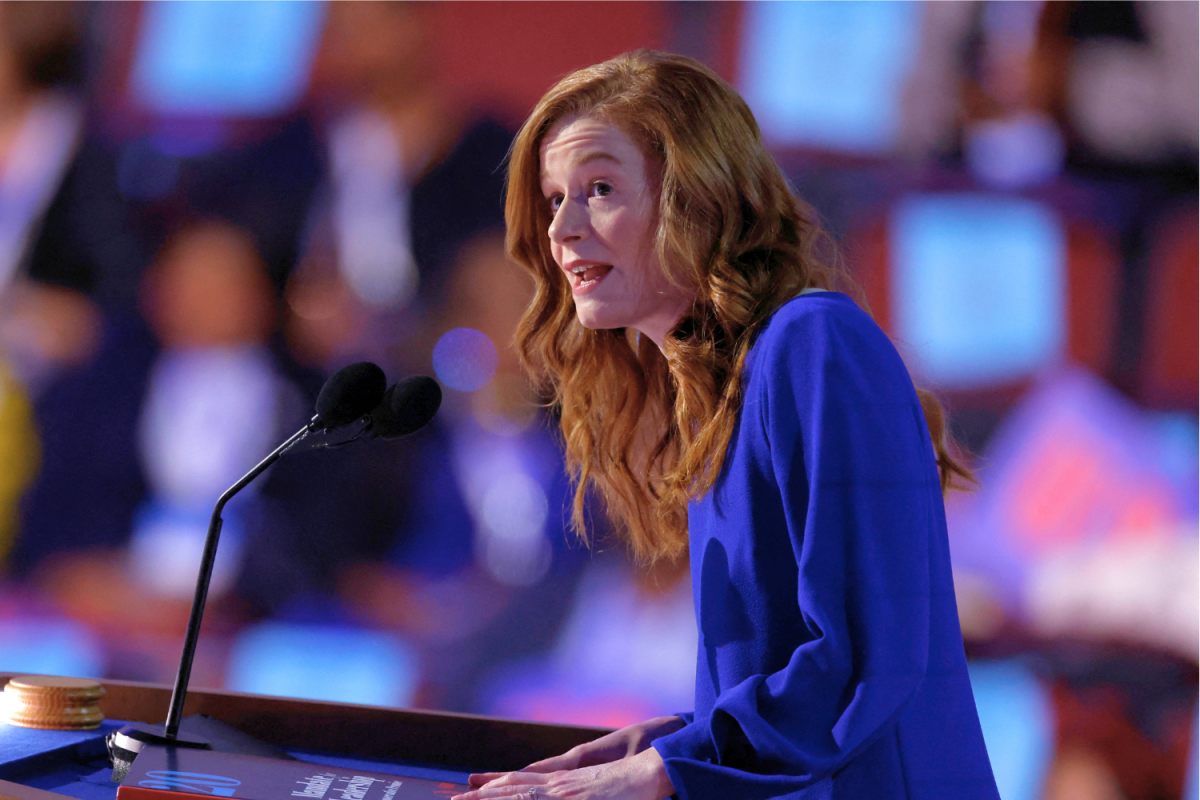
Mallory McMorrow’s Senate campaign did not end with a decisive loss at the ballot box, or with a dramatic debate moment, or even with a hard-fought concession speech. It ended, she now believes, with a lie—a quietly fabricated poll that arrived at the worst possible moment and, in her words, “killed us.” The former Michigan Democratic Senate candidate, a state senator who had entered the race for the open seat being vacated by Gary Peters, was once seen as one of the most promising rising stars in the state party. She had built her campaign on authenticity, organizing, and the kind of grassroots energy that can still topple political machines. But on June 29, a company called Wedgewood Polls released a survey that showed her in a devastating third place, with just 9 percent support in the Democratic primary, while Abdul El-Sayed stood at 46 percent and U.S. Representative Haley Stevens at 39 percent. The same poll showed her losing to Republican Mike Rogers by seven points in a hypothetical general-election matchup, while El-Sayed beat Rogers and Stevens tied him. It was a fatal blow to momentum, morale, and money. Within a week, on July 5, McMorrow suspended her campaign. Her name remained on the ballot, and El-Sayed would go on to win the primary, but the dream many volunteers had poured their hearts into was already over. It later emerged that Wedgewood had made up the data, and the organization admitted the poll was part of a fake “experimental project” designed to expose weaknesses in the polling industry. For McMorrow, the point was cold comfort. “Sure, a point was proven,” she wrote on X. “Polling is broken. But tens of thousands of people poured their hearts, time, energy, hard-earned money into something they believed in – for a year-and-a-half, and it was treated like a game.”
To understand how much damage one invented survey could do, you have to remember the shape of the race before Wedgewood dropped its bombshell. McMorrow entered the Democratic primary as a serious contender in a crowded and consequential contest for the seat Gary Peters had held. She had a compelling story, a substantive policy agenda, and an early polling surge: in April, Emerson College Polling found her tied with El-Sayed at 24 percent, with Stevens at just 13 percent. The race was wide open, and McMorrow looked like a candidate with real momentum. But the Wedgewood survey, released just about a month before the August 4 primary, depicted something entirely different. It claimed to have surveyed 602 likely general-election voters from June 25 to 28, including an oversample of 353 likely Democratic primary voters, and it listed a margin of error of ±5.7 percentage points for the primary sample. The numbers were specific, dramatic, and instantly usable by opponents and journalists: McMorrow at 9 percent, trailing badly; El-Sayed dominant; Stevens close behind. In the general election matchup, the poll showed El-Sayed beating Rogers 49 to 44, Stevens tying him at 46, and McMorrow losing 48 to 41. The narrative was devastating because it combined two ideas at once: McMorrow wasn’t just losing the primary, she was also the weakest possible nominee against Mike Rogers. It painted her as a spoiler, a lost cause, or someone who should step aside for the good of the party. For a candidate whose entire appeal rested on authenticity and connection with everyday voters, that image was poison.
McMorrow suspended her campaign on July 5, less than a week after the fabricated poll appeared, and about a month before the August 4 primary. Her name stayed on the ballot, but her candidacy was effectively over. El-Sayed eventually won the Democratic nomination, and McMorrow, to her credit, urged Democrats to unite behind him, endorsing the man who had supposedly been leading her by 37 points in that fake survey. Then, on October 20, the other shoe dropped. Wedgewood Polls admitted that the vast majority of the polling it had released was not supported by genuine survey data. The organization called itself an “experimental project” designed to demonstrate weaknesses in the polling industry—a kind of intellectual prank with a purpose. Detection came after researchers Mary Radcliffe, G. Elliott Morris, and Cooper Burton investigated a later Wedgewood poll and found serious irregularities in the supposedly raw Pollfish data, including respondent and transaction IDs that clearly did not behave the way real data from the platform should. Confronted with their findings, Wedgewood confessed. By then, however, the damage had already rippled far beyond McMorrow’s campaign. Wedgewood polls had been picked up by major polling databases and repeated by multiple media outlets, including Newsweek, which retracted three stories and corrected others. The story was not a niche malpractice; it had polluted the national information ecosystem. What had been intended as an experiment in showing how broken polling can be became a real-world demonstration of exactly how broken it is, with real people paying the price.
For McMorrow, the confession brought anger, grief, and a bitter kind of vindication. She described the experience in visceral terms. “Our volunteers gave their all. And then some. I felt like I had let so many of them down,” she wrote on X. “Donations dried up and reporters hounded me with calls to drop out.” Her campaign had not simply failed because of bad organization or poor messaging; it had been caught in a current of fake news that made it impossible to raise money, build trust, or generate the kind of excitement a primary challenger needs. She argued that the incident should teach politicians and voters alike not to grow complacent and not to trust polls blindly. But she also made clear that the real problem went deeper than one bad pollster. There were, to be sure, other signs that McMorrow’s run was already in trouble before Wedgewood’s intervention. The Associated Press reported that, when she suspended her campaign, a person with direct knowledge of her decision said the biggest factor was an influx of outside spending supporting Stevens—specifically millions of dollars in ads from the American Israel Public Affairs Committee, which left McMorrow and El-Sayed struggling to keep pace. In an August interview with WLNS, before the fabrication was revealed, McMorrow herself pointed to that outside spending as the decisive factor. Additionally, several legitimate polls had also placed her in single digits during June: Mitchell Research had her at 6 percent, Susquehanna at 9 percent, and Quantus Insights at 8 percent. None of those, however, had the same explosive timing, dramatic spread, and broad distribution as the Wedgewood survey. The fake poll was not the only problem, but it was the one that broke the campaign’s back.
The deeper scandal is how easy it all was. Wedgewood’s statement on X said that falsifying the poll was “far too easy” and added that “the polling industry needs reform.” McMorrow echoed that call, writing: “I hope Democrats are ready to blow up the system with campaign finance and transparency reforms.” Her words captured a strange irony: the very exercise meant to expose polling’s vulnerability had demonstrated, in the most brutal possible way, how vulnerable a real human campaign can be. A small group of people, likely motivated by intellectual mischief rather than partisan malice, rerouted the course of a Senate race with fabricated numbers. Their experiment worked exactly as they said it would—it showed that a fake poll can be distributed, amplified, repeated, and believed. But the “lesson” came at the expense of a candidate and her supporters, who had spent eighteen months building something real only to watch it collapse under the weight of a lie. McMorrow’s name remained on the ballot, and she has continued to advocate for unity and reform, but the experience stands as an unsettling testament to how easily modern politics can be manipulated. The supply chain of political information—pollsters, media outlets, databases, comment sections—is only as strong as its weakest link, and Wedgewood demonstrated that the weak link can be exploited in a matter of days. Once a fake poll enters the bloodstream, it is nearly impossible to remove; retractions are never read as widely as the original headline.
At its heart, McMorrow’s story is not just a technical critique of survey sampling or margin of error. It is a story about trust, and about the quiet, devastating cost of deception in American public life. Every campaign is built on belief: the belief that hard work matters, that voters will listen, that truth has weight. When a fabricated poll is released into the world, it does not just alter a horse-race number; it corrodes the foundation on which people make decisions. Donors wonder whether they are wasting their money. Volunteers wonder whether their evenings knocking on doors were worth anything. Voters wonder whether any candidate can actually win, so they shift their support to whoever looks safest. That is what happened to Mallory McMorrow, and no retraction, correction, or apology can fully undo the personal and political damage. As she wrote, “Trust is at an all-time low.” That phrase applies not just to polling institutions, but to the entire democratic project. The people who gave McMorrow their time and money did nothing wrong; they were betrayed by a shadowy operation playing with real lives for the sake of an academic point. In the end, the fake poll served as a painful reminder that democracy depends on a shared commitment to honesty—and that without it, cynicism wins. McMorrow may have lost her bid for the Senate, but her warning remains: don’t get complacent, don’t trust the polls, and demand a system that treats voters and volunteers as people rather than props in an experiment. That is the real lesson of Wedgewood, and it is one every American, regardless of party, has a stake in remembering.