


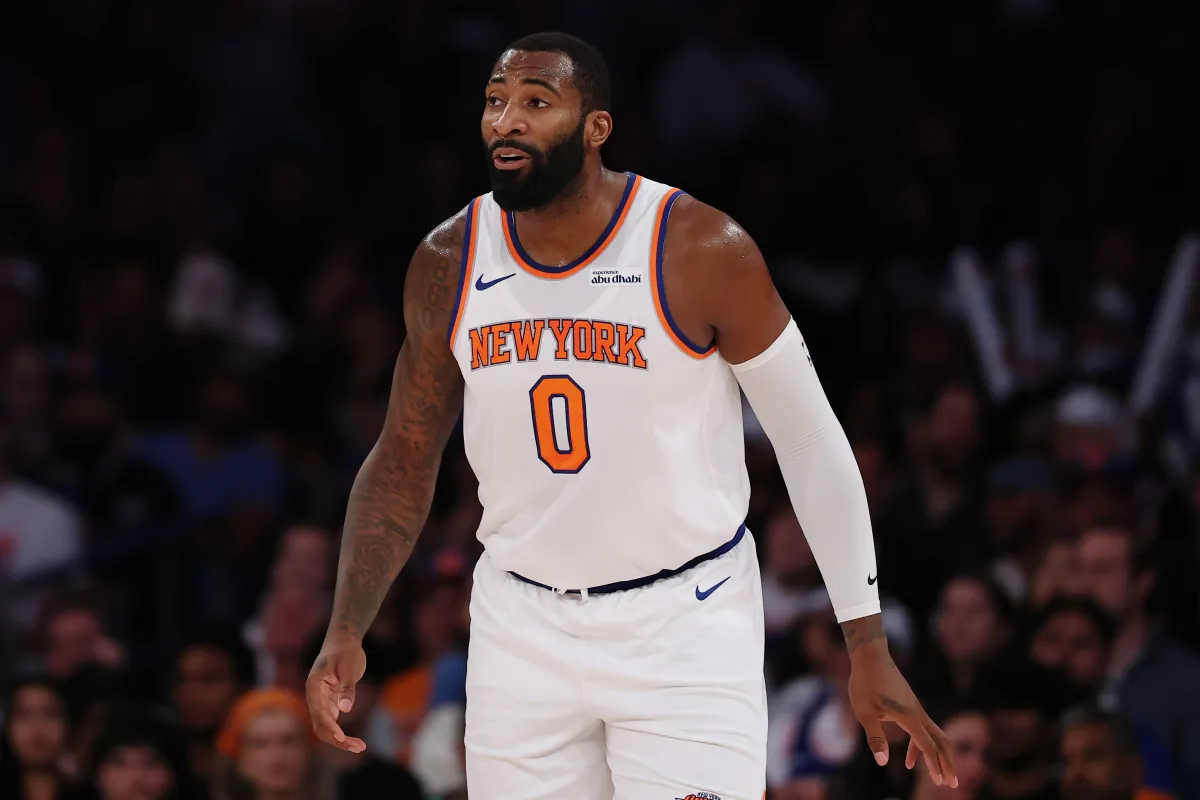
Let’s be honest: Knicks fans walked into this season opener with a knot in their stomachs. The team had just watched Mitchell Robinson walk out the door in free agency, off to Boston, and the center position suddenly felt like a giant question mark. How do you replace a player who did all the dirty work around the rim? How do you keep the frontcourt from falling apart when the game gets physical? Those were the questions hanging over Madison Square Garden as the Knicks tipped off against Philadelphia. Then Andre Drummond happened. The veteran center didn’t just show up; he made a statement in the first half that left everyone in the building doing a double take. Before the second quarter was even halfway over, he had already piled up a double-double. The Knicks’ official public relations account was quick to point out just how rare that was: it was the third-fastest double-double by any Knicks player in the first half since the play-by-play era began in 1996-97, and he became the first and only player in franchise history to record a first-half double-double in a season opener in that same span. That isn’t just a nice stat. That’s a loud, early message from a player the Knicks brought in specifically to help ease the pain of Robinson’s departure.
It’s worth remembering just how much Robinson meant to this team. He was never the flashiest player on the floor, but he was the engine that made so much of New York’s play work. He crashed the boards with relentless energy, turned second-chance opportunities into easy points, and protected the paint with the kind of physicality that makes opposing drivers think twice. When the Knicks made their championship run, Robinson’s presence around the basket was a huge reason why the team could afford to play small and spread the floor. Losing that kind of player would hurt any franchise, and the front office knew that no single replacement could simply copy what he did. But Drummond’s first game in a Knicks uniform offered a hopeful answer: maybe the drop-off won’t be as steep as everyone feared. He gave the Knicks an early reason to feel better about life after Robinson, not by pretending to be someone he isn’t, but by doing exactly what he has always done best—dominating the glass and making his presence felt around the rim.
The numbers from his first half were eye-opening. At the time the milestone was announced, Drummond had 10 points, 12 rebounds, three assists, one steal, and two blocks in just 18 minutes of action. Those weren’t empty stats, either. Every rebound seemed to come at a crucial moment, every block set the tone for a defense that needed to prove it could still be imposing without Robinson. There was a physicality to his play that immediately connected with the crowd. He wasn’t just filling a spot; he was making the type of impact that changes a game’s momentum. For a player who signed a one-year, $3.9 million contract, this kind of production is exactly what the Knicks needed from a veteran backup. He’s not expected to replicate every facet of Robinson’s game—especially not the long-limbed shot-blocking that gives opponents nightmares—but his rebounding ability and his knack for finishing around the basket provide a steady floor for the frontcourt. If he can keep playing anywhere close to that level, New York’s center rotation suddenly looks a lot more stable than it did a few hours earlier.
What makes Drummond’s performance so compelling is the human story behind it. He’s 33 years old now, a veteran of many battles, and he arrived in New York after spending last season with the Philadelphia 76ers. In 63 games with Philadelphia, including 25 starts, he averaged 6.4 points and 8.4 rebounds per game. Those are modest numbers for a player who was once one of the most dominant rebounders in the league. But Drummond has always understood his role, and he seems to have found a perfect fit with the Knicks. There’s something admirable about a player who is willing to embrace a supporting part, who doesn’t sulk about coming off the bench or about being asked to do the unglamorous work. He seemed genuinely excited to be playing in New York, and that enthusiasm was contagious. When the Knicks’ PR account tweeted out his historic first-half double-double, it felt like more than just a milestone. It felt like a veteran proving that he still has plenty left in the tank, and that he’s ready to pour everything into a team with serious ambitions. For Knicks fans, that kind of effort is what turns a new signing into a fan favorite.
Of course, it would be foolish to overreact to one half of basketball. The season is long, and there will be nights when Drummond’s shot isn’t falling, when the rebounds don’t bounce his way, or when he picks up early foul trouble and has to sit on the bench. The Knicks’ center rotation still has plenty of questions that won’t be answered in a single game. Can Drummond stay healthy enough to carry a meaningful workload? Can he hold up against bigger, more physical centers over the course of an 82-game season? Will the coaching staff trust him in crunch time when the playoffs roll around? None of those questions went away just because he had a historic first half. But what that half did do was provide a promising sign that the team’s front office might have gotten this right. Drummond was brought in to help replace Robinson, and on opening night, he looked like a player who could absolutely handle that responsibility. It’s a small sample size, but it’s a meaningful one, because it shows that Drummond is capable of stepping into a demanding role and making an immediate impact.
There’s a reason Knicks fans left that game feeling a little lighter. The team is trying to defend its championship, and every piece of the puzzle matters. Robinson’s departure was a tough blow, but Drummond’s historic start suggests that the gap might not be as enormous as some expected. He may not be Mitchell Robinson, and he doesn’t have to be. What he brings is his own unique blend of experience, toughness, and relentless rebounding. He gives the Knicks a reliable option in the middle, someone who can anchor the second unit and also step in when the starter needs a rest. The energy he brought to the season opener was exactly what a championship-caliber team needs from its role players. It’s still very early, and there’s a long road ahead, but for one night at least, Andre Drummond made the Knicks feel whole again. He made the loss of Robinson sting a little less, he gave the fans something to cheer about, and he reminded everyone that sometimes the most valuable additions don’t come with the biggest contracts. They come with the biggest hearts. And on this night, Drummond’s heart was impossible to miss on the court.