



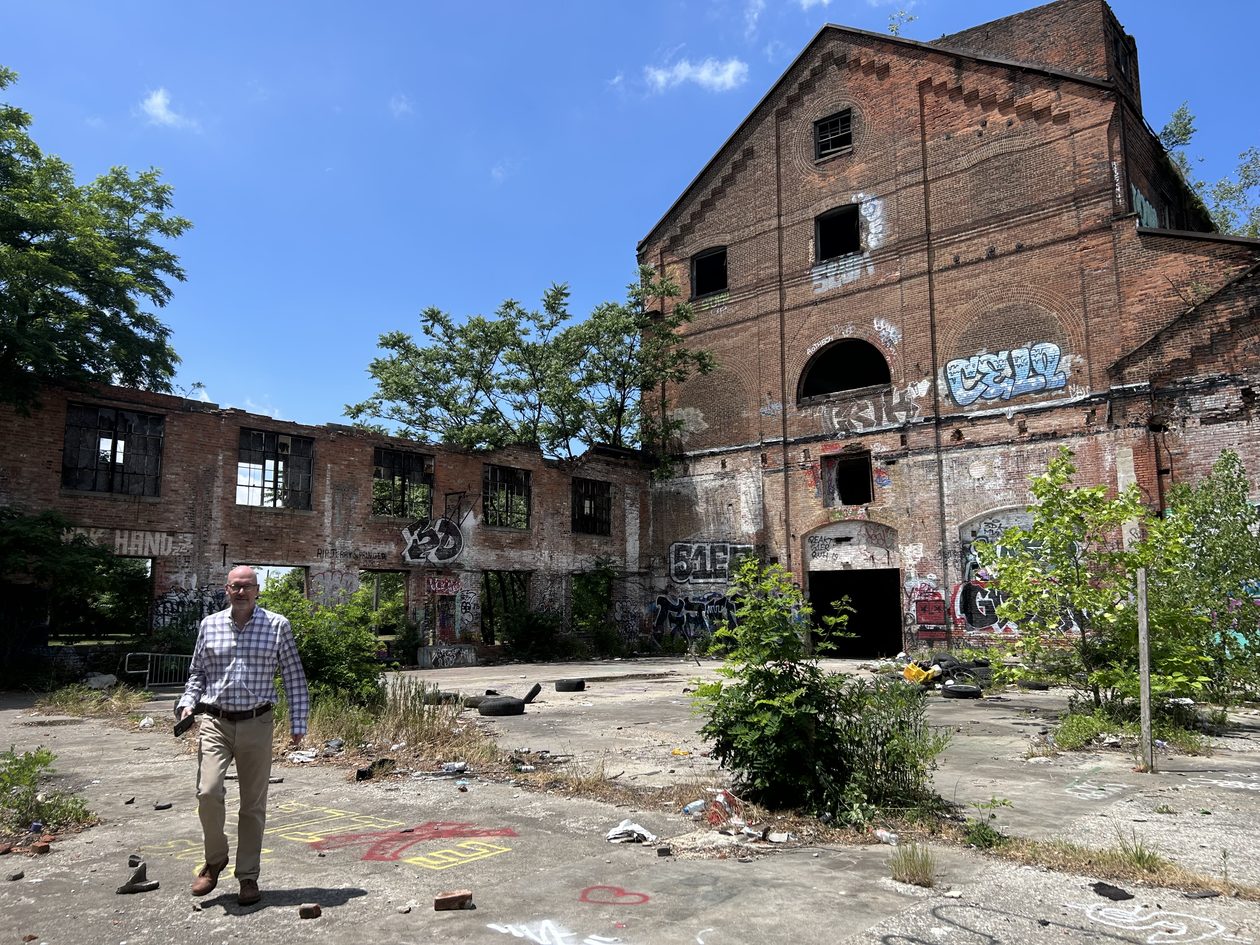
Let’s get one thing straight right away: When someone says Seattle should avoid becoming Cleveland, they aren’t insulting the Cleveland of today. They’re talking about the Cleveland of the second half of the twentieth century, a cautionary tale about what happens when a thriving city assumes its good fortune will last forever. It doesn’t. The world changes, industries shift, employers close, and before anyone fully understands what’s happening, a generation of prosperity has slipped away. That’s the warning Charles Fitzgerald brings back from a visit to an abandoned Westinghouse factory in Ohio, and it’s the message Seattle needs to hear while its economy is still strong enough to act. Today’s Cleveland is a different story. It’s hungry, united, and focused on rebuilding, and it actually has a lot to teach a successful city like Seattle. The anxiety in Seattle isn’t paranoid. City Hall, the Seattle Metropolitan Chamber of Commerce, and the newly formed Partnership for a Competitive Puget Sound are all sounding alarms about the region’s economic future. Even the independent 127-page economic report commissioned by the city, Seawall: Building a Resilient Seattle Economy, which calls the Cleveland comparison “likely hyperbolic,” admits that Seattle has serious problems. The report is honest enough to criticize the mayor’s signature policies and lay out the risks ahead. As Fitzgerald says, being called hyperbolic is far from the worst thing he’s been called. The point isn’t to doom-scroll about the future. It’s to recognize that prosperity is fragile, decline is real, and recovery can take decades. Seattle still has time to write its own next act, but only if it stops treating growth as an enemy and starts treating it as something to protect.
Look at what Seattle has accomplished in the last decade, and it’s genuinely remarkable. According to the Seawall report, Seattle delivered more broad-based prosperity than almost any other U.S. region. Wages rose across the income spectrum, with the biggest gains at the bottom. Even after adjusting for the cost of living, workers at the 25th percentile earned roughly 15% more than their counterparts in Atlanta, Charlotte, and Minneapolis. That’s a record any city would be proud of, and it makes Seattle’s current anxiety harder to dismiss. If a city like this is worried, then what hope is there for anyone else? The answer is that Seattle’s very success created expectations, and those expectations are now colliding with a changing economic landscape. The warning signs are hard to ignore. Amazon and Microsoft have cut more than 10,000 jobs across the Seattle metro area since 2023. Downtown office vacancy remains among the highest in the country. And the center of gravity for the artificial intelligence boom has shifted to the Bay Area, raising uncomfortable questions about whether Seattle can capture the next wave of technological growth. The city’s own economic report puts the challenge bluntly: “The version of the tech sector that drove the last wave of economic growth will not drive the next one.” That sentence should worry everyone who cares about the region’s future. The risk isn’t just layoffs or empty office towers. It’s the company never founded, the midsize business squeezed by rising costs, or the engineer who leaves to build a startup somewhere else. It’s the slow erosion of the things that made Seattle special, happening quietly until one day the city wakes up and realizes the magic is gone.
To understand what that looks like, you only need to study Cleveland seventy-five years ago. Back then, Cleveland was a very successful city riding decades of strong economic and population growth. It was home to some of that era’s big technology giants, and its football team, the Cleveland Browns, dominated the NFL in the 1950s. Sound familiar? It should. Seattle today has its own giants, its own swagger, and its own championship history. But Cleveland’s prosperity unraveled quickly. The world changed, the Rust Belt started to rust, and employers closed down. The city’s population dropped 59% from its 1950 peak of 914,808 to just 372,624 by 2020. It went from one of the nation’s richest cities to one of its poorest. And as Seahawks fans might notice, the Browns have never been to the Super Bowl. That’s not a joke at Cleveland’s expense; it’s a symbol of how far a once-dominant institution can fall. When Fitzgerald and his colleagues visited Cleveland earlier this year, they asked everyone from the mayor to real estate developers to arts leaders what they wished they had done differently. They heard a common theme: prosperity isn’t permanent, and once an economy spirals downward, rebuilding is far harder than maintaining what you already have. Cleveland today is a city with real momentum and a clear sense of purpose, but it also carries the scars of a decline that took generations to reverse. Seattle would be wise to listen.
At its simplest, a city’s job is to attract people and give them reasons to stay. Population isn’t a perfect measure of prosperity, but it’s a useful proxy for a city’s appeal. People come for opportunity, and they stay when the opportunities and quality of life are worth it. Growth brings challenges, especially when it’s poorly managed, but the alternative is worse. Cleveland Mayor Justin Bibb put it perfectly: “I envy problems around growth.” Seattle’s population has grown nearly 40% since 2000, but that growth is now slowing as the economic engine sputters. The Boeing Bust of the 1970s, when Seattle’s population fell 7% and unemployment hit 17%, is a reminder that what goes up can come down. Today, cities compete globally for talent, entrepreneurs, and employers, and that competition is only going to intensify as populations age and immigration restrictions tighten. The most talented workers and entrepreneurs can go wherever they see the greatest opportunity, and they tend to go where they feel wanted. Consider what Seattle’s last century might have looked like without three people: Bill Boeing, Bill Gates, and Jeff Bezos. Boeing turned Seattle into an aerospace powerhouse. Gates chose to move Microsoft from Albuquerque to the Seattle area, ushering in the software boom. Bezos and his then-wife, MacKenzie, famously drove their Chevy Blazer from Texas to Seattle to start Amazon. Each one shaped the region’s economic future in ways no one could have predicted at the time. Seattle can’t predict who the next generation of business builders will be, but it can ask whether it has the same pull today. Are the people the region needs choosing Austin, Miami, San Francisco, or somewhere else instead? Are the people already here staying, or are they quietly making plans to leave?
That question matters because Seattle is at risk of losing people and businesses that won’t be easy to replace. Talented workers, entrepreneurs, executives, inventors, technologists, engineering teams, and global headquarters are not interchangeable. As Seattle’s mayor waves goodbye to departing business leaders, the city’s own Seawall report offers a blunt warning: “Headquarters and top-tier tech jobs are very hard to replace.” The report also makes a broader case for growth that gets lost in the noise of progressive politics: losing tech jobs and companies won’t make Seattle more equitable. The report puts it starkly: “If they leave, Seattle won’t become more equal, it will just become poorer.” There’s a practical reason for that. Seattle’s fiscal model depends on a growing economy. More residents and businesses generate property and sales tax revenue without requiring higher tax rates on those already here. As the report says, “it is easier to distribute the benefits of a growing pie than a fixed one.” That’s another way of saying that when government spending outpaces population growth, a stagnant economy leaves fewer options for paying the bills. It’s also a reminder that the politics of resentment and zero-sum thinking are dangerous. The city needs to keep its headquarters, keep its tech jobs, and keep its entrepreneurs, not because they are more important than anyone else, but because they fund the schools, the roads, the services, and the safety nets that everyone depends on. And it needs to make sure the fundamentals are right: public safety, housing costs, homelessness, schools, government services, and taxes. Do the positives still outweigh the negatives? For many residents, that math is getting tighter every year.
The lesson from Cleveland is not that Seattle is doomed. It’s that prosperity is fragile, decline is real, and recovery can take generations. Seattle rode the software boom to remarkable wealth, and now it faces the challenge of doing it again in the age of artificial intelligence. That won’t happen by accident. It will require honest conversations, difficult policy choices, and a willingness to admit that growth is not the enemy but the foundation of everything else. Thanks to Cleveland for reminding us all of that. The city that once lost nearly sixty percent of its population is now hungry, united, and focused on building prosperity for its residents, and it has become a model of resilience. Seattle’s next era of prosperity is ours to build, or squander. The city can cling to the comforts of the past and hope the next wave of innovation lands on its doorstep, or it can make itself the kind of place where the next Bill, Jeff, or Bezos wants to put down roots. It can treat change as a threat, or it can embrace the uncomfortable work of adapting to a new economic landscape. The choice is not abstract. It will be made in the coming years by the leaders Seattle elects, the entrepreneurs it welcomes, the businesses it keeps, and the people it convinces to stay. Cleveland lost decades because it thought its success was permanent. Seattle still has the chance to prove that a city can learn from another’s mistakes, and that the next act can be even better than the last one. But the time to start is now, before the warning signs turn into a painful reality.