

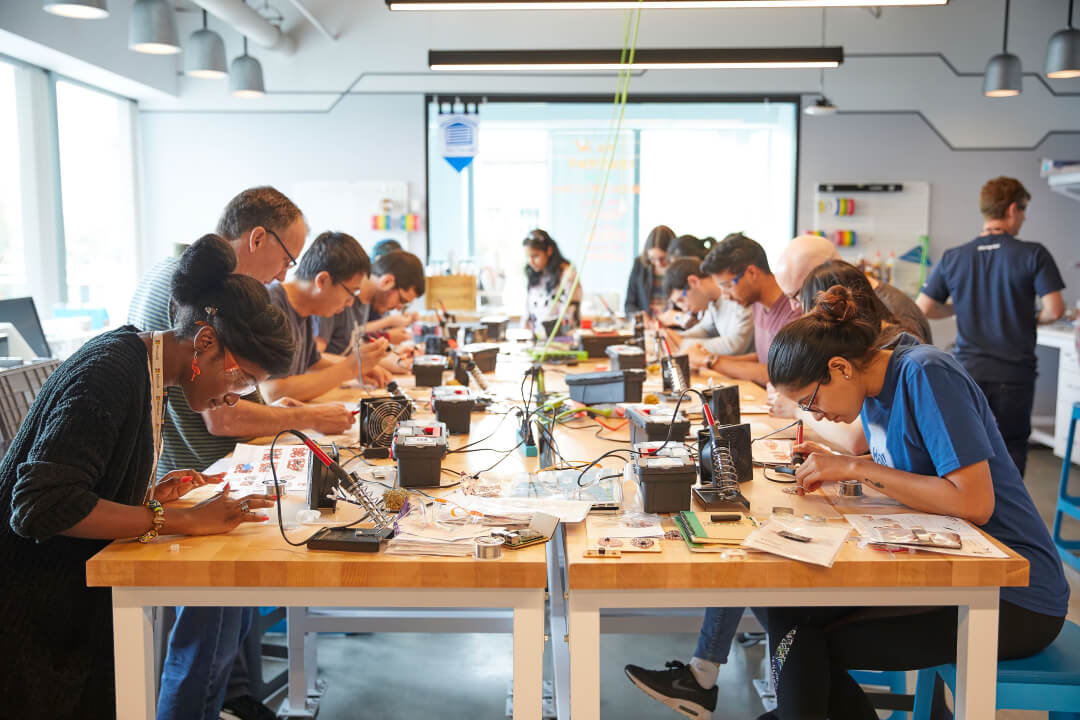
For nearly two decades, Microsoft’s Garage was the place where the company’s restless tinkerers could go to play. It wasn’t a formal department with quarterly goals or a mandate to ship products—at least not in the traditional sense. It was a workshop, a sanctuary, a permission slip to be curious. On a campus known for its sprawling buildings and intense product cycles, The Garage offered employees soldering stations, 3D printers, whiteboards, and, perhaps most importantly, a culture that said: “Doers. Not Talkers.” That phrase, the program’s slogan, captured something essential about the spirit of Microsoft’s most inventive employees. They were the ones who stayed late to build a tool to control multiple computers with one keyboard, or who gathered on weekends to prototype an app that might never see the light of day. But now, that era is coming to a close. Microsoft is winding down The Garage as a companywide program, according to an internal FAQ viewed by GeekWire. The move ends a 17-year run for an initiative that had become a beloved fixture of the company’s culture, with a flagship location on the Redmond campus and more than a dozen other sites stretching from Vancouver, B.C., to Beijing. For many employees, the news feels less like a strategic pivot and more like the loss of a home—a place where careers were launched, friendships were formed, and the joy of building for its own sake was celebrated.
The story of The Garage begins in 2009, inside Microsoft’s Office Labs group in Redmond, with a simple but powerful idea: instead of collecting ideas and funding the most popular ones, why not support the employees who were already making things on their own? The program was designed for those internal entrepreneurs who couldn’t help but build, even when no one asked them to. It was a bottom-up approach to innovation, rooted in the belief that the best ideas often come from the people closest to the work, not from the top of the org chart. For years, The Garage operated quietly, a hidden gem for those in the know. But everything changed in 2014, when Satya Nadella took over as CEO. Nadella, who has often spoken about the importance of a “learn-it-all” culture over a “know-it-all” culture, embraced The Garage as a symbol of the company’s transformation. In July of that year, The Garage ran Microsoft’s first companywide hackathon, drawing more than 11,000 registrants from 80 countries. It was a staggering show of enthusiasm, and it quickly became an annual tradition—a time when the entire company stopped its usual rhythm and gave itself over to the chaos of creation. Over the years, The Garage also released experimental apps to the public, including Mouse without Borders, a clever tool that let users control multiple PCs with a single keyboard and mouse, and Arrow Launcher, which eventually evolved into Microsoft Launcher for Android. These projects may not have been the biggest products in Microsoft’s portfolio, but they were proof that the company could still take risks, ship small, and learn from the fringes.
So why end something so beloved? Microsoft’s official explanation, as outlined in the internal FAQ, is that the kind of experimentation that started in dedicated programs and spaces like The Garage now happens “every day within each of our teams.” The company says it is “reinventing how we foster innovation, learning, and experimentation” across Microsoft, and that employees are already building new skills and adopting new tools in their regular work. There is some truth to this. Over the past decade, the boundaries between “work” and “side project” have blurred, especially as companies have embraced agile methodologies, design sprints, and always-on collaboration tools. But the timing of the decision is hard to ignore. Microsoft is currently spending enormous sums on artificial intelligence—much of it going to data centers and other infrastructure—while simultaneously cutting costs and jobs in other parts of the business. The Garage, with its physical spaces and dedicated staff, is a visible expense, and in an era of AI-driven efficiency, it may have seemed like a luxury. A Microsoft spokesperson confirmed the changes, saying, “We regularly evaluate how we use our physical spaces to best support our employees, customers and partners. As part of that ongoing work, we’re making changes to some Garage spaces. Innovation and a builder mindset remain central to how we work every day.” The company declined to comment further, including on the effect on Garage employees, and the FAQ makes clear that the impact on each physical space “will vary by location.” Some spaces could be restricted as early as Friday, Oct. 23. Employees are not allowed to take equipment, tools, or materials with them. The ambiguity has left many feeling anxious and unmoored.
The future of Microsoft’s Global Hackathon, perhaps The Garage’s most visible legacy, is also unsettled. According to the FAQ, the hackathon team is “reimagining the program,” and Microsoft says it will have more to share later. But for employees who have participated over the years, the hackathon was more than just an event. It was a moment of collective energy, a chance to work with people from different teams and countries, to explore wild ideas without fear of failure, and to reconnect with the reason many of them joined Microsoft in the first place. The public Garage website, which once showcased hackathon projects and experimental apps, was redirecting to the Microsoft homepage as of Tuesday morning—a small but telling sign that the door is already closing. As of this year, Microsoft listed Garage locations in 15 regions, including Redmond, Vancouver, B.C., the Bay Area, New York City, Ireland, Israel, India, and Beijing. Each of these spaces had its own character, its own community, its own local flavor. But they all shared a common purpose: to give employees a place where they could be makers, not just managers. The decision to wind down The Garage as a centralized function does not necessarily mean every space will disappear overnight, but it does signal a fundamental shift in how Microsoft views experimentation. The question is whether the spirit of The Garage can survive without the structure that nurtured it.
The employee reaction, captured on the anonymous workplace app Blind, reveals the depth of the loss. A post titled “Amy kills the Garage” drew more than 70 comments, with the original poster attributing the move to cost-cutting by Microsoft CFO Amy Hood. Whether that attribution is accurate or not, the sentiment reflects a broader anxiety: that Microsoft’s aggressive focus on AI and financial discipline is squeezing out the kind of organic, playful creativity that The Garage represented. One employee wrote that The Garage was where they met their friends on campus and made connections that advanced their career. Another commenter put it more bluntly: “The Garage offices were one of the last few cool things about Microsoft.” That line resonates because it speaks to something deeper than nostalgia. In a company of nearly 200,000 employees, it can be hard to feel a sense of belonging. The Garage provided that. It was a place where a software engineer from one team could meet a designer from another, where a program manager could learn to solder, where a data scientist could try their hand at building a robot. It was a physical manifestation of the idea that everyone, regardless of their role, has a builder inside them. To see that space taken away—to be told that innovation now happens “every day within each of our teams”—can feel like a betrayal of the very culture Nadella has worked so hard to cultivate. It also raises a troubling question: if every team is expected to innovate as part of their daily work, where will the time and space come from? The Garage existed precisely because innovation often needs a break from the daily grind, a different environment, a new set of collaborators.
In the end, the winding down of The Garage is not just a story about office space or cost-cutting. It is a story about the tension between efficiency and creativity, between scale and soul. Microsoft is betting billions on artificial intelligence, and that bet requires discipline, focus, and a willingness to make hard choices. But the hard choices can sometimes come at the expense of the very things that made a company great. The Garage was never going to be the source of Microsoft’s next multi-billion-dollar product. Its value was always more subtle, more human. It was a reminder that work can be joyful, that curiosity is a form of productivity, and that the best ideas often come from unexpected places. As Microsoft moves forward into an AI-driven future, it will need people who can think differently, who can challenge assumptions, who can build things just to see if they work. The company says it is “reinventing how we foster innovation, learning, and experimentation,” and perhaps that reinvention will eventually produce something new and wonderful. But for the employees who called The Garage their home, the loss is real and immediate. They are losing a place, yes, but also a piece of their identity. The soldering irons will go cold. The whiteboards will be erased. The hackathon may continue in some new form, or it may fade away. But the spirit of The Garage—the doers, the tinkerers, the dreamers—cannot be so easily dismantled. It lives on in the friendships, the skills, and the projects that grew there. And perhaps, in some new corner of Microsoft, a small group of employees will find a way to keep building, just as they always have. After all, that is what makers do. They don’t wait for permission. They make.