


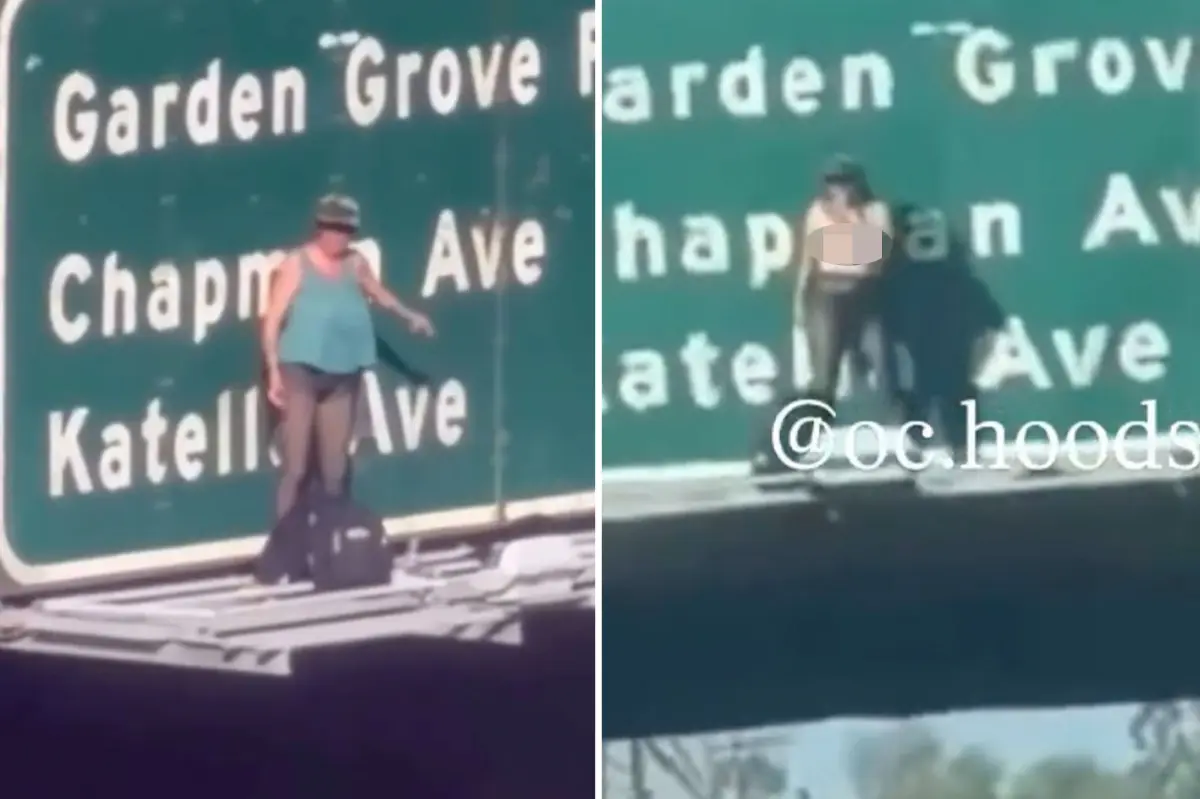
For thousands of drivers making their way home through Orange County on Monday evening, the commute was supposed to be just another familiar crawl along the 55 Freeway—headlights, brake lights, the low hum of engines and the shared, unspoken hope of getting home in time for dinner. Instead, the evening became something no one could have anticipated. Traffic slowed, then stopped, and hundreds of faces turned upward in disbelief at a sight that seemed pulled from a strange dream or a movie scene: a woman, bare-chested, was perched on a sign platform high above the freeway in Santa Ana. She was clinging to the structure, her body silhouetted against the fading light, her presence both terrifying and inexplicable. Commuters who had been listening to podcasts or thinking about the next day’s meetings suddenly found themselves frozen, hearts pounding, unsure whether they were witnessing a stunt, a tragedy, or something far more fragile. Some reached for their phones to call 911; others simply watched in anxious silence, their own problems shrinking beneath the gravity of the moment. The woman was not just standing there casually—she was holding on, her posture suggesting exhaustion, desperation, or perhaps a mind caught in a storm no one else could see. The scene unfolded above the Santa Ana Freeway, just south of 17th Street, and it swiftly transformed an ordinary traffic report into a full-scale emergency. No one knew how long she had been up there, or what had driven her to climb so dangerously high. There was no way to know if she was angry, frightened, confused, or all three. All anyone could do was wait, watch, and hope that the first responders already racing toward the scene would find a way to bring her down safely. For the drivers stuck beneath the overpass, the minutes felt stretched and strange, as if time itself had paused to witness a human life hanging in the balance. The woman’s identity, her story, her pain, were all unknown, but her vulnerability was unmistakable—a single, fragile figure against the immense, cold steel of a highway sign, a reminder that sometimes the most visible moments of crisis are really the most private ones.
The response was swift, coordinated, and resolute. California Highway Patrol officers and professionals from the Orange County Fire Authority converged on the area, quickly realizing that this was no ordinary rescue. The freeway’s northbound and southbound lanes were shut down at the overpass south of 17th Street, bringing traffic to a standstill and rerouting drivers through unfamiliar side streets. For many commuters, the closure was an inconvenience, a delay that would ripple through the evening; but for the first responders, it was a necessary measure to create a zone of safety around a woman in deep distress. The decision to close lanes is never made lightly—it disrupts thousands of lives, triggers hour-long backups, and demands public patience—but in this moment, the priority was unmistakably clear: protect the woman, protect the rescuers, and do whatever was needed to avoid a tragedy playing out in full view of rush-hour drivers. Fire trucks arrived, their lights painting the twilight in urgent red and white, and crews began setting up the equipment that would form the backbone of the rescue effort. A massive inflatable cushion was positioned below the sign, a silent but hopeful gesture that perhaps the worst could be softened if the unthinkable happened. Firefighters extended a towering ladder toward the platform, careful not to move too quickly or too aggressively, knowing that every motion could sway the woman’s fragile state of mind. Meanwhile, officers from the Santa Ana Police Department, including members of the department’s Crisis Negotiation Team, began doing what may be the most difficult and most human work of any emergency: talking. They spoke to her in calm, steady voices, trying to build a bridge of trust across the distance and the noise and the fear. The negotiators did not shout commands or issue ultimatums; they listened, they acknowledged, they tried to understand a person who was, at that moment, standing at the edge of an abyss in every sense. The scene was a study in contradiction—the vast, impersonal machinery of a modern freeway system, with its concrete and steel, suddenly transformed into a stage for compassion and patience. Strangers in uniform, trained for times like this, refused to see the woman as a problem to be solved or a spectacle to be contained; instead, they treated her as a human being deserving of dignity and care, even as she stood in a place that made every heartbeat feel like a countdown.
The standoff stretched on for more than two and a half hours, and the longer it lasted, the more the air thickened with tension. At times, the woman shifted her weight, and the crowd of onlookers below—journalists, officers, rescue workers, and commuters who had left their cars to peer between the gaps in the overpass—caught their breath collectively. At one point, officials later confirmed, she threatened to jump. That moment must have been excruciating for everyone involved, a single sentence that carried the weight of a life and sent a fresh wave of urgency through the rescue effort. The negotiators did not flinch. They kept talking, drawing on training and experience and the simple, profound power of one human being addressing another with kindness and persistence. The woman was not merely a problem to be talked down; she was a person in crisis, and the negotiation team understood that her behavior was not a betrayal or an inconvenience but an expression of profound suffering. The hours passed, the sky darkened, and the freeway remained a strange, empty canyon apart from the flashing lights and the towering sign. Firefighters stayed near the ladder, ready to move at any second, while the cushion below remained in place, a quiet testament to the hope that no one would ever need to use it. The woman’s body language was a puzzle—sometimes defiant, sometimes exhausted, sometimes distant, as if she were somewhere else entirely, caught between the world around her and the world inside her head. It would have been easy to feel frustration, to wonder why this was taking so long, to see the woman as merely the cause of a massive traffic jam. But those who watched closely saw something more: a person struggling, an emergency that could not be forced or rushed. The rescue teams understood that her trust had to be earned, that the decision to step back from the edge had to come from within her, and that the only path to safety was through the fragile, delicate work of human connection. And so they kept talking—through the noise of the freeway, through the cold of the evening, through the uncertainty that hung in the air like fog. It was a test of patience, compassion, and endurance, and everyone on the scene passed it moment by moment.
Then, at last, the breakthrough came. After roughly two and a half hours of negotiation, the woman made a choice—a small but monumental decision to stop fighting, or to trust, or simply to let go of the unbearable weight she had been carrying. The Santa Ana Police Department’s Crisis Negotiation Team had managed to convince her to surrender, though the word “surrender” feels wrong, because what she did was not giving up; it was reaching out. She stepped toward the raised platform where first responders were waiting, and they caught her, literally and figuratively, guiding her into their arms with a gentleness that was visible even to observers from a distance. In that moment, the enormous tension that had gripped the scene seemed to break like a wave against the shore. There was relief—so much relief—and a sense of something close to grace. The woman was safely brought down from the sign with the assistance of the Orange County Fire Authority, transferred from the elevated platform to the ground, and placed in the care of emergency medical personnel. She was then taken to a local hospital for a mental health evaluation, a step that spoke volumes about how the situation had been understood from the start: not as a criminal act, but as a health emergency, a crisis of the mind and heart that required medical attention and compassion rather than punishment. The law enforcement agencies involved did not celebrate or treat the rescue as a victory over an adversary; instead, they spoke with a kind of professional humility, acknowledging the teamwork that made the safe resolution possible and thanking the public for their patience. The Santa Ana Police Department posted a brief message on social media, confirming that the woman was safely brought down and taken to a hospital, and expressing gratitude for everyone’s patience as officers worked to bring the situation to a safe resolution. The message was short, factual, and careful—there was no mention of charges, no speculation, no hint of judgment against the woman. It was simply a statement of what had happened and a recognition that the goal had been achieved: a life had been protected, a person had been helped, and a community had been asked to wait, and had waited.
In the aftermath, many questions remained unanswered. It was unclear whether the woman would face any charges, and that uncertainty seemed intentional—an acknowledgment that the focus should remain on her well-being, not on legal repercussions. Santa Ana, one of the largest cities in Orange County, located about thirty-two miles southeast of downtown Los Angeles, became the backdrop for a story that would be shared and debated across the region, but the woman herself remained a mystery. Who was she? What had brought her to that sign above the freeway? What pain, what loss, what internal earthquake had led her to climb so high in search of something—perhaps escape, perhaps silence, perhaps help? These are questions that may never be fully answered, and perhaps they are not ours to answer. What is known is that the community around her responded with care: the drivers who called for help, the officers who shut down the freeway without hesitation, the firefighters who positioned the cushion and raised the ladder, the negotiators who spent nearly three hours treating a stranger with dignity, and the medical professionals who would continue her care long after the cameras and the crowds had gone. The story of the woman on the sign might easily have become the subject of mockery or morbid curiosity, another strange news item to scroll past on the way to something more entertaining. But there is another way to read it—as a reminder that crises are not always loud and obvious, that people can find themselves in impossible places without anyone noticing until it is almost too late. The woman’s vulnerability was on full display under those highway lights, but vulnerability is everywhere, often hidden behind ordinary faces, ordinary routines, ordinary days. The rescue was not just a technical achievement or a triumph of emergency response; it was a demonstration of what it means to be human in the presence of another human’s suffering. It said, without words: You matter, your pain is real, and we will not leave you out there alone.
Ultimately, the story of that Monday evening is not really about a topless woman on a freeway sign, or a traffic delay, or even a dramatic rescue. It is about the fragile, invisible thread that connects all of us—a thread that can snap under pressure, but that can also be mended by patience, kindness, and the willingness to stand beside someone in their darkest moments. The first responders who spent those two and a half hours on the 55 Freeway did not know the woman’s name, but they treated her as if her life mattered—because it did. The negotiators did not merely try to end a standoff; they tried to understand a human being. The firefighters did not simply do their jobs; they held out hope in physical form, with a cushion and a ladder and steady hands. And the commuters who sat in their cars, frustrated and delayed, were asked to wait, and almost everyone did, because somewhere deep down they knew that this was more important than any meeting or dinner or plan. The woman stepped into the arms of first responders, and in doing so, she reminded everyone watching that rescue is possible, that despair does not have to be the final word, that there is always someone willing to reach out a hand. Her story may not have a neat ending—there is still a road ahead, a hospital stay, a recovery that will take time and patience and support. But the ending that did occur on that overpass was a good one, in the truest sense: a person came down from the edge, a crisis was met with compassion, and a community proved that it could hold space for a stranger in pain. The 55 Freeway reopened, traffic resumed, and life in Orange County moved on. But something about that evening lingered—a reminder of the fragility of the human mind, the power of human connection, and the quiet heroism of those who spend their lives catching people who have fallen, or convincing them not to fall in the first place. It is a story that deserves not just to be summarized, but to be remembered, because in its small, strange way, it tells us who we are and who we can be for one another.