



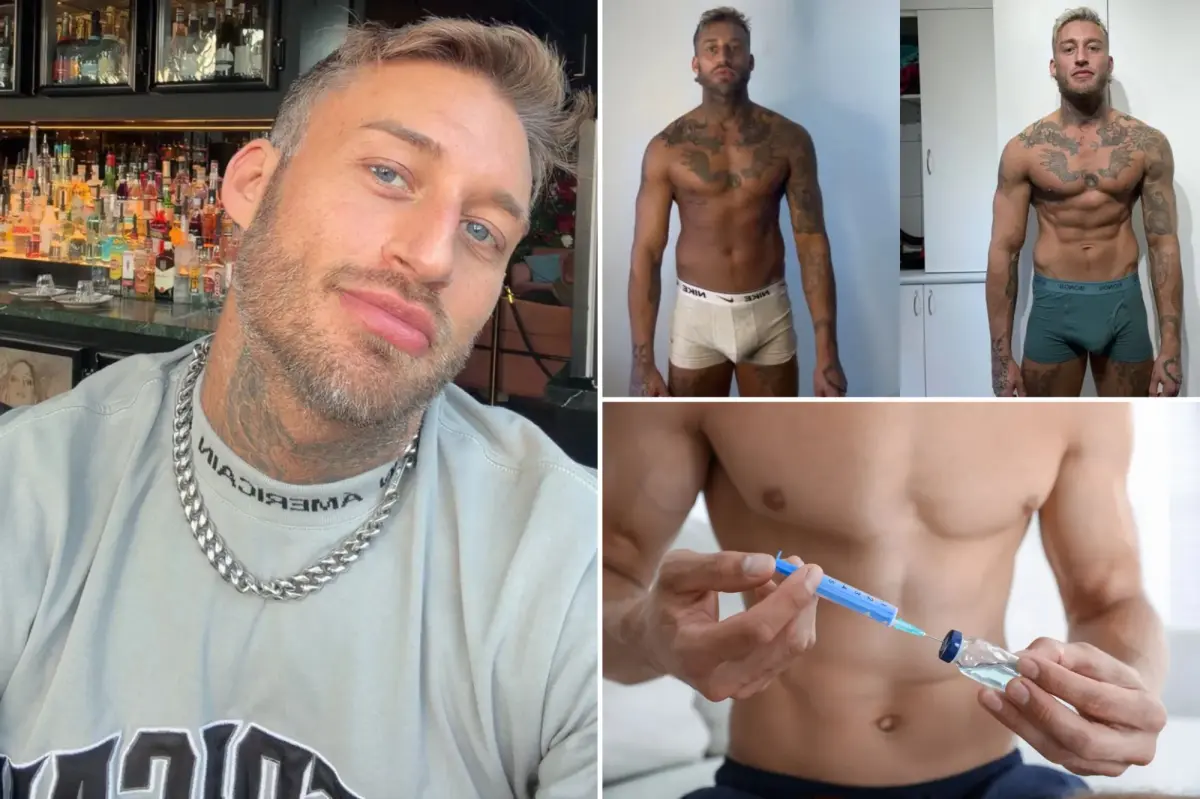
For years, Aiden lived in a body that didn’t feel like his own. He was athletic but slight, naturally skinny in a way that made him feel disconnected from the man he wanted to be. He wanted to feel strong and substantial, but his reflection told a different story. After turning 30, he decided to do something about it. He ate more protein, prioritized sleep, and started training with a personal trainer. Progress came, but eventually his gains plateaued. Around the same time, he began to feel what he described as lower testosterone or general energy levels. Instead of seeing a doctor, he decided to take matters into his own hands. He began injecting testosterone, sourced without a prescription. He never had his levels checked, and he didn’t want a medical professional to talk him out of it. “I haven’t spoken to a doctor because I didn’t want to be talked out of it, as I had my mind set on it,” he said. “I just researched a lot online.” After three hormone cycles over two years, he reports feeling more energy, more focus, more motivation, more strength, and faster recovery than at his natural baseline. His story is not rare. Across gyms and online forums, young men who have not been diagnosed with testosterone deficiency are increasingly using testosterone to accelerate their gains. The trend has a name: testmaxxing. It is sold as a way to unlock a more masculine, more successful version of yourself. But behind the promise of optimized hormones lies a more complicated story about insecurity, identity, and the lengths men will go to in order to feel adequate.
Testosterone is the main androgen produced by the testes, and in adult men it supports libido, erectile function, muscle strength and mass, bone density, sperm production, and red blood cell production, explains Dr. Sam Saling, a general practitioner. Both men and women produce it, but in men it has become a cultural symbol of vitality and masculinity. The testmaxxing movement has latched onto this, promoting the idea that maximizing testosterone means maximizing muscle, sex drive, energy, and ultimately a more masculine physique. For some, this means lifestyle changes like lifting heavy, sleeping better, and eating foods that support natural production. For others, that’s not enough. Henry is a fit professional in his 30s. He had trained for years and “yo-yoed a bit,” and he was looking for an edge to push stubborn fat and build muscle. The tipping point came when he saw a friend’s before-and-after photos. The two used the same personal trainer, and Henry was convinced the results were not natural. His friend was injecting synthetic testosterone and recommended Henry try it. Henry found a backdoor supplier who sold him a product labeled Pharma Test 250, listing testosterone enanthate 250 mg/mL as its active ingredient. Three months in, Henry says he is definitely getting stronger, weights at the gym have gone up dramatically, mood is good, and he has no side effects yet. He plans to keep cycling the injections until he reaches his ideal physique. Henry had a blood screening before starting, but it did not reveal a testosterone deficiency. He sees the hormones not as medicine but as an enhancer, part of his training regimen, a tool to accelerate a process that would otherwise take years. That attitude is at the heart of testmaxxing: a belief that the body’s natural limits are just another obstacle to be overcome.
What drives a man to inject a hormone he may not need? For many, it is not just about strength. It’s about what that strength represents. Aiden grew up skinny and gay, and he associated being slight with feeling “more feminine.” With testosterone injections, he says he is working toward a physique he associates with greater masculinity. “I definitely feel more masculine taking it,” he said. “Masculine, to me, is feeling strong, and looking physically fit and more built.” Henry’s explanation is even more direct: “Ultimately, we all wanna be hot, so will do whatever it takes if you don’t have good genes.” That raw honesty reveals a deep vulnerability. The pursuit of testosterone is often a pursuit of self-worth, a desire to finally feel comfortable in your own skin. But that comfort can be elusive when the standards keep shifting. Male-dominated online spaces are full of messages that link muscularity, confidence, and sexual performance to “alpha” masculinity, and they urge men to see their bodies as projects that can and should be continually optimized. This is part of a broader “looksmaxxing” culture, in which men chase an ever-more-idealized version of masculine appearance. Joe Rogan has long been open about his own testosterone use, and in a 2018 episode of his podcast he dismissed the stigma around not producing enough naturally, saying that ultimately “all that matters is that you have it in your system.” Not every man injecting testosterone belongs to the manosphere, but these spaces can expose fitness-focused men to polarizing ideas about masculinity. A 2024 study from Dublin City University’s Anti-Bullying Centre found that male-identified accounts were served masculinist and extremist content within 23 minutes of scrolling. The algorithm turns curiosity into conviction, and the pressure to optimize becomes harder to escape.
Doctors are watching the trend with growing concern. Google Trends data show that US search interest in “testosterone” was 30% higher over the past 12 months than the year before, and urologists are seeing the fallout in their clinics. “Tons of people are coming in and asking about this to a greater degree this year than ever before, and then last year more than any year previous,” said Dr. Joseph P. Alukal, a professor of urology and director of Men’s Health at Columbia University. But the medical reality is more complicated than the internet suggests. Testosterone does decline gradually with age, but healthy bodies are “pretty good at regulating our hormone levels for optimal bodily function,” said Associate Professor Dr. Tim Moss. “This is true for testosterone—so healthy boys and men need not worry about their testosterone levels.” For men whose levels are already within the normal range and who have no symptoms of androgen deficiency, testosterone injections are unlikely to be the answer. They are, however, likely to cause harm. Taking synthetic testosterone tells the body to stop producing its own. It also turns off sperm production, and those systems can take months or even years to return to normal after stopping. Withdrawal symptoms can make coming off difficult. The list of potential risks is long: synthetic testosterone can cause polycythemia, which increases the risk of blood clots and stroke, and doctors also flag mood disorders, irritability, tendon rupture, liver disease, heart attacks, and even death. Dr. Alukal is blunt: if a man’s levels are normal, “that’s not somebody who should be taking testosterone or testosterone boosters because he incurs real risks like health risks that are serious.” The irony is that the symptoms these men are trying to escape—fatigue, low libido, a sense of decline—can be worsened by the very hormones they are taking. And genuine men’s health concerns, like the absence of morning erections or a complete change in libido, deserve real medical investigation, not a self-prescribed experiment.
Neither Aiden nor Henry is unaware of these risks. They simply choose to accept them. Henry says that seeing a doctor “comes with a layer of judgment, despite probably being safer.” Aiden wasn’t concerned about long-term risks when he started, reasoning that he could be putting worse things into his body. So far, he has experienced one side effect: shoulder acne, which cleared up after he switched cleansers. He takes his own blood pressure at home, but he admits he hasn’t gotten “proper blood work” in the past. If he experienced bad side effects, he says, he would stop. That may be wishful thinking. The internal damage caused by synthetic hormones—to the heart, liver, and fertility—does not always announce itself with visible symptoms. By the time a problem is noticeable, it may be serious. When asked why he would take such a risk, Henry’s answer is stark: “body dysmorphia.” That may be the painful truth underpinning testmaxxing. For some men, hormones become a landing place for the belief that their bodies, even healthy ones, are not enough. There is always a higher tier of optimization: more muscle, less fat, better energy, higher testosterone. The goalposts keep moving. For Aiden, testosterone is a vehicle to achieve the physique and the masculinity he always wanted. But if masculinity is just another hormone cycle away, when is enough ever enough? These are not reckless or shallow men. They are men who have absorbed a cultural message that self-worth must be earned through physical achievement, and that the natural limits of the human body are obstacles to be overcome. The desire to improve is human. But when improvement becomes an endless war against yourself, it may be worth asking what—or whom—we are really fighting.
The testmaxxing trend is not just a health story; it is a story about modern manhood. Men are being told, from every direction, that their value lies in their physical performance, their virility, their muscle mass, their ability to project confidence at all times. Podcasts, social media, and online forums have turned testosterone into a magical metric of masculinity—a number that can be measured, optimized, and displayed like a score. But in the process, something important is being lost: the ability to feel at home in your own body, to trust that it is doing what it needs to do. Testosterone is not the enemy. It is a hormone with important functions, and for men with a genuine clinical deficiency, replacement therapy can be life-changing. But testmaxxing has turned a medical tool into a lifestyle accessory, and the casualties are the men who believe they are not enough without it. Aiden and Henry are not villains. They are products of a culture that equates masculinity with size, strength, and dominance, and that offers synthetic solutions instead of the harder work of self-acceptance. The real act of masculinity might be having the courage to ask for help, to accept your limits, to care for your body rather than chemically attack it. It might mean recognizing that being “hot” is not the same as being whole, and that no injection can fill a void that is actually emotional. If we want to talk about optimization, let’s optimize for health, longevity, and genuine connection—not for an impossible ideal. That would be a version of masculinity worth fighting for.