



There is a particular kind of quiet that settles over a startup office when the news is not good. It is the silence of conversations that stop when someone walks by, of empty desks where laptops once hummed, of messages asking, “Have you heard?” That quiet arrived at Carbon Robotics this week. The Seattle agricultural technology company, known for its AI-powered LaserWeeder, confirmed on Monday that it had cut staff. The news came as an email, or a meeting invite, or a brief conversation with a manager—and regardless of the medium, it did not soften the blow. The company did not disclose the total number of layoffs, but acknowledged that the reductions touched employees in multiple departments across the U.S. and internationally. Carbon Robotics now employs 275 people worldwide, according to Brett Goodwin, vice president of marketing. For a company that had been riding a wave of momentum—a $20 million raise last year, a new autonomous tractor kit, and a marquee spot in the Pacific Northwest’s startup rankings—the news landed with a jolt. Behind the corporate language of “realigning costs,” there are real people: engineers who spent late nights refining algorithms, field teams who sleep away from home to support growers, salespeople who believe in a future with fewer chemicals. For them, a layoff is not a headline. It is a paycheck, a team, and a mission suddenly in question. The company’s response to the cuts—offering no total number, saying only that the moves were necessary—did little to quiet the anxiety that now hangs over the remaining staff. But to understand how a fast-growing company arrives at such a moment, you have to look at the path it took to get there.
Startups often promise to disrupt industries, but the path to disruption is paved with hard financial choices. Carbon Robotics had been moving at a remarkable clip. In 2025, it raised $20 million to support the development of an undisclosed AI-powered farm robot. It also unveiled an autonomous tractor kit, signalling that its ambitions extended beyond the LaserWeeder into the broader future of farm automation. The company had a signature product, a growing customer base, and a founder who talked openly about scaling toward a public offering. Yet none of that protected it from what Goodwin called “broader economic conditions.” That phrase has become a familiar euphemism in the tech industry, but it carries real weight. Capital is no longer as cheap as it once was; investors are more impatient with companies that spend heavily without a clear route to profitability; and startups that once grew at all costs are now being told to do more with less. Carbon Robotics is not alone. Across the tech sector, companies have tightened belts, reduced staff, and postponed moonshot projects. The difference here is that the company’s technology—lasers that kill weeds—is so specific, so ambitious, and so tied to solving real problems in agriculture that the layoffs feel especially counterintuitive. How can a company with a product this unique and a revenue line that just crossed a major milestone have to cut jobs? The answer is that even good companies are not immune to economic gravity. The $100 million revenue milestone is real, but so are the costs of manufacturing hardware, running a global workforce, and investing in research that hasn’t yet paid off. Hardware startups are particularly exposed to this pressure because they cannot simply ship code and let cloud hosting handle the rest; they need supply chains, service teams, warehouses, distribution, and a support network that spans countries. For employees who joined because they believed in the mission, the decision was a sobering reminder that mission alone doesn’t pay the bills.
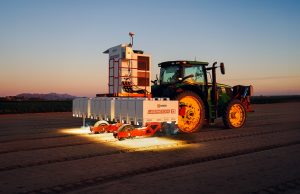
To appreciate what Carbon Robotics has built, it helps to imagine a farm field in early summer. Weeds are everywhere, competing with vegetables for water and nutrients. For generations, farmers have fought them with herbicides and plows, both of which come with a cost: chemical runoff, resistant weeds, damaged soil, and a growing public demand for cleaner food. The LaserWeeder, the company’s signature product, offers a different way. Pulled behind a tractor, the machine uses artificial intelligence to scan the ground, identify crops and weeds in real time, and then deliver precise flashes of laser energy to the unwanted plants—no chemicals, no soil disturbance, no guesswork. The latest version, the LaserWeeder G2, is faster and more capable than its predecessors, and it has made Carbon Robotics a leader in what is often called “precision agriculture.” The technology is not just a novelty. It has been deployed in commercial fields and has attracted attention from the highest levels of government. Earlier this year, Robert F. Kennedy Jr., the U.S. secretary of health and human services, touted the company’s machines on “The Joe Rogan Experience” as a possible solution for cutting pesticide use. Love him or hate him, that kind of platform reaches millions of people and shines a national spotlight on a Seattle startup that most Americans had never heard of. For the farmers who use the LaserWeeder, the appeal is more practical: fewer chemicals to handle, less time spent on manual weed control, and more data about their fields. Weeds are not just an annoyance—they are a constant economic threat, and the cost of controlling them across a large farm can be staggering. The machine does not replace human labor; it replaces chemicals and drudgery. In an era of farm labor shortages and growing environmental concern, that is precisely the kind of innovation that matters to the people who grow our food and to the consumers who eat it.
The people behind that innovation have worked for nearly eight years to get here. Carbon Robotics was founded in 2018 by Paul Mikesell, a CEO who has guided the company from an idea to a nine-figure revenue business. To date, the company has raised about $177 million from investors including BOND, NVentures, and Anthos Capital. That kind of investor confidence is rare, especially for a hardware company in agriculture, a notoriously difficult sector for tech startups. In a recent interview with AgFunder, Mikesell said the startup had crossed the $100 million revenue threshold and made clear that he intended to keep growing. “We intend to keep scaling from there—it’s our intention to get to the point that we’re an independently publicly traded company, so that would involve going through an IPO,” he said. Those are bold words, and they reveal the scale of the ambition. But an IPO also requires a company to show investors that it can grow efficiently, with disciplined costs and a clear path to profitability. Layoffs, while painful, are often part of that discipline. For Mikesell, the decision to cut staff could not have been easy. He started the company with a specific vision, and he has fought for years to bring it to life. But the weight of that vision now rests on a smaller team. The remaining 275 employees are being asked to carry a big mission forward while still processing the loss of colleagues, the uncertainty of their own roles, and the knowledge that even a successful, celebrated startup can be knocked off balance by the broader economy. The phrase “we intend to keep scaling” sounds confident, but behind it is a quieter truth: scaling sometimes means closing doors for some people so that the company can keep moving.
The timing makes the news especially bittersweet. Earlier this year, Carbon Robotics was named Next Tech Titan at the 2026 GeekWire Awards, one of the Pacific Northwest’s most prominent honors for emerging companies. The award is meant to celebrate a startup that shows exceptional potential, and it is chosen by a community that has seen many companies grow from garages to giants. On top of that, the company is currently ranked No. 8 on the GeekWire 200 index of the Pacific Northwest’s top startups. Those honors mean something. They signal to investors, customers, and the broader tech community that Carbon Robotics is not just another venture-funded experiment. They validate the enormous effort of the team and the promise of the technology. But awards do not pay rent. They do not make up for the fact that a company with 275 employees had to reduce its workforce. For the Seattle startup ecosystem, the layoffs are a reminder that recognition on a list can never fully protect a company from economic reality. The same people who proudly celebrated the GeekWire award may now be helping outplaced colleagues update their résumés and search for new jobs. It is a humbling moment, and it exposes a truth that many entrepreneurs know all too well: the public highs and the private lows are often closer together than they appear from the outside. A company can be simultaneously celebrated and struggling. It can have millions of dollars raised, hundreds of employees, and a product that captures the imagination—and still have to make difficult decisions to survive into the future. The Pacific Northwest has a proud history of startups that stumbled, regrouped, and eventually thrived, and Carbon Robotics still has the ingredients to be one of those stories. But no award can shield it from the difficult work of rebuilding trust with the people who remain.
What comes next for Carbon Robotics is hard to predict, but the story is far from over. Layoffs are brutal, but they are not always the end of a startup’s arc. Many of today’s most successful technology companies faced painful contractions before finding their footing. The question is not whether Carbon Robotics stumbles—it already has—but how it responds. Will it support the employees who were laid off with fairness and humanity? Will it protect the mission that attracted them? Will it use its remaining resources to strengthen the LaserWeeder, finish the mysterious AI-powered farm robot, and make the case to public markets that it can be a durable company? The technology itself is not the problem. In fact, it may be more relevant than ever as the world looks for ways to reduce chemical use in agriculture, protect soil health, and feed a growing population. But companies are made of people, and people need trust. The remaining employees will be watching how leadership behaves now. The farmers who bought LaserWeeders will be watching too. If Carbon Robotics can navigate this difficult chapter, it may emerge leaner and stronger, closer to Mikesell’s dream of an independent public company. But the journey there will be built on the commitments made in the aftermath of this layoff. The quiet in the office will eventually be filled with conversation again, but it will take time. Startups are resilient by nature, and the people who build them are even more so. For now, the company—and everyone who cares about its mission—is left waiting, hoping that the future arrives with fewer surprises and more of the steady, patient growth that farming itself teaches.