


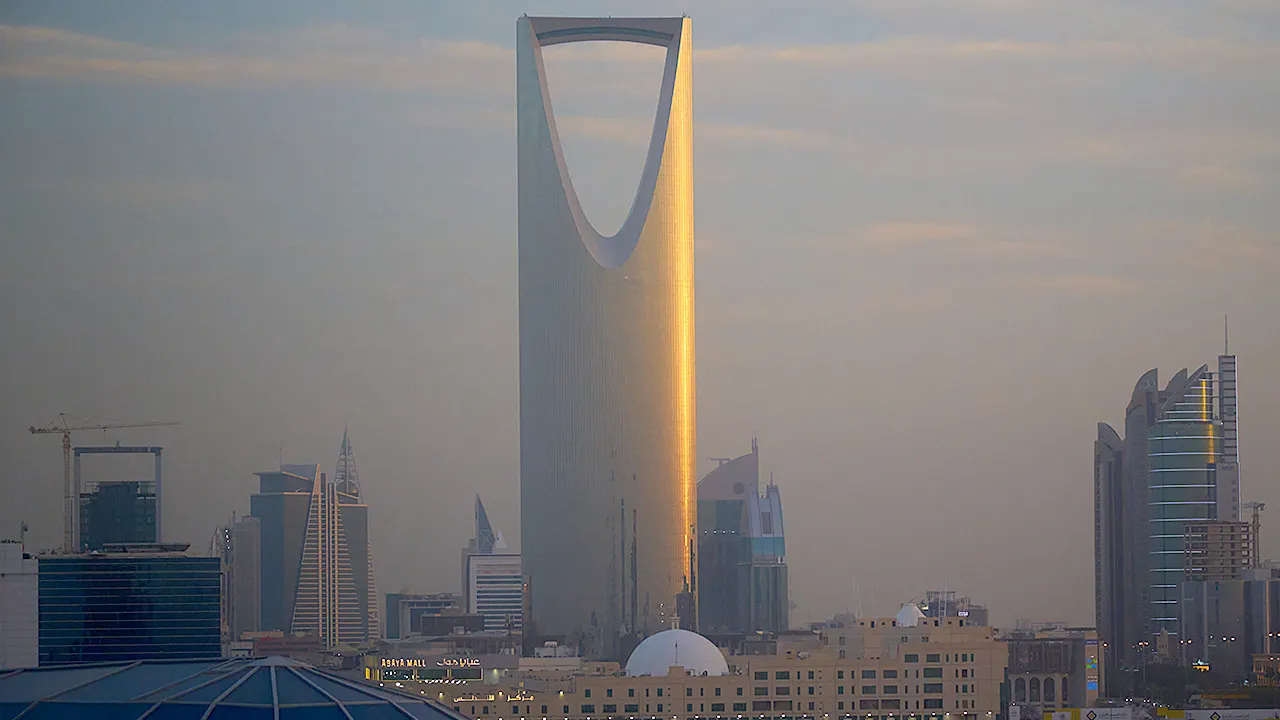
On a Sunday that felt less like the start of a workweek than a held breath, one of Saudi Arabia’s most recognizable buildings became a symbol of a city under siege. Management at the 99-story Kingdom Centre, the sleek tower that anchors Riyadh’s skyline, sent an urgent email telling every office employee to work remotely until further notice, according to Agence France-Presse. The directive applied to some of the world’s most powerful institutions, including Merrill Lynch, McKinsey & Company and the International Monetary Fund—places where people are used to long hours in glass-walled conference rooms, not to studying the sky for traces of smoke. The building management said that remote working arrangements were mandatory for all office employees, effective immediately, and that employees should not report back. It offered no reason, but none was needed. The Saudi-led coalition had just reported intercepting two drones in the Riyadh area, a third over the Eastern Province and two ballistic missiles in southern Saudi Arabia overnight. Authorities had already issued a security alert across the capital, sharing it on X, and the message was unmistakable: the war with Yemen’s Houthi rebels, backed by Iran, had reached the very heart of the kingdom. Yet the ground of Kingdom Centre, with its upscale shopping mall and polished cafés, remained open to the public. Shoppers could still wander beneath the atrium, but dozens of floors above them sat empty—offices with laptops, family photos and half-empty coffee cups abandoned. For the analysts and consultants who usually filled those workspaces, the email was not simply a matter of convenience. It was a quiet admission that their presence in one of the most visible buildings in Saudi Arabia had become too dangerous. They were being asked to stay home because a missile or a drone could strike at any moment, and no spreadsheet or meeting agenda was worth that risk.
That single order was part of a much larger wave of disruption that has reshaped everyday life in Saudi Arabia. In the early hours of Oct. 10, an attack on King Khalid International Airport killed 13 people and wounded more than 300 others. The next day, another strike killed one person and injured 11 more. Airport operations have been severely disrupted since then, and what was once a bustling gateway of international travel has become a place where every waiting area feels tense and every delayed flight makes people wonder whether the danger is closer than they think. Schools in Riyadh have extended remote learning, so children who used to share classrooms and jokes are now stuck behind screens, their childhoods reduced to video calls and digital assignments. Parents have been forced to become teachers, tech support, counselors and guards all at once, trying to explain to their kids why they cannot go to school or visit friends while also trying to keep their own careers on track. The idea of a normal routine has quietly slipped away. In the capital, residents still go to grocery stores and visit relatives, but there is a heaviness in the air, a feeling that the violence could interrupt at any second. The Houthis, who control Yemen’s capital, Sanaa, and much of the country’s north, have shown they can reach deep into Saudi Arabia. They have made the skies feel less like open air and more like a ceiling that could crack at any time. Office workers in the Kingdom Centre now know what it means to be a target, not because they are soldiers or politicians, but simply because they show up to work in a building that can be seen from miles away. The fear has become both personal and collective, and it is changing the way people think about safety, family and the future.
Far from the towers of Riyadh, along the southern border with Yemen, the war has an even starker and more intimate face. Saudi Arabia’s military reported that two service members were killed when an AH-6i reconnaissance helicopter crashed in the Najran region because of a technical malfunction. The phrase “technical malfunction” sounds clinical, but for the families of those two crew members, it means an empty chair at the dinner table, a phone that will never ring again, and a lifetime of grief disguised as a one-line news report. They were soldiers, but they were also someone’s children, someone’s partners, someone’s best friends. Their deaths are a reminder that the conflict is not carried out by machines alone; it is fought by young men and women far from home, doing jobs that have become even more dangerous as the Houthi attacks intensify. On the same day, Saudi civil defense authorities reported that six people were injured when a hostile projectile struck a residential neighborhood in Najran, damaging three homes and three vehicles. That attack turned ordinary houses into scenes of chaos, sending families running into the street, filling the air with smoke and dust, and leaving six people in need of medical care. For the civilians who live along that border, the crisis does not arrive in the form of emails or news alerts. It arrives as explosions in the night, as shattered windows, as the smell of burning debris. They have learned to listen for the difference between a distant strike and one that is coming closer. They have learned to pass the hours of darkness with the windows darkened and phones close by. The Saudi-led coalition, which supports Yemen’s internationally recognized government, has been fighting the Houthis for years, but the front lines keep moving deeper into Saudi territory, and the human cost keeps rising. Every day, the people of Najran wake up and wonder whether this will be the day their neighborhood becomes another headline.
While soldiers and civilians were paying that price, the region’s political machinery began to move in response. Egypt’s President Abdel Fattah el-Sissi requested an emergency parliamentary session to authorize defensive military support for Saudi Arabia if Riyadh asked for it, according to Reuters. Lawmakers were expected to continue discussions Monday, but the very fact that such a request was made shows how serious the situation has become. Egypt’s National Defense Council, chaired by el-Sissi and attended by the country’s top military and security officials, met to discuss the crisis, and afterward the Egyptian presidency said Cairo was prepared to help Saudi Arabia defend its security, stability, territorial integrity and Islamic holy sites. Egyptian Foreign Minister Badr Abdelatty also reached out to Saudi Foreign Minister Prince Faisal bin Farhan, and the two spoke about regional developments and the importance of de-escalation, according to a post on X. Behind the formal diplomatic words lies a much more human reality: Egypt, with one of the largest militaries in the Arab world, is now preparing to potentially step into a widening war. This would not be a small gesture or a symbolic show of solidarity. It could mean more aircraft flying patrols, more troops stationed along Saudi borders, and a much stronger deterrence against the Houthi attacks. But it could also mean more bloodshed, more families torn apart, and a conflict that spreads even further across a region already exhausted by violence. The decision to request parliamentary approval was a careful balancing act, a way of saying that Egypt stands with Saudi Arabia without yet committing to a full deployment. It was also a recognition that no country can face this threat alone. In the halls of power, those debates can sound distant and technical, but their outcome will determine whether a family in Najran hears another explosion or sleeps through another quiet night. Diplomacy and military readiness are not abstract concepts; they are the forces that decide who lives, who dies and who is left to mourn.
This crisis did not begin with the email at Kingdom Centre or the crash in Najran. It has deep roots in a regional struggle that has been left to fester for years. The Houthis, backed by Iran, have established a stronghold in Sanaa and much of northern Yemen, and from that base they have launched an increasingly bold campaign of missiles, drones and assaults on shipping routes. The Saudi-led coalition, which supports Yemen’s internationally recognized government, has responded with air strikes and military operations, but the attacks continue. Analysts have warned that Saudi Arabia is facing its biggest threat to oil production in decades, as the Houthis target refineries, pipelines and other critical infrastructure. The economic consequences are global: when oil shipments are interrupted, prices rise, and consumers in the United States and elsewhere feel it at the gas pump, in grocery stores, in airline tickets, in the cost of nearly everything. But the crisis is not only about oil. It is also tangled in the broader confrontation between the United States, Israel and Iran, a confrontation that has turned the Middle East into a powder keg. The Houthis are not an isolated rebel group; they are one piece in a larger puzzle of proxies and alliances, and every strike they launch widens the circle of involvement. Some observers argue that the Houthis are not somebody else’s problem, and that America cannot afford to look away while its allies are attacked. Others worry that deeper military engagement would drag the United States into another endless war. Meanwhile, the people of Riyadh and Najran continue to live in the crossfire, and the decisions made in Washington, Cairo and Tehran affect their daily lives more than any press release can express. A drone intercepted over the Eastern Province is not just a military success; it is a near miss for a school, a hospital, a place of worship. A missile destroyed over the south means that someone’s family will live to see another day, but it also means that the attackers will try again.
Perhaps the most remarkable thing about this moment is that ordinary life continues alongside extraordinary fear. The mall at the base of Kingdom Centre is still open, and people still wander through its bright corridors, buy coffee and meet friends, even if the offices above are empty. Children in Riyadh are still learning, though their classrooms are now kitchens and bedrooms, their school bells replaced by video call notifications. Parents are still working, though they are balancing conference calls with helping their children with homework and keeping an ear out for the news. The soldiers who died in the helicopter crash left behind colleagues and families who will honor their memory, and their sacrifice will not erase the threat but will remind everyone of the cost of this conflict. The six injured civilians in Najran will hopefully recover, and their neighbors will help rebuild homes that should never have been damaged in the first place. Egypt’s parliament will debate whether to send assistance, but at its heart, that debate is about more than politics or alliances. It is about whether the nations of the region can find the courage to protect one another, and whether they can find the wisdom to prevent even more suffering. The Houthis, Iran, Saudi Arabia, Egypt and the international community will eventually have to choose between continued escalation and some form of peace, because war cannot go on forever without consuming the values it claims to defend. In the meantime, the people caught in the middle—office workers checking alerts, parents soothing frightened children, soldiers flying missions over hostile terrain—must find ways to keep going. They hold onto hope not because the danger is small, but because giving in to fear would mean surrendering their lives before the first missile ever lands. The sky may be tense, the news may be grim, and the future may be uncertain, but the human spirit, with its stubborn determination to carry on, remains the one force that no drone or rocket can destroy.