

On a gray, wind-whipped afternoon in Cleveland, the Baltimore Ravens found themselves in a familiar, uncomfortable place: fighting for every yard, every possession, every breath. Ever since Lamar Jackson sprained his left ankle in a Week 4 win over the Tennessee Titans, the Ravens have been living on the edge, scraping by with a backup quarterback and a defense that has had to be almost perfect. The games have not been pretty. They have not been comfortable. But they had been, at least until Sunday, enough. Lamar stood on the sideline in his sweatpants, unable to do anything but watch, and the weight of that helplessness seemed to settle over the whole team. A team that once won with explosions now had to win with patience, and patience is a fragile thing. Then came the Browns, a division rival with a defense that seemed to know exactly where Baltimore’s weaknesses were hiding. Sunday’s 13-10 loss was the sharpest reminder yet that the margin for error is paper-thin. It was not a game decided by a single dramatic touchdown or a spectacular catch. It was a game decided by inches, by small mistakes, by the quiet weight of missed opportunities. The Ravens were leading 10-3 in the fourth quarter, with the ball and a chance to put the Browns away. Instead, they walked off the field with their heads down, their record at 4-2, and a knot in their stomachs that no postgame speech could untangle. For a team built around Lamar’s otherworldly ability to turn broken plays into highlights, life without him has become a grinding, low-scoring test of will. Every drive feels like a negotiation. Every third down feels like a small crisis. And every mistake, no matter how small, feels like the whole season might slip through their fingers. The Ravens did not lose because they were outclassed. They lost because they were human, and humans sometimes miss kicks, drop balls, and fail to rise up when their teammates need them most.
The opening minutes offered hope. Baltimore came out with something close to swagger, moving the ball efficiently on their first two possessions and scoring all ten of their points before the first quarter faded into the second. Tyler Huntley, the steady-handed backup thrust into the spotlight, completed 19 of 31 passes for 165 yards and a touchdown, adding 28 yards on the ground with the kind of scrambling grit that Jackson makes look effortless but is actually exhausting. Derrick Henry, the relentless running back, pounded the Browns for 58 yards on 17 carries, carrying defenders and reminding everyone why the Ravens traded for a player who treats contact as a conversation starter. The sideline was alive, the fans were loud, and for a brief, beautiful stretch, it looked as though the Ravens had found a way to survive without their superstar. But after that bright start, the offense vanished. From the second quarter onward, Baltimore punted seven times. Seven drives that ended with the ball sailing away, with the defense jogging back onto the field, with the sideline growing quieter and more desperate. The Browns’ defense began to adjust, crowding the box, trusting their cornerbacks in single coverage, and daring Huntley to beat them with deep throws he could not quite complete. The Ravens’ play-calling grew conservative, almost cautious, as if the fear of making a mistake had already replaced the hope of making a play. By the time the fourth quarter arrived, the game had become a battle of attrition, and Baltimore was losing it slowly, one punt at a time. The defense, meanwhile, had been magnificent for most of the afternoon, but even the best defense in the world cannot score points, and on a day when the offense could not sustain anything, the burden was simply too heavy.
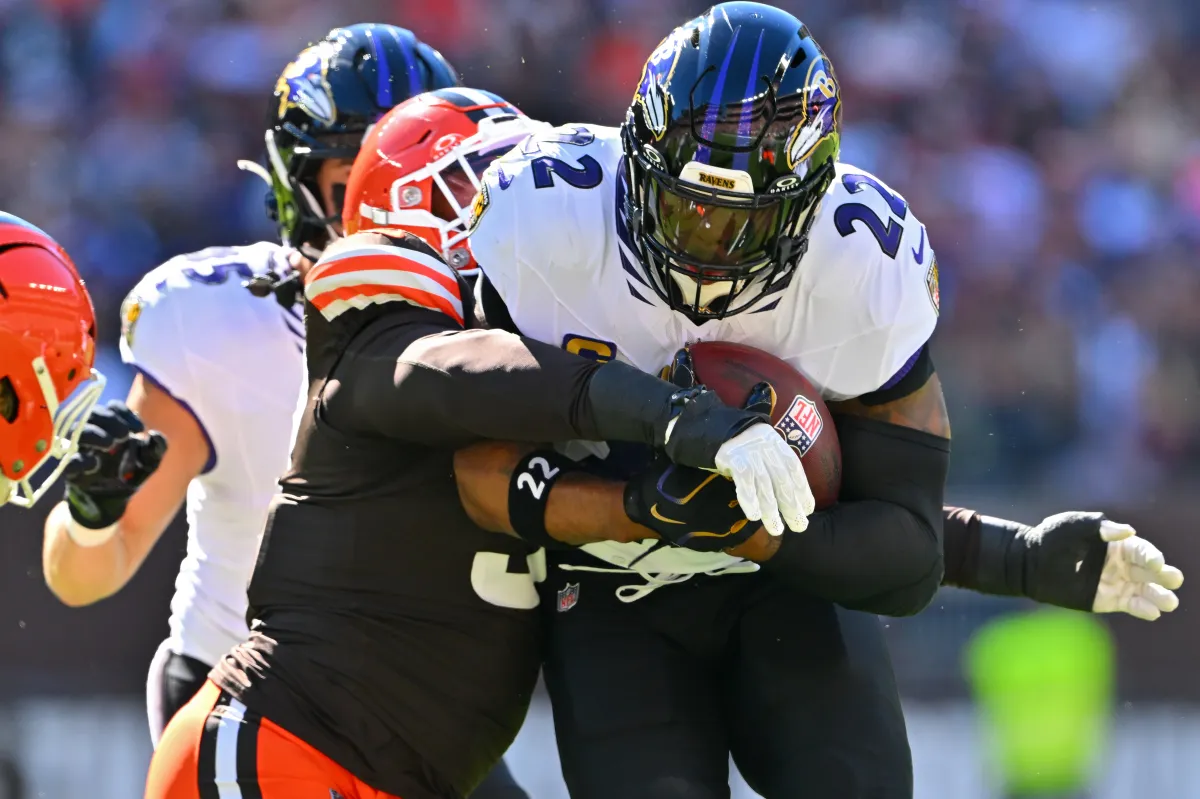
The decisive sequence was a study in heartbreak. Leading 10-3, Baltimore had a chance to extend its lead and force Cleveland into a two-score desperation. The kicker, Tyler Loop, lined up for a 49-yard field goal, the kind of kick that should have been routine in a dome but felt like a mountain in the open air. The snap was clean, the hold was good, but the ball sailed wide left, and the Ravens’ sideline sagged as if the air had been let out of the entire stadium. It was the kind of miss that does not just cost three points; it costs momentum, confidence, and the comfortable cushion that a defense desperately needs. Then, on the next possession, Derrick Henry took a handoff and fought for extra yards, as he always does, but the Browns stripped the ball away at the Baltimore 28-yard line. In an instant, the defense that had carried the team all afternoon was asked to make one more stop, with the game hanging by a thread. Seven plays later, Cleveland found the end zone, and the score was tied. The silence in the visitors’ locker room afterward was not the loud, angry silence of a team that had been blown out; it was the hollow silence of a team that had done so much right and still lost. A missed kick. A fumble. One stop that never came. Any one of those moments could have been the difference. All of them together were too much to overcome.
In the aftermath, Henry did not hide. The Ravens’ head coach, Jesse Minter, said the veteran running back stood up and took responsibility for the loss, the way a leader should, even when nobody was pointing fingers. “He just said something about it,” Minter said. “You know, nobody works harder. Nobody works harder at ball security and does those things. Again, it happened. It was a good play by them.” Those words carried the weight of a coach who knows his player’s character and hates that one mistake can overshadow a career full of reliability. But what frustrated Minter most was not the fumble itself; it was what happened after. “I’d like for us to be able to rise up and get a stop right there and have each other’s back; we weren’t able to do that. So it becomes an even bigger play when you’re not able to kind of back it up with the defense, so basically it is what it is.” There is something deeply human about that frustration. A team is not a collection of individuals; it is a promise that when one person falls, another will be there to catch him. On Sunday, that promise was broken. Henry’s teammates know he is the last person who needs a lecture on ball security. The game had already punished him enough. What the coach wanted was a response, a refusal to let one mistake define the afternoon, and the defense could not deliver it. That is the part that will linger.
Look closer at the individual numbers, and the story becomes even more human. Henry, the same man who has carried offenses for years, ended with 58 yards on 17 carries, a modest total that undersells how hard every one of those yards felt. His fumble was the only turnover the Ravens committed all game, which only magnified its cost. Huntley threw for 165 yards and a touchdown and ran for 28 more, numbers that show a backup quarterback fighting to keep a season alive. He did not throw an interception, but he could not create the explosive play that might have broken the game open. The offense scored all ten of its points on those first two drives. After that, seven punts. The defense, meanwhile, had held Cleveland to three points for most of the game, bending without breaking, forcing the Browns into third-and-long situations and celebrating every stop. But football is a game of shared fate. A defense can play brilliantly for fifty minutes, and then one fumble, one field goal miss, one long touchdown drive can erase all of it. There is no stat for the emotional toll of watching your offense struggle, of knowing that any mistake might be the one that costs everything. The Ravens were not beaten by a superior team; they were beaten by the cumulative weight of small failures. That is what makes loss so hard to process. It is not the one big moment that kills you. It is the way all the little moments pile up until there is no room left for hope.
The loss changes the landscape of the AFC North. The Browns now sit alone atop the division, while Baltimore falls to 4-2, still very much alive but suddenly with less room to breathe. The Ravens will host the Cincinnati Bengals in Week 7, another AFC North battle that will test their resilience and their patience. There is hope, of course. Lamar Jackson’s ankle is not a season-ending injury, and the Ravens have proven they can compete without him. But “compete” and “win” are not the same thing, and the margin between them is often just a single play. For a team that has been scraping by since Week 4, Sunday was a painful reminder that scraping by is not a sustainable way to live. The good teams find a way to win these games. The great teams find a way to win them even when they have no business winning. The Ravens, on this afternoon, were neither. They were just a group of exhausted, disappointed players staring at a locker room wall and wondering what might have been. The season is far from over. The path forward is still there. But it is a lot harder now, and the next chapter begins at home, with the Bengals waiting and the pressure rising. For Henry, for Huntley, for the defense that came up one stop short, the only way forward is to carry the weight of Sunday into the next game and turn it into something sharper, something more determined. That is the quiet, unglamorous work of football, and it is the only thing that can heal a wound like this.