

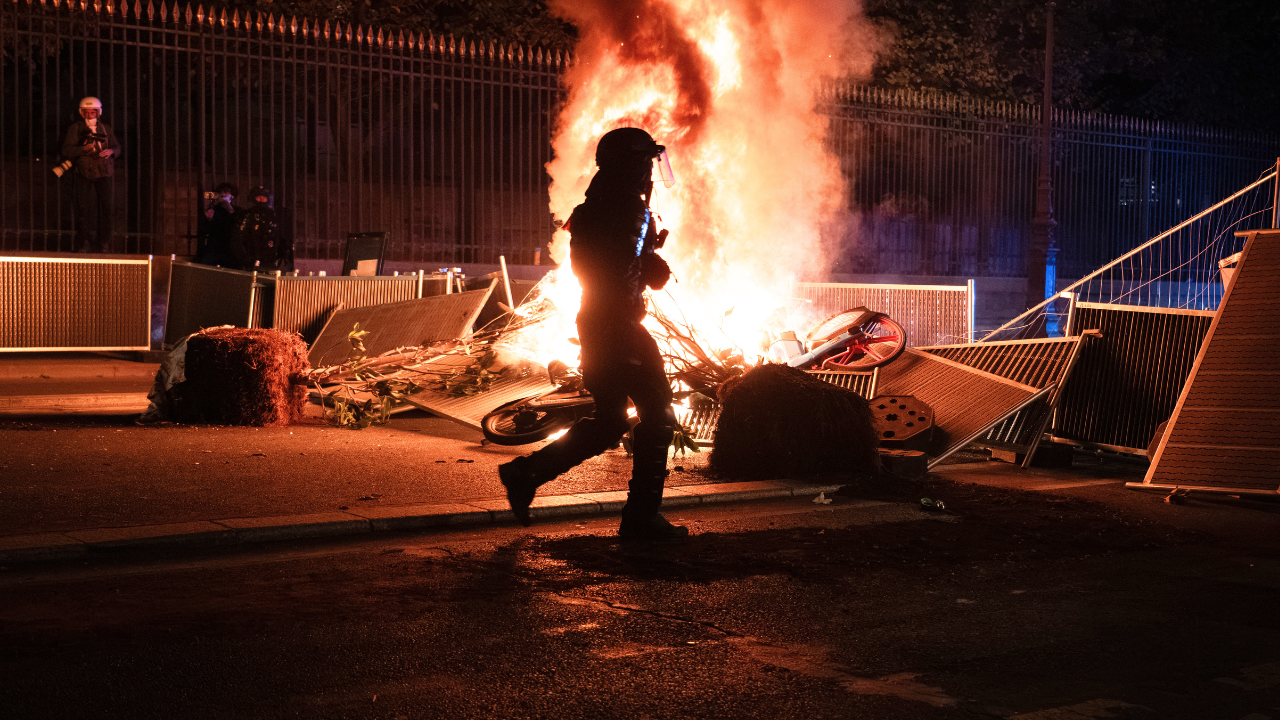
The sun rose over a wounded Paris on Sunday, and the city that so often evokes images of romance, elegance, and timeless beauty looked instead like a battlefield. Shattered storefronts lined the streets, their glass glittering in the early light like fragments of a broken mirror. Burned cars sat abandoned, blackened shells still smoking faintly, while rows of police vans and officers in heavy gear stood watch over intersections that had been scenes of chaos just hours before. The smell of smoke and tear gas lingered in the air, a sharp reminder that the night had not been one of celebration but of confrontation. Parisians emerged from their apartments slowly, some in disbelief, others with brooms and trash bags, trying to piece together what was left of their neighborhoods. The violence had erupted during nationwide demonstrations Saturday, when hundreds of thousands of people took to the streets to protest rising living costs and deteriorating school conditions. What began as a march of frustration and demand for change had, in too many places, spiraled into something far darker. Masked groups broke away from the crowds, hurling projectiles at police, smashing windows, setting fires, and looting businesses. By Sunday morning, the French interior ministry had reported roughly 1,800 arrests across the country, with 855 of those in the Paris region alone. The numbers were staggering, but the human weight behind them was heavier still: shopkeepers staring at ruined livelihoods, families walking past their children’s schools with worry etched on their faces, and a nation questioning how it had reached this point.
The causes of the unrest are not difficult to understand, even if the violence is hard to justify. France has been gripped by a cost-of-living crisis that has squeezed ordinary households for months. Food prices have climbed, energy bills have soared, and wages have failed to keep pace. At the same time, public schools have struggled under years of underfunding, overcrowded classrooms, teacher shortages, and mounting pressure on both students and staff. For many French families, these are not abstract political issues but daily realities, the kind of pressures that make people feel ignored, invisible, and desperate to be heard. Saturday’s demonstrations were, in part, an expression of that desperation. Parents marched alongside teachers, union members, and students, carrying signs that demanded dignity, fair pay, and a future for their children. There was, in those crowds, a genuine sense of hope that their voices might finally matter. But as the day wore on, the message became tangled in violence. Small groups of agitators, many wearing masks and arriving with deliberate intent, turned peaceful protest into open conflict. They fought with police, torched vehicles, and targeted businesses, their actions overshadowing the legitimate grievances of the many. It is a painful irony that those who had marched peacefully for better living conditions and schools would wake to find their own neighborhoods damaged, their own causes tarnished by the destruction. The anger that fueled the demonstrations was real, but so was the sorrow that followed the flames. For every arrest made, there were families left to wonder what had been accomplished, and for every broken window, there was a community left to ask whether the violence had silenced the very message it was meant to amplify.
Nowhere was that loss felt more acutely than in Limoges, a city about three hours south of Paris, where the destruction struck at the heart of local history and identity. As flames tore through the city’s historic town hall, a building that had stood since 1883, residents watched in horror. The structure was not just a government office; it was a monument to the city’s past, a beloved landmark designated as historically significant in 1975, and a source of pride for generations. By the time firefighters brought the blaze under control, the damage was catastrophic. Maurice Barate, the local prefect, described the scene in sobering terms, telling AFP that the roof had collapsed onto the lower floors and that roughly two-thirds of the building’s exterior had disappeared. He called it “a catastrophe for heritage,” and the words felt like an understatement. To lose a building of that age and significance is to lose a piece of the collective memory, a place where citizens had gathered, celebrated, and mourned for over a century. Its walls had witnessed the quiet rhythms of municipal life, the ceremonies and decisions that shaped the community, and the everyday comings and goings of ordinary people. Now, all that remained was a hollowed skeleton, smoke still rising from the ruins. The fire in Limoges became a symbol of the broader tragedy unfolding across France: the damage inflicted not only on property but on the shared spaces that bind a society together. In the aftermath, there was no easy comfort, no quick fix, only the hard work of rebuilding what had been lost and the painful recognition that some things, once gone, can never truly be restored.
Amid the chaos, many French citizens found themselves asking a question that carried more weight than any political slogan: where was their president? Emmanuel Macron had, in the days leading up to the demonstrations, called for “calm and respect,” urging that the right to protest be exercised with respect for people and property. It was a measured statement, an appeal to reason, but as the violence escalated and images of burning buildings filled television screens, the absence of strong, visible leadership became impossible to ignore. According to French media reports, Macron and his wife, Brigitte, were spotted at a Celine Dion concert in Nanterre, west of Paris, on the very night that clashes were erupting in the capital and beyond. The couple reportedly arrived discreetly, attended the performance, and left quietly, blending in among the roughly 35,000 spectators at the Plenitude Arena. Macron had spent the previous two days in Brussels at a European Council meeting, but the choice to spend such a volatile evening at a concert struck many as tone-deaf, even callous. The criticism came quickly and sharply, with opponents and ordinary citizens alike wondering aloud how a president could enjoy a night of music while his country’s streets were on fire. The image of Macron at the arena, far removed from the turmoil, seemed to encapsulate a broader sense of disconnect between the government and the people it serves. It was not that a leader is forbidden from taking a moment of respite, but in a moment of national crisis, symbolism matters. The French people needed to see their president present, engaged, and accountable. Instead, many saw only absence, and that perception threatened to deepen the very divisions the country desperately needed to heal.
The political reactions to the unrest reached far beyond France’s borders, adding another layer of complexity to an already volatile situation. In the United States, President Donald Trump weighed in Sunday with a characteristic blend of bluntness and moral certainty, using his Truth Social platform to place the blame squarely on immigration. “The immigration of people from an entirely different world, people with hatred in their hearts, has shattered that once great country,” he wrote, before urging France to “close your borders and take control, before it is too late!” The statement was a sharp departure from the more nuanced conversations unfolding in French media, where commentators wrestled with questions of economic inequality, public services, and the erosion of social trust. Trump’s framing reduced the crisis to a simple, visceral narrative, one that resonated powerfully with his supporters but seemed to ignore the complex realities on the ground. For many in France, the president’s words felt like an unwanted intervention, a foreign voice claiming to understand a situation he had not lived and a people he had not heard. Others, however, saw truth in his bluntness, pointing to longstanding tensions over integration, identity, and the pressures of globalization that have unsettled communities across Europe. The divide was not just between nations but within them, as people on both sides of the Atlantic searched for explanations and scapegoats. In the end, Trump’s post added fuel to a fire that was already burning out of control, reminding the world that political discourse itself had become a battleground, where every crisis is filtered through partisan lenses and every tragedy is seized upon to advance a preexisting agenda.
Yet beneath the political posturing and the broken glass, there remains a deeper, more human story that deserves attention. France is not simply a country in crisis; it is a country in pain, struggling to reconcile its values with its realities, its traditions with its future. The people who marched on Saturday were not enemies of the state; they were citizens who believed, rightly or wrongly, that their voices were not being heard. The shopkeepers who woke to shattered windows are not faceless victims; they are members of communities, neighbors, parents, dreamers who had built something and watched it crumble. The young people who clashed with police are not merely troublemakers; they are products of a world that has offered them too little certainty, too little opportunity, too little hope. The fire in Limoges did not burn down a building alone; it burned down a symbol of continuity, of the idea that institutions outlast the chaos of the moment. And the president at a concert, the foreign leader with his harsh words, the officials counting arrests, they are all part of a larger narrative, one that is still being written. The road ahead will not be easy. Rebuilding trust takes time, and rebuilding a town hall takes even longer. But if there is any hope to be found in the ashes of Saturday night, it lies in the resilience of ordinary people, the teachers, workers, parents, and students who still believe that a better France is possible. They deserve leaders who will listen, not merely lecture; who will act, not merely attend concerts; who will unite, not divide. Until then, the country will continue to hold its breath, waiting to see whether the morning after the fire brings only smoke, or the first faint light of a new beginning.