


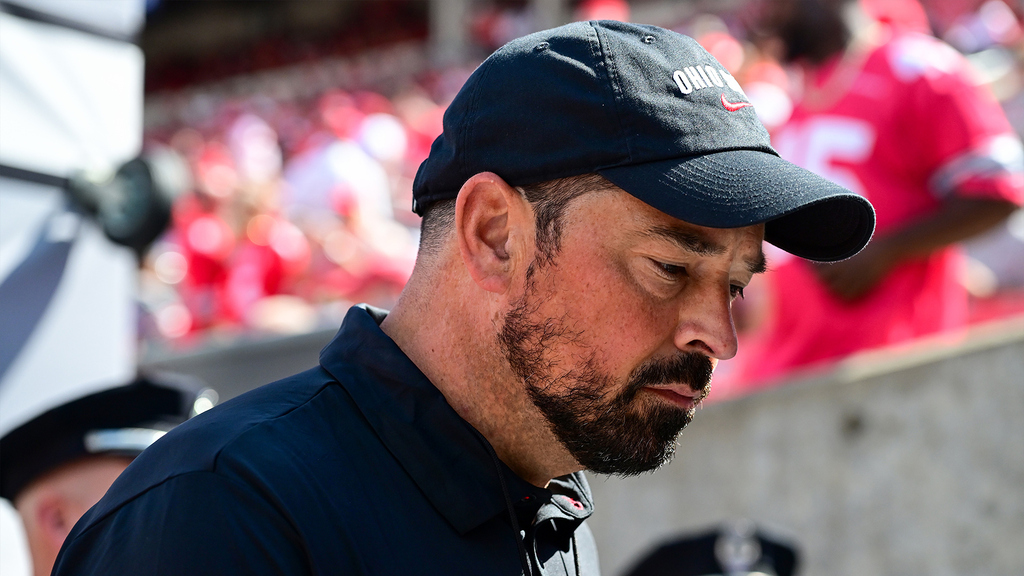
Ryan Day knows what it feels like to own a city. Two winters ago, when the confetti fell in Atlanta after Ohio State knocked off Notre Dame in the College Football Playoff national championship game, he was the proud architect of a dream that Buckeye Nation had chased for a decade. He stood at the peak of his profession, celebrated as a coach who had done the one thing that mattered most. Yet if he thought that championship would buy him permanent grace, the last few months have been a brutal awakening. In Columbus, Ohio State football is not a team; it is an inheritance, a religion, a baseline of expectation. The same fans who once chanted his name now mutter into their foam fingers, because Ryan Day just did something no Ohio State coach had done in decades: he lost to Indiana. And while one loss to the Hoosiers was bad enough, the looming rematch in Bloomington has turned those early-season grumbles into full-throated panic. If the Buckeyes lose on Saturday, Day will become the first Ohio State head coach in more than 100 years to lose consecutive games to Indiana. That kind of record has a way of erasing a national title from the collective memory. It feels almost irrational. It isn’t. At Ohio State, the list of sins that can get a coach fired has always been shorter than the list of ways to get forgiven. Lose to Michigan, and you’d better win everything else. Lose to Indiana twice in a row, and you’ve entered a historical no-man’s-land. Day is now walking that line, and the ground under his feet is crumbling. The symmetry is cruel. His national title was supposed to be armor against Michigan criticism. Instead, it has become a footnote in a conversation dominated by what has gone wrong since. A coach who has won 87 of 100 games can look like a failure because the losses carry so much weight. That’s the strange arithmetic of Ohio State, where even a 13-0 season can feel hollow if the wrong team is on the losing end. Day understands this better than anyone. He lives it every day.
To understand why Ryan Day’s seat is so hot, you have to understand the history that runs through Ohio Stadium like a current. The Ohio State-Indiana rivalry doesn’t have the name recognition of The Game, but for generations, it was a one-way street. The Hoosiers were the kind of team the Buckeyes were supposed to handle on their way to bigger things. Losing to Indiana was the football equivalent of tripping on the curb in front of your entire neighborhood. It happened to John Cooper back in 1988, and it was treated as an embarrassment. But Cooper was a coach who eventually became defined by his failures against Michigan, and that same ghost now hovers over Day. The 2-4 record against the Wolverines is the first line in any discussion of Day’s future. In Columbus, Michigan isn’t just another opponent; it’s the measuring stick, the obituary writer, the final judge. Fans can tolerate almost anything, including a playoff loss, as long as the team beats Michigan. But Day has not done that nearly enough, and the national championship, while glorious, did not fully heal the wound. The Wolverine loss in the regular season still stung through the playoff run. Now the Indiana problem has started to bleed into the Michigan problem. Losing to an unheralded conference rival once is a blip. Losing to them twice in a row suggests a deeper vulnerability. And when combined with a 2-4 mark against the hated Wolverines, it starts to feel less like bad luck and more like a pattern. The fans aren’t just upset; they’re terrified that Day is the kind of coach who wins the games that should be hard to lose, but loses the games that should be hard to win. In a town where the phrase “What have you done for me lately?” was practically invented, the recent “lately” is becoming impossible to defend. And if Indiana walks off the field victorious again, Day won’t just have lost a football game. He will have lost the story, the narrative, the wobbly foundation of trust that has kept the wolves at bay. That’s why the history matters. That’s why a trip to Bloomington has become more than another Big Ten Saturday.
Behind every coaching crisis, there is a contract, and Ryan Day’s is a monster. After leading the Buckeyes to the 2024 national championship, Day was rewarded with a five-year, $87.5 million extension that reflected his value to the program. He was no longer just a coach; he was the highest-paid employee in the state, a man whose salary made even university presidents uncomfortable. But that contract also created a golden cage. Firing Day would require paying out the remaining guaranteed money on his deal, a sum that sits at roughly $75 million over the next five-plus years. That kind of cash doesn’t appear from a loose change jar. It is a staggering financial commitment, one that would make any athletic director pause, even one who believes a change is necessary. In the modern college football economy, buyouts are common, but $75 million is the kind of number that can reshape an athletic department’s budget, affect other sports, and force a university to make uncomfortable choices about booster donations and debt. It’s also, oddly, a reason Day might survive. The people who want him gone have to convince those who control the purse strings that $75 million is worth spending on a coach with a national championship on his resume. That’s not an easy argument to win, especially when the alternative—keeping the coach, hoping he fixes the rivalry issues—costs nothing upfront. But the math is only part of the equation. College football is no longer a sport; it’s an arms race, and Ohio State has an entire city and an international alumni base watching its every move. A $75 million buyout might be worth it if the program starts sliding into irrelevancy. The problem is that Day hasn’t made Ohio State irrelevant. He’s made them very good, sometimes elite, but not consistently dominant in the games that matter most. That nuance is nearly impossible to explain to a donor who just watched the Buckeyes lose to Indiana for the second straight year. In that moment, the buyout becomes a price tag, and the question becomes not “Can we afford it?” but “Can we afford not to?”
Amid all the gloom, it’s worth remembering how good Ryan Day has been. His overall record at Ohio State is a jaw-dropping 87-13. He has won two Big Ten championships. He has won a College Football Playoff national title. He did it in the first year of the 12-team playoff, a grueling gauntlet that required beating Oregon, Texas, and Notre Dame in succession. That run alone should have cemented his legacy. The victory over Notre Dame in the title game was not just a win; it was a release valve, a moment of pure catharsis for a fanbase that had spent years hearing about Michigan. Day was on top of the world, and the future seemed unlimited. The following season brought more promise. Day guided Ohio State back to the Big Ten championship game for the first time since the COVID-shortened 2020 season, and if that sentence feels stale, it’s because the weight of the rivalry has a way of overshadowing conference trophies. Yet when the Buckeyes walked off the field in the conference title game, they had lost to Indiana, 13-10, in a defensive slugfest that felt less like an upset and more like a changing of the guard in the Big Ten. Even that might have been survivable if Ohio State had responded in the College Football Playoff. They drew a bye and then fell to 10-seed Miami in the Cotton Bowl, a loss that ended their season with more questions than answers. Now, with a national championship less than two years in the rearview mirror, Day is being forced to defend his entire tenure. It seems ungrateful. It seems unfair. But in the ruthless world of elite college football, gratitude has a short half-life, and unfairness is simply the cost of doing business. Day’s wins are real. His talent evaluation is real. His ability to recruit at a top-five level is real. The problem is that the jury in Columbus doesn’t want a report card; they want results that come in late November and early January, and they want an opponent from a state up north to feel the pain for once.
Now the stage is set for the most consequential regular-season game of Day’s career. On Saturday, in Bloomington, the Buckeyes will walk into Memorial Stadium facing a team that has already beaten them once, a program that now believes it can beat them again. That alone is a psychological hurdle. Indiana was once a team you played before the serious season began. Now the Hoosiers are a measuring stick, a legitimate conference power with a stadium full of fans who smell blood. If Day loses again, he will make history in the worst way possible: the first Ohio State coach in 113 years to lose consecutive games to Indiana. Think about that. A hundred and thirteen years. Presidents have come and gone. Wars have started and ended. Ohio State has employed a dozen coaches over a century of football. None of them ever suffered consecutive losses to the Hoosiers. But Day could. And the saddest part is that it wouldn’t be a fluke. It would be the result of a pattern, a tendency to shrink in the biggest moments, to let fear creep into a program that has always been built on intimidation. The players may feed off his anxiety. The coaches may mirror his caution. And in a game against an opponent with nothing to lose, that can be fatal. The fans know it. You can hear it in the radio call-in shows, see it in the social media timelines, feel it in the air at the coffee shops around Columbus. A second straight loss to Indiana would not merely be a bad day; it would be a referendum on Day’s entire tenure. It would be the piece of evidence that his critics have been waiting for, the final confirmation that the national championship was a beautiful accident, not a foundation. And once that narrative takes hold, no contract, no buyout, no past victory can protect him. The seat he’s sitting on isn’t just hot; it’s on fire.
Where does this leave Ryan Day? It leaves him in a strange and lonely place, a coach who has won more than almost anyone but is being judged for the few losses that matter most. It leaves him at the center of a college football culture that worships success but punishes imperfection. If he beats the Hoosiers on Saturday, he buys himself a little more time, a little more space to try to fix the Michigan problem and make another playoff run. If he loses, he likely becomes the most expensive coaching casualty in the history of the sport, a cautionary tale about the impossible expectations that come with leading Ohio State. The truth is, Day isn’t a bad coach. He might even be a great coach who simply hasn’t figured out how to win the two or three games each year that define success in Columbus. But great is rarely enough in a program that expects perfection, and the gap between “very good” and “eternally remembered” is measured in inches, in blocked kicks, in fourth-quarter decisions, in moments that coaches replay in their heads for the rest of their lives. Day has given Ohio State championships, and for that, he deserves a level of respect that no amount of rivalry pain can erase. But respect doesn’t pay the buyout, and it doesn’t cool down a hot seat. Saturday in Bloomington will tell us more about Ryan Day’s future than any press conference or contract clause ever could. It will tell us whether he has the emotional strength to reverse the narrative, whether he can handle the weight of history, whether he can find a way to win a game that has suddenly become bigger than the sport itself. There is still a version of this story where he rewrites the ending, where the same coach who led Ohio State to a title proves he can survive the most unforgiving season of his life. The answer, one way or another, is almost here. And for Ryan Day, the only certainty is this: the eyes of Ohio State are on him, and they aren’t blinking.