


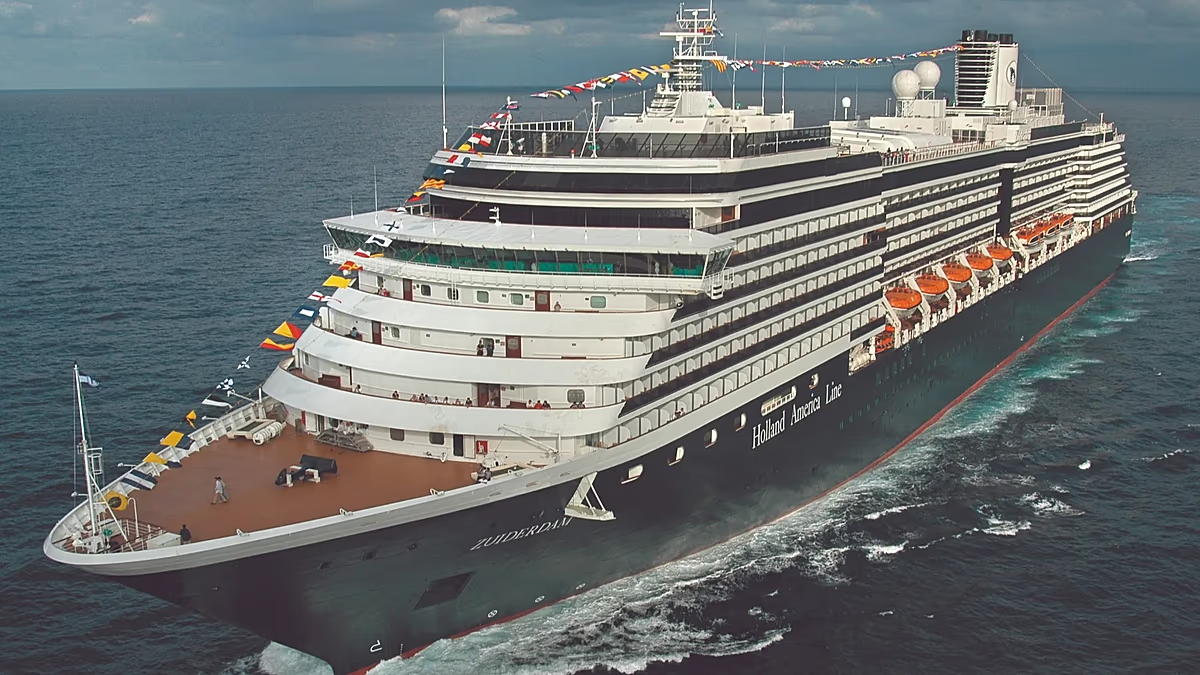
There was a time, not so long ago, when the words “Pan Am” conjured more than just an airline. They summoned an entire era of glamour, of impossibly stylish passengers walking through futuristic terminals, of crews in crisp uniforms and pilots who seemed to have stepped out of a movie. Pan Am was shorthand for adventure, for the whole wide world itself—a promise that the journey could be just as magical as the destination. For anyone born after the airline’s final flight in 1991, that world has felt forever out of reach, a sepia-toned dream preserved in vintage luggage tags, old posters, and grainy home movies. And yet, a remarkable opportunity is about to bring that dream back into focus. Holland America Line has announced a Pan Am 100th Anniversary Legendary Voyage, a one-of-a-kind cruise that invites travelers to step inside the romance of aviation’s golden age, even though they will be traveling by sea rather than by air. Scheduled to set sail from Miami on October 30, 2027, the 28-day journey will retrace portions of Pan Am’s historic routes through the sun-drenched waters of the Caribbean and Central America. It is, in effect, the next best thing to boarding a Clipper in the 1950s. The cruise line promises far more than a beautiful itinerary; it will be a deeply immersive tribute, with talks from aviation historians, Pan Am-inspired dining experiences, and a recreation of the Clipper Club, the airline’s legendary private airport lounges. As Paul Grigsby, vice president of itinerary planning and deployment for Holland America Line, put it, Pan Am helped redefine what it meant to travel, turning the journey into an experience filled with discovery, connection and a sense of occasion. With this cruise, he said, the company is bringing that era to life while merging elements of Pan Am’s storied history with Holland America Line’s signature experiences. Guests will have a chance to see how the legacies of two travel brands come together in ways that feel authentic to both, from the ship itself to the destinations along the way. It is a seductive promise, especially for those who have always felt a pang of longing when looking at old photographs of stewardesses in smart hats and passengers laughing over champagne at 30,000 feet.
Aboard the ship, the spirit of Pan Am will be woven into every detail, beginning with the kind of food that economy-class passengers today can only dream of. While modern airline meals have become synonymous with plastic trays, wilted salads and mystery proteins, Pan Am’s menus were a point of pride—elegant productions that turned a flight into a restaurant in the sky. Guests on the Legendary Voyage will be able to sample dishes that might once have appeared on those celebrated menus, including cocktail de crevettes, a classic starter of jumbo shrimp, boiled egg, asparagus and Louis dressing; broiled filet mignon Maître d’Hôtel, with all the buttery, herb-infused indulgence of old-school Continental cuisine; and a soufflé grand marnier with crème anglaise that sounds like the very definition of a grand finale. The bars, too, will get in on the act, with specially crafted cocktails designed to evoke the era. There is the Pan Am, a bright, complex mix of white rum, Campari, orgeat, lemon juice and egg white, and the Clipper, a softer, more mysterious blend of rum, Dolin Blanc and grenadine garnished with a lemon twist. Sipping one of these while the ship slips through warm Caribbean waters, it will not be hard to imagine a time when travel moved at a slower, more deliberate pace. Perhaps the most evocative touch of all is the recreation of the Clipper Club. In its heyday, the Pan Am Clipper Club was a sanctuary for the well-heeled, a quiet haven away from the bustle of the terminal where travelers could enjoy a drink, a meal and a view of the runway before boarding. Recreating that space on a cruise ship is a deeply romantic gesture, a way of reviving not just the aesthetics of the era but its atmosphere of privilege and ease. For guests, it offers a chance to dress up, settle into a comfortable chair, and feel, if only for a moment, like one of the lucky few for whom flying was the high point of the trip, not a chore to be endured. The attention to detail is a reminder that Pan Am understood something essential: travel is not just about arriving somewhere; it is about the way we are made to feel along the way.
But the voyage will not simply be a feast for the senses; it will also be an education. Holland America Line has assembled a programme of talks and presentations that promise to offer genuine insight into the airline’s culture, its triumphs and its heartbreaks. Among the speakers is Linda Freire, the chair and co-founder of the Pan Am Museum Foundation, an organization dedicated to preserving the airline’s legacy and sharing its history with new generations. Also joining the cruise is David Kliman, a former Pan Am pilot who can speak with firsthand authority about what it was like to fly the routes that helped define commercial aviation. These are not the kind of dry, academic lectures one might expect; rather, they are an invitation to listen to stories from people who lived and breathed Pan Am, to ask questions and to connect with a past that still resonates in the present. For anyone with an interest in aviation, mid-century design, or cultural history, these sessions will surely be among the highlights of the journey. Off the ship, the adventure continues with a series of Pan Am-inspired excursions in a string of storied ports. The itinerary includes Cartagena in Colombia, a walled city of colonial charm and Caribbean energy; Colón in Panama, the gateway to the canal and a place that holds a special place in Pan Am’s history; St. John’s in Antigua, with its white sand beaches and British colonial remnants; and Port of Spain in Trinidad and Tobago, a vibrant melting pot of cultures and rhythms. Each of these destinations was once part of Pan Am’s sphere, and the excursions will be designed to help passengers see them through the eyes of a traveler from the golden age, when every stop was a new discovery, when the world felt both enormous and intimate. It is a chance to understand not just the airline’s routes, but the places that made those routes so magical—and to appreciate how much of the modern Caribbean’s tourism landscape owes its origins to those pioneering flights.
The Holland America cruise is not the only sign that Pan Am’s mystique remains as potent as ever. Late last year, JP Hospitality announced that it would be reviving the Pan Am brand for a collection of airport hotels, a move that seems almost too perfect to be true. The company plans to open properties in a number of major European cities, including Amsterdam, Berlin, Brussels, Copenhagen, Geneva, Lisbon, London, Oslo, Madrid, Milan, Munich, Paris, Stockholm and Vienna, as well as far-flung destinations around the globe such as Dubai, Bangkok, New York, Tokyo and Sydney. The idea of checking into a Pan Am hotel in the middle of an airport, with all the retro styling and glamorous associations that the name implies, is deeply appealing, especially for those who never had the chance to fly the airline. It is a clever reimagining of the brand, one that shifts the focus from the journey itself to the liminal spaces where travel begins and ends. Meanwhile, Pan Am Hotels already operates a suite and lounge in Berlin, which have been designed in a mid-century style that channels the golden age of air travel. From the vintage furniture to the careful attention to color palettes and typography, these spaces offer a glimpse of what the full hotel experience might look like. It is fascinating to see a brand that went bankrupt in 1991 being resurrected for a new era, not as a functioning airline but as a lifestyle concept, a symbol of a time when travel felt more romantic. The cruise, the hotels and the hospitality ventures all share a common thread: a deep, almost wistful longing for a kind of travel that has largely disappeared. In a world of budget carriers, packed security lines and constant connectivity, the Pan Am name has come to stand for an alternative—an idealized past in which flying was special, and the traveler was a guest rather than a customer. Whether that dream can ever truly be recaptured is another question, but it is certainly a beautiful one to explore.
What is it about Pan Am, specifically, that continues to capture the imagination? After all, many other airlines from the golden age have vanished without inspiring much beyond a shrug. Pan Am was different. It was a pioneer, the airline that in many ways invented the idea of global air travel, opening routes across oceans and continents at a time when flying was still a thrilling novelty. It was also a cultural icon, immortalized in films, novels and the collective memory of anyone who ever aspired to board one of its Clippers. The airline helped redefine what it meant to travel, as Holland America’s Paul Grigsby noted, turning the journey into an experience filled with discovery, connection and a sense of occasion. That language matters. In today’s world, travel has often become transactional—a matter of getting from point A to point B as quickly and cheaply as possible. The romance has been stripped away, replaced by efficiency and algorithms. Pan Am represents the opposite instinct: the idea that the journey itself should be savored, that every meal, every cocktail, every conversation with a fellow passenger is part of the adventure. It is a philosophy that translates beautifully to a cruise, where the pleasure of the journey is the entire point. There is something profoundly appealing about stepping back into that slower, more elegant world, even for just a few weeks. It is a chance to disconnect from the noise of modern life and embrace a rhythm that feels more human, more intentional. Perhaps that is why the Legendary Voyage has generated so much excitement, and why the Pan Am revival in general has found such a receptive audience. We may not be able to turn back the clock, but we can still dream, and we can still create experiences that evoke the magic of an era we never knew. The cruise is not just a holiday; it is a time machine, a floating tribute to an age when the world seemed larger and somehow more accessible at the same time. For 28 days, passengers will be able to live, if only temporarily, in the world Pan Am created.
For those who are ready to book their passage, the Pan Am 100th Anniversary Legendary Voyage promises to be an extraordinary journey. It departs from Miami on October 30, 2027, and for 28 days, it will curl through the Caribbean and Central America, following in the wake of the Pan Am Clippers that once connected the Americas to the world. The ship will call at historic ports, host fascinating guests, and offer culinary and cocktail experiences that would make a mid-century flight attendant nod in approval. But above all, it will offer something increasingly rare in the modern world: a sense of occasion. The very act of traveling on such a voyage feels like taking a stand for the beauty of slow, deliberate exploration. It is an invitation to dress for dinner, to linger over a conversation, to watch the sea slide by with no other goal than to enjoy the moment. Holland America Line has clearly taken great care to honor the Pan Am legacy, working with museums, historians and former crew members to ensure that the details are authentic. The result is a voyage that is equal parts celebration, education and nostalgia trip. It is also a reminder that the past is never really gone; it lives on in the stories we tell, the meals we share, and the journeys we take. Whether you are a lifelong aviation enthusiast, a fan of mid-century aesthetics, or simply someone who dreams of a more romantic way to see the world, this cruise offers a rare opportunity to step into that dream. And with the Pan Am brand continuing to find new life in the hospitality world, it seems the legend is far from finished. So begin planning now, perhaps with a vintage Pan Am poster in hand and a martini in the other. The Clipper Club is waiting, the sea is warm, and somewhere over the horizon, an era is waiting to be rediscovered. All you have to do is book a ticket and let yourself be carried away.