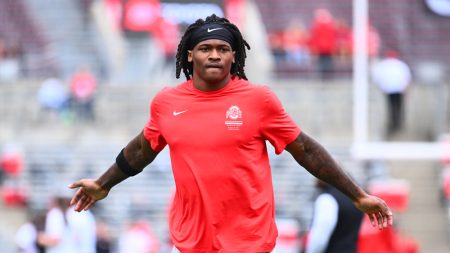
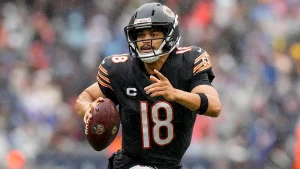


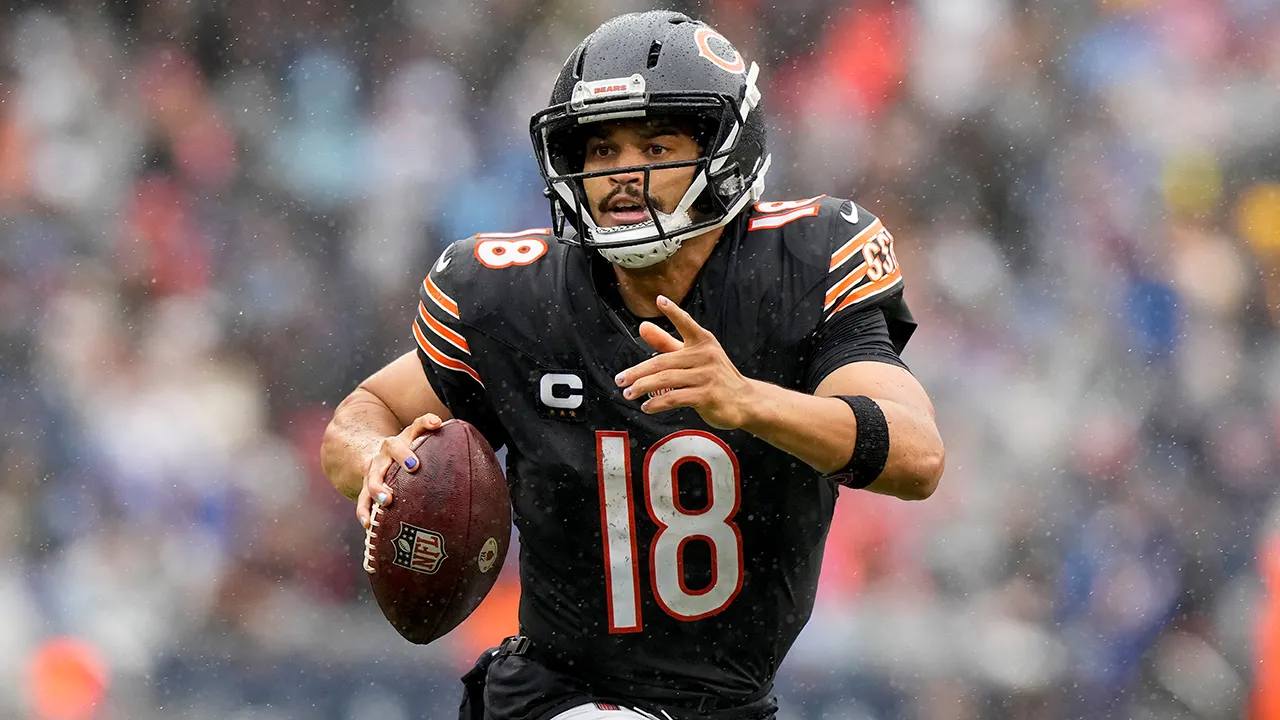
The crisp autumn air over Lake Michigan carried an unexpected charge as Caleb Williams strode back onto the practice field Thursday morning. For the first time in nearly a month, the Chicago Bears’ franchise quarterback wasn’t a spectator in street clothes or a tentative figure testing his legs on the sideline. He was a full participant, cutting, sprinting, and throwing with the kind of freedom that had been painfully absent since that grim September afternoon in Minnesota. But if his body had healed enough to resume his craft, his spirit was clearly still bruised. When Williams later faced the media in the Halas Hall auditorium, the atmosphere was less like a standard press conference and more like a cold war summit. The young signal-caller, usually known for his easy smile and polished answers, sat with crossed arms and a defensive glare. The first question hadn’t even fully left the reporter’s mouth before the tension became tangible: What exactly was the grade of the hamstring tear that had sidelined him? Williams, who had just described the injury as “pretty serious,” flatly refused to provide the medical classification. His answer—”Because it’s not deserving”—hung in the air like a challenge, and the icy standoff that followed made it clear that the real battle wasn’t with his hamstring, but with the media machine that demanded a tidy label for his pain.
The saga traces back to that chaotic fourth quarter of Week 2, when the Bears were fighting to stay competitive against the Vikings. Williams scrambled toward the end zone, his legs churning with the explosive athleticism that made him the first overall pick, and then—without warning—he pulled up. The replay showed him glancing back, puzzled, almost as if an unseen defensive back had grabbed at his ankle. In his own words, “I felt a pop.” That pop was a tear, a serious one, and the television cameras captured the raw aftermath: Williams sitting on the turf, his face contorted in anguish, tears streaming down his cheeks as the cart rolled out. For a rookie quarterback already shouldering the hopes of a starved franchise, it was a moment of utter vulnerability. Yet in Thursday’s press conference, Williams didn’t shy away from that emotional display. He defended it fiercely, insisting that his tears were not a sign of weakness but a testament to how deeply he cares about his teammates and the game. “I’m always going to show emotion,” he said, “especially when I can’t be out there with the guys.” He dismissed the jokes and ridicule that followed, claiming they didn’t bother him—though the tight set of his jaw suggested otherwise. That moment of unfiltered humanity, so rare in today’s carefully curated athlete persona, became the backdrop for the real issue at hand: who gets to define the truth of his injury?
For weeks, the national sports media had been spinning narratives. They spoke of a Grade 2 hamstring strain, confidently projecting a two-to-four-week recovery timeline, analyzing his every sideline step, even critiquing his casual pace during the national anthem. Williams, clearly still fuming, torched that reporting Thursday with a five-minute opening statement that was part catharsis, part rebuke. “There’s nothing that has come out that has been right about what it is and what it has been,” he insisted. The grade, he argued, was not just a medical detail—it was a secret weapon, a chip on his shoulder, a piece of knowledge that belonged only to him and his medical staff. Why should the public get to slap a label on his body? Why should a number dictate the narrative of his struggle? In an NFL where injury transparency is often treated as gospel, Williams’ refusal to play ball was a quiet act of rebellion. He seemed to be saying that his recovery is not a commodity to be traded for news cycles. The reporters pressed, prodding for a clue, but he held the line, turning the press conference into a philosophical debate about privacy in a sport that exposes everything. The exchange grew testy, with Williams repeating that the details were “not deserving” of public consumption—a phrase that left many wondering if he meant the reports were beneath him, or that the grade itself was too personal to be reduced to a data point.
Behind the standoff lies a much larger story—the burden of being the Bears’ chosen one, the man anointed to end decades of quarterback purgatory. Williams arrived in Chicago amid a blizzard of hype, comparisons to legends, and a crushing weight of expectation. Every throw is dissected, every incompletion magnified, every emotional reaction weaponized against him. His critics have already begun to question his toughness, his leadership, even his dedication, pointing to his visible frustration as a sign of immaturity. But Thursday’s defense of that emotion was a glimpse into his inner world. He is not a robotic, media-trained automaton; he is a passionate young man who wears his heart on his sleeve, who weeps when he lets his brothers down, and who treats a hamstring tear as a personal betrayal. The press conference was not just about a medical grade—it was about ownership. Williams is demanding control over his own narrative in a world that wants to package him into sound bites. He didn’t just refuse to answer the question; he flipped the question itself, challenging the premise that fans and pundits have an automatic right to his most intimate health details. It’s a calculated stance, and perhaps a risky one, but it’s also undeniably human. He is a man saying, “This is my body, my recovery, and I will tell you what I want, when I want.”
The physical comeback, meanwhile, has been a grueling testament to his determination. Williams revealed that he has been undergoing five to six hours of daily rehabilitation—a brutal routine of stretching, massaging, strengthening, and agonizingly gradual reintroduction to sprinting. He reported reaching top speeds in recent workouts, a milestone that offered a glimmer of hope to a Bears fanbase desperate for good news. Yet the road to Sunday’s game against the Atlanta Falcons remains uncertain. Williams himself was emphatic on that point: “Before you start asking, I do not know if I’m playing yet.” The decision, he said, hinges on medical clearance, not just his own willingness. “If I’m good to go, I’m good to go. If I’m not and we’re just not ready, then we got to wait.” That final word—wait—carries a heavy resonance for a team still seeking its identity. The Bears have stumbled out of the gate, and their offense has been anemic without their dynamic leader. The temptation to rush Williams back is real, especially with a winnable game on the horizon. But Williams is signaling that he won’t be bullied into premature return, even by the weight of his own ambition. He knows that a compromised hamstring could jeopardize not just this season, but his entire career. And so he waits, not out of cowardice, but out of a hard-won wisdom that sometimes the bravest thing is to sit still.
In the end, Thursday’s press conference was a mirror into the soul of a young quarterback who refuses to be a cardboard cutout. His icy exchange with reporters, his defiant secrecy about the grade, his unapologetic embrace of emotion—all of it paints a portrait of an athlete who is fiercely protective of his own humanity. As the Bears prepare for the Falcons, the football world will be watching to see not just whether Williams plays, but how he carries himself in the midst of continued scrutiny. The hamstring may be healing, but the trust between him and the media remains torn. Williams has made it clear that he will not hand over the keys to his story; it must be earned. And if his silence frustrates those who demand instant answers, so be it. He is not just a quarterback; he is a man navigating pain, pressure, and the unrelenting glare of the public eye. His message to the world is simple, echoed in his every curt reply: he will be ready when he is ready, he will speak when he chooses, and he will define his own recovery on his own terms. That may not satisfy the 24-hour news cycle, but it’s a stance as real as the “pop” he felt in his leg—undeniable, unmistakable, and entirely his own. The next chapter of this saga will unfold under the Sunday lights, where the only grade that truly matters is the one that wins games. And for now, Caleb Williams holds that verdict in his hands.