


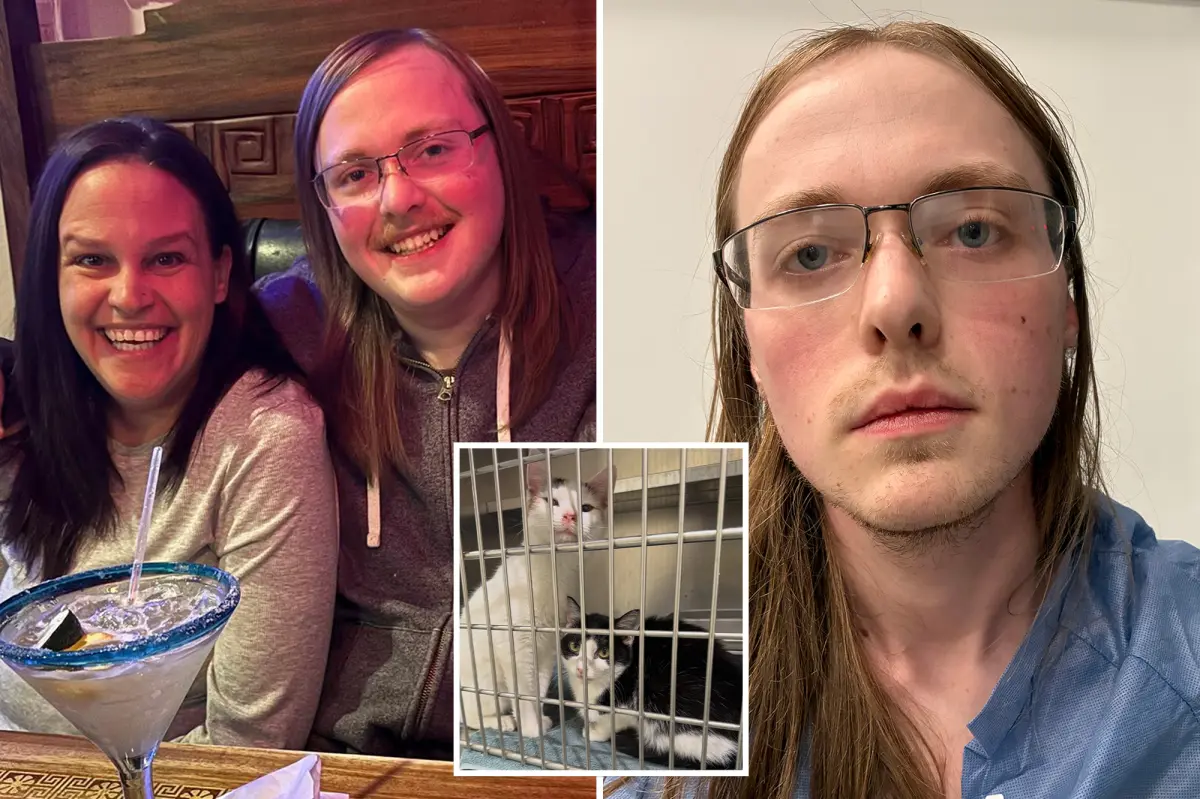
On a cool October evening in the quiet town of Reading, Massachusetts, the life of Andria Hanafin—a devoted mother, a skilled veterinary technician, and a woman who opened her home to the most vulnerable of creatures—came to a violent and incomprehensible end. Authorities allege that her own 22-year-old son, Ryan Hanafin, shot her in the head inside their family kitchen, following a bitter argument over something that, on its surface, seems almost absurd: the sheer number of cats she had taken in as a foster caretaker. That number, it would later be revealed, was staggering—eighty-four felines were eventually recovered from the home, a testament to Andria’s boundless compassion but also, in the eyes of her son, a source of unbearable friction. The tragedy that unfolded has left a community reeling, a family shattered, and a young man facing a first-degree murder charge, yet the story is far more complex than a simple headline can capture. It is a tale of love turned to resentment, of mental strain and unchecked emotions, and of how even the most altruistic impulses can, in the most tragic of circumstances, become a flashpoint for violence.
The events leading to that fateful night began days earlier, when Ryan’s father, Matthew Hanafin, last saw his son on the morning of October 7. Concerned about Ryan’s lack of direction, Matthew urged him to find a job and “do something with his life.” It was a common, well-meaning plea from a parent, but it clearly fell on unreceptive ears. Later that evening, Andria called her husband and conveyed a decision that had likely been building for some time: she wanted their son to move out. The tension in the household had presumably reached a breaking point, centered largely on the overwhelming number of cats she was fostering. For Andria, a vet tech who had dedicated her career to animal welfare, the cats were a mission, a calling. For Ryan, they may have represented chaos, filth, and an intrusion on his space. By nightfall, that simmering conflict exploded into deadly violence. After allegedly shooting his mother, Ryan did something bizarre and deeply disturbing: he sent a message to his cousin via Snapchat, boasting that he had “blew madre to pieces” and that he had “blew her [expletive] smooth off.” The cold, casual tone of that message, delivered through a platform meant for fleeting moments, underscores the disconnect from reality that seems to have gripped Ryan in the aftermath.
The grim discovery came around midnight on October 8, when Matthew Hanafin arrived home and found his wife lying in the kitchen with a gunshot wound to her head. But the horror did not end there. In another room of the house, Andria’s 13-year-old son—Ryan’s half-brother—was present, having been in the home during the shooting. The psychological impact on that young teenager is impossible to fully fathom; to lose a mother so violently, and to know that a sibling was alleged to be the perpetrator, is a trauma that will likely reverberate for the rest of his life. Meanwhile, Ryan had already fled the state, making his way to Vermont, where he was arrested on October 8. He was subsequently extradited back to Massachusetts and arraigned on first-degree murder charges, pleading not guilty. As investigators combed through the house, they uncovered another layer of the tragedy: more than 19 firearms were found in Ryan’s bedroom, which itself was described as being in “hoarding conditions.” Fifteen of those guns were unsecured, meaning that a young man with no discernible employment or stable life had easy access to an arsenal of weapons—a fact that has become a focal point of the additional charges he now faces.
To understand Andria Hanafin, one must look beyond the grim statistics of the case. She was remembered at a Wednesday vigil by more than 100 community members as a caretaker and a friendly neighbor, someone who would go out of her way to help others, both human and animal. Her work as a veterinary technician was not just a job; it was a reflection of her character. The 84 cats that were rescued from her home were not merely possessions—they were creatures she had saved from difficult circumstances, nursing them back to health and giving them shelter. In many ways, her home was a sanctuary, but it was one that came at a cost. The conditions inside the house, with the overwhelming presence of animals, had clearly created stress for the family. Yet for Andria, the alternative—turning away animals in need—was likely unthinkable. Her 13-year-old son, now left without a mother, will have to navigate a future shaped by this tragedy, guided by relatives and a community that has rallied around him, but forever marked by the senseless loss of one of the most caring people they knew.
The legal proceedings against Ryan Hanafin are just beginning, and the details that will emerge in court are likely to be complex and painful. He faces charges of first-degree murder, as well as additional counts related to the unsecured firearms, which prosecutors argue represent a criminal neglect of safety responsibilities. The fact that Ryan pleaded not guilty suggests that his defense may center on mental health or diminished capacity, though no such claims have been formally made. Middlesex County District Attorney Marian Ryan (no relation) spoke at the vigil, acknowledging the broader impact of the tragedy on the community, especially its children. “These are the kinds of things that frighten people,” she said. “They’re hard for kids to process. Even for folks like the police and fire department, we sometimes underestimate the trauma that these things cause to people. Yes, it’s their job to go and do that. That doesn’t make it easier.” Her words underscore the ripple effect of violence—how it touches not just the immediate family but the entire fabric of a neighborhood, leaving fear, confusion, and grief in its wake. The presence of over 100 mourners at the vigil is a testament to Andria’s legacy and the collective heartbreak of those who knew her.
As the community of Reading grapples with this shattering event, there are larger, uncomfortable questions that must be asked. What drives a young man to turn against the mother who raised him, especially over something as benign as the number of cats she chose to foster? Is it a story of untreated mental illness, of a growing alienation exacerbated by a father’s admonishment to “do something with his life”? Or is it a cautionary tale about the accumulation of stress—financial, emotional, and physical—that can rend a family apart? The hoarding conditions found in both the cats’ living spaces and Ryan’s own bedroom suggest a household in which order had collapsed, perhaps symptom of deeper dysfunction. The easy availability of firearms, too, is a stark reminder that in moments of extreme distress, access to lethal means can transform a heated argument into an irreversible tragedy. While no explanation will ever justify the taking of a life, humanizing those involved means acknowledging that both Andria and Ryan were caught in a perfect storm of unmet needs and unchecked pressures. Andria’s love for animals was a virtue, but one that may have inadvertently contributed to an untenable home environment. Ryan, now awaiting his next court appearance on November 10, is a man whose life has been irrevocably destroyed as well, even as his actions have destroyed another’s. In the end, this is not a simple story of good versus evil, but a profound and painful example of how fragile human bonds can be—and how quickly they can shatter under the weight of circumstances that no one fully understood until it was too late.