


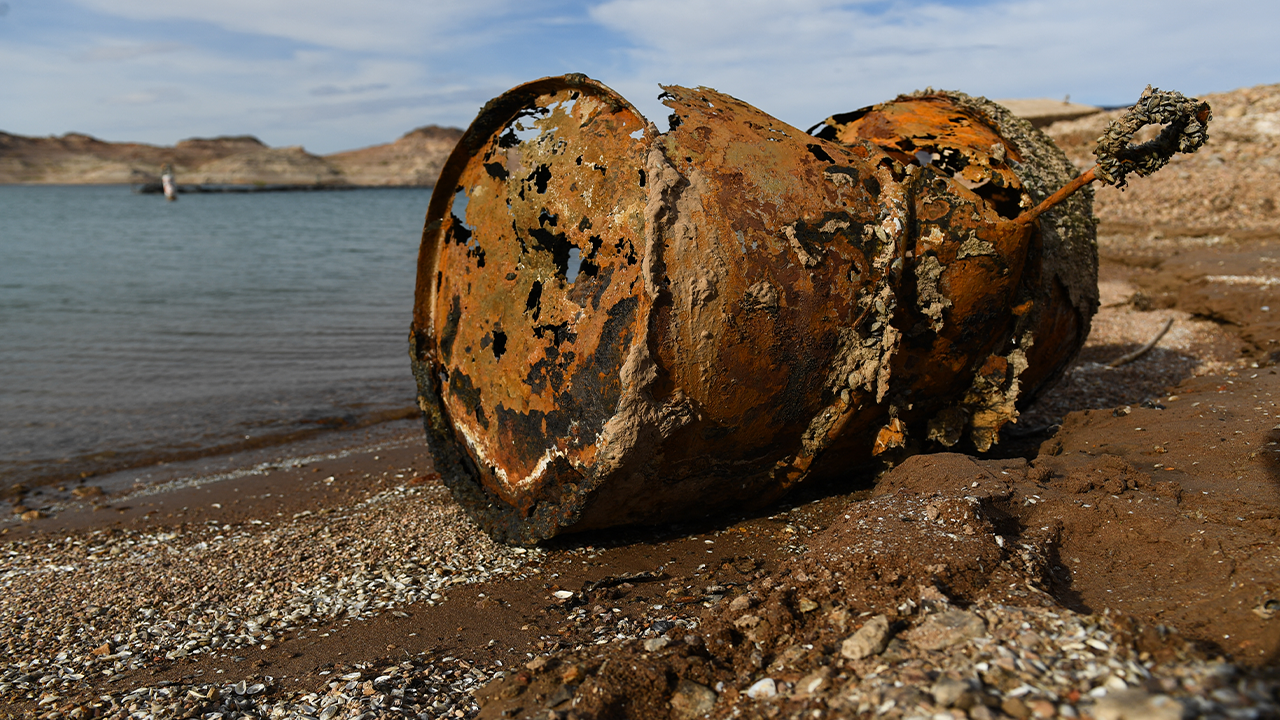
Water, it is often said, keeps its mysteries. But a lake in drought has no choice but to confess. For years, Lake Mead has been retreating, its shorelines pulling back like a slow curtain, and in the spring of 2022 the retreat exposed something terrible. On May 1 of that year, a group of boaters at Hemenway Harbor, a familiar launch point on the Nevada side of the reservoir, spotted a rusted barrel half-born from the drying mud. It was not the kind of debris you kick aside with a laugh; it was the kind you stop and stare at, then quietly back away from. The boaters reported it, and when authorities arrived, they opened a container that was never meant to be opened. Inside were the remains of a man. He had been shot, killed, and then sealed inside a steel drum, hidden beneath the waters of a place known for keeping its own counsel. For four years, that barrel sat at the center of a strange and somber case: a body without a name, a crime without a date, a silence that would not break. Now Las Vegas authorities say they have finally identified the suspected victim and expect to publicly announce the news this afternoon. In an instant, a decades-old mystery may acquire a name, a face, a family, and a history that someone swore would never see the light.
The announcement comes after four long years of patient, painstaking forensic work. When the Clark County Coroner and Medical Examiner’s office received the remains from Hemenway Harbor, they had little to go on but a gunshot wound and a wardrobe. The clothing suggested a man who had died sometime between the mid-1970s and the mid-1980s — an era when Las Vegas was a different kind of town, and when disappearing was not always a choice. Investigators immediately suspected foul play, and the presence of the barrel only deepened that suspicion. You do not put a body in a barrel if you want it found. You put it there to vanish. But the investigation pressed on across the years, using the tools of a colder case: dental records, DNA profiles, comparisons with missing persons reports that had gathered dust for a generation. Someone, somewhere, must have wondered what happened to him — a brother, a mother, a child who grew up not knowing. The identification announced today is the end of one long road for the scientists and detectives who refused to let the lake keep its secret, and, if the family is out there, it is the beginning of another painful chapter of reckoning. It is also a reminder that the modern Las Vegas of bright lights and clean images was built atop a graveyard of darker dealings that still refuse to stay buried.
Retired Las Vegas police lieutenant Randy Sutton, who has been closely monitoring the case, put it plainly: “The bad old days always resurface, don’t they?” He and other experts believe the victim may have been killed in a mob hit, a theory that fits both the era and the manner of death. “Two in the back of the head,” Sutton said, describing the mob-style executions of that period. “Bury them in the desert or Lake Mead if they didn’t want them found or leave them where they lay to make a statement.” The words summon a time when Las Vegas was run by men who operated outside the law, a city of casinos and unions and shadowy figures who settled disputes with violence and silence. The names of that era still echo — Meyer Lansky, whose own grandson has reflected publicly on the late mobster’s crime empire, his Las Vegas legacy, and the millions that were never recovered. The Mob’s grip on New York and Las Vegas was so complete that it took a relentless legal offensive, chronicled in countless prosecutions and even in Fox Nation’s reporting, to break it. But while the bosses were brought down, their victims were never brought back. This unknown man in the barrel may be one of the forgotten ones, a person erased by a bullet and a lie.
Lake Mead, it turns out, is a graveyard that the climate itself is revealing. The receding water levels that exposed the barrel have also been credited with unearthing human remains that had long been sealed below the surface — suspected drowning victims, people who went missing under unexplained circumstances, and now a murder victim stashed in the kind of container that suggests organized crime had thrown him into the reservoir instead of the desert. Every foot of lost shoreline returns something that was hidden when the water was high. Sutton has noticed this pattern extending beyond the lake itself. As Las Vegas has grown, new housing developments have been built on land that was previously considered the badlands outside town, and construction crews have stumbled upon human remains buried in places that were once isolated, empty, and perfect for keeping a secret. The desert has always been a dumping ground, he suggests; the difference is that now the city is expanding toward its own buried history, and the water is lowering its guard. It is a strange and unsettling archaeology: a megadrought, a building boom, and a tireless coroner’s office working together to give the dead back their names.
Behind the forensic labels and the mob theories, however, there is a human story that is easy to overlook. Somewhere, in the years between the mid-1970s and mid-1980s, a man was alive. He had a voice, a laugh, a way of walking, probably people who loved him and people who feared him. He may have had enemies; he may have simply been in the wrong place at the wrong time, caught in the orbit of dangerous men. The mob did not always kill people who deserved it — it killed people who were inconvenient. Either way, his life ended violently, and then a barrel was closed over him, and the lake took him in like a cold, indifferent confessor. For his family, if they exist, the pain is not simply in the years of absence, but in the uncertainty: the not knowing whether he was dead or alive, the dread at every phone call from an unknown number, the slow erosion of hope. And now, with this identification, that uncertainty has ended. But the victim remains unknown to the public until authorities step forward today, and until that moment, all we can do is imagine him as someone’s someone — a person whose fate was decided by others, and whose story has finally been allowed to surface from the mud.
This afternoon, at 3 p.m. Pacific time, Las Vegas authorities will hold a news briefing and reveal who he was. It is a moment four years in the making, but also decades in the making, and it carries an almost unbearable weight. The identification is not an ending in the legal sense — murder has no statute of limitations, and investigators may now have a path toward finding whoever put him in that barrel and condemned him to the silent dark. But it is an ending of another kind: the end of the long, nameless loneliness of a body that existed only as evidence. The bad old days, as Sutton said, have a way of resurfacing. The water receded, the truth came up with it, and now a city that was built partly on ruthless silence is being asked to remember. Maybe that is the real lesson of Lake Mead. The lake gives back what was stolen from it, not to haunt the living, but to remind us that every cold case is warm somewhere — in the heart of someone who never stopped asking what happened, and in the memory of a man who deserved more than a barrel in the depths. Today, he gets a name. And with that name, he gets a little of the justice he was denied when the shots were fired, the barrel was sealed, and the water closed over everything.