


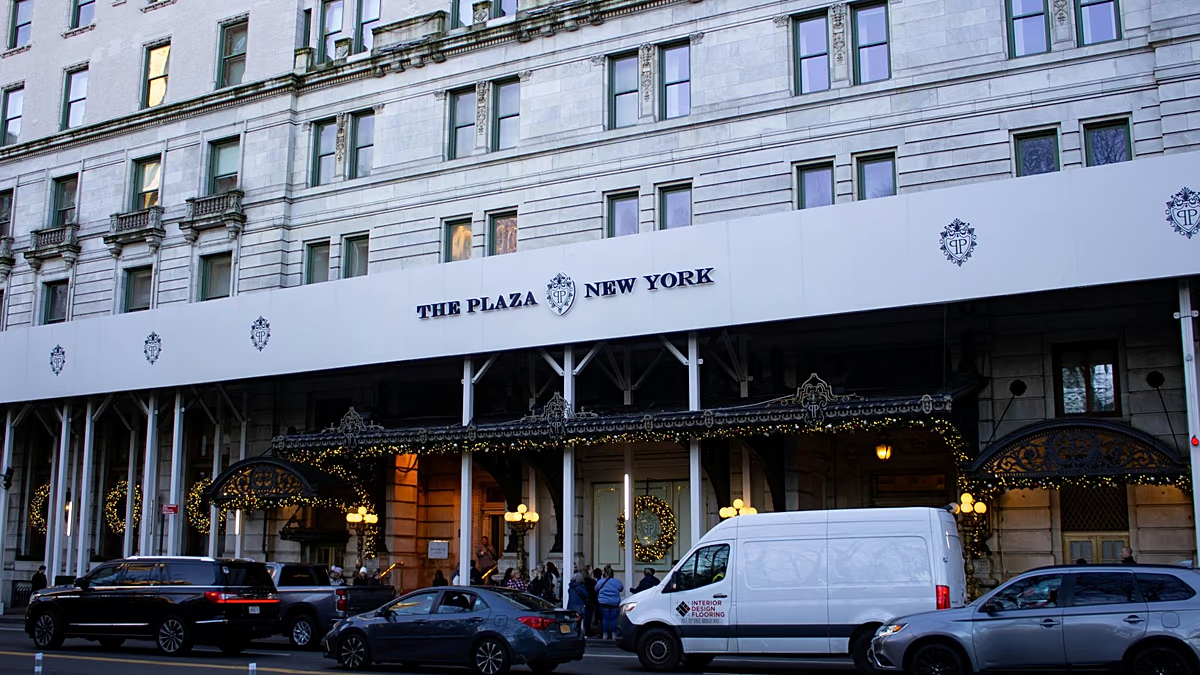
For more than a century, The Plaza Hotel has stood at the corner of Fifth Avenue and Central Park South like a magnificent, cream-colored dowager, watching New York City change around it while somehow never seeming to change itself. Its fairy-tale turrets, steep mansard roofs, and glittering chandeliers are so embedded in the popular imagination that stepping through its revolving doors can feel like entering another era, one of slow luxury, whispered secrets, and polished silver. It is the kind of building that does not simply host guests; it welcomes them into a story. Since it opened in 1907, the hotel has been a symbol of the city’s ambition and glamour, a stage for the wealthy, the artistic, and the curious. It has survived Prohibition, the Depression, the turmoil of the 1960s, the city’s financial lows, and the strange quiet of a pandemic, yet it has always retained its dignity. It has also been a mirror of American culture, appearing in novels, films, and millions of personal photographs. Even for those who have never stayed a single night, the Plaza is instantly recognizable and strangely intimate. That is why the news from its management landed with such a quiet emotional thud: in January 2027, the hotel will close its doors, and its beloved façade will undergo a restoration expected to take at least four years. This is not a quick cosmetic fix, not a weekend of power washing and fresh paint. It is a full, painstaking renewal of an exterior that has absorbed more than a century of sun, storms, and city grit. The official statement is careful to mention complexity, preservation, and safety, but for people who love the Plaza, the announcement carries a much simpler meaning: for a while, a dear old friend will be out of the room.
The undertaking is enormous, and The Plaza’s management was careful to frame it as something deeper than ordinary maintenance. “The undertaking reflects the complexity of maintaining a property of such architectural and historical significance,” the statement said, with careful consideration given to “preservation requirements and the building’s long-term care, as well as the safety of our guests, employees, and the wider community.” In plain language, every carved cornice, every decorative finial, every copper detail has to be evaluated, repaired, and in many cases recreated by skilled hands. Historic buildings do not behave like modern ones; they cannot simply order new parts from a catalogue. They demand patience, archaeological precision, and an understanding of materials and methods long since abandoned. The work will involve not only engineers and masons but historians, conservationists, architects, and preservation officers. It must also be coordinated with city agencies and stakeholders who share responsibility for a landmark at one of Manhattan’s most visible intersections. Add to that the safety of everyone passing by, and the framework becomes even more complex. For at least four years, the Plaza will be wrapped in scaffolding, a strange and slightly melancholy sight for thousands of commuters and tourists who pass the corner every day. It will be a bit like seeing a beloved actor in a mask and gown, resting while the lights dim in the theater. Yet the goal is clear: when the tarpaulins come down, the building should face its next century with dignity, its original beauty restored, its aging accepted and repaired with care. It is a long, unglamorous labor of love—one that the Plaza, with all it has given the world, certainly deserves. Old buildings remember everything, in their own way; they carry each party, each conversation, each sigh in the grain of their wood and the patina of their marble. This restoration is simply the next line in a very long story.
The Plaza’s story begins in a way that feels almost allegorically New York: it replaced an earlier, simpler hotel on the same site, and the grand new structure was designed in the style of a French Renaissance chateau. When it opened in 1907, it was immediately a sensation, a “new chateau” on the edge of Central Park. Its location across from the Pulitzer Fountain and the horse-drawn carriages made it the city’s most theatrical threshold. The design conjures old-world grandeur: steep mansard roofs, ornamental ironwork, dormer windows, and a creamy limestone body that glows in the late afternoon light. But the Plaza has always been more than architecture; it is a storybook. F. Scott Fitzgerald placed one of the most charged scenes in The Great Gatsby within its rooms, using the hotel as a shimmering symbol of old-money New York and the fragile dreams of the Jazz Age. Decades later, the hotel became a character of a wildly different sort in Kay Thompson’s Eloise, the beloved children’s books about a six-year-old girl who lives at the Plaza with her nanny, her dog, and her turtle. Eloise orders room service, rides the elevators, and turns the grand hotel into a kingdom of childhood mischief and wonder. For readers of every generation, those books made the Plaza feel less like a luxury fortress and more like a dreamhouse, where even a child could be at home among the housekeepers and the whispering guests. That same blend of grandeur and playfulness has kept the hotel relevant for over a century, inviting everyone from presidents to pajama-wearing fictional children to make themselves comfortable. It is that layered history, at once sophisticated and playful, precious and welcoming, that makes the upcoming closure feel so personal.
Beyond the page, the Plaza has been a constant presence on the silver screen. In Home Alone 2: Lost in New York, the hotel becomes a glittering playground for Kevin McCallister, who checks in, orders ridiculous amounts of dessert, and outwits two bumbling thieves. The film featured a cameo by Donald Trump, then the hotel’s owner, an odd moment that now feels like a time capsule of New York’s gaudy 1980s. The Plaza also appeared in Crocodile Dundee, where an Australian outsider gapes at its splendor, and in Sleepless in Seattle, where it serves as a romantic landmark in the chaos of Manhattan. In film after film, the hotel is shorthand for “this is a big deal”—the place where proposals are made, fortunes are discussed, and lives suddenly pivot in a new direction. That same magic attracted real-life celebrities. The Beatles stayed at the Plaza in 1964, near the height of Beatlemania, and the image of them waving from the windows became part of the hotel’s folklore. Liza Minnelli, with her brilliant and vulnerable glamour, was a regular, seeming to belong among the dark wood and crystal chandeliers. Frank Lloyd Wright, the visionary architect, was also a notable guest; he was not a man easily impressed by other people’s buildings, yet he found something in the Plaza’s proportions and light. To walk through those lobbies and corridors is to sense that the building itself is a living archive of extravagant parties, secret negotiations, and heartbroken goodbyes. Every chandelier could tell a story; every staircase has seen someone pause to compose themselves before stepping into a ballroom. That is why the coming closure feels like a pause in a long, beloved conversation—not a final farewell, but a breath before the next sentence.
For many people, the heart of the Plaza is the Palm Court. This elegant, airy restaurant—with tall marble columns, a gilded ceiling, and carefully placed palm trees—is where afternoon tea becomes more than a meal; it becomes a ceremony. For decades, New Yorkers and tourists have dressed up and gathered here to mark life’s milestones: birthdays, engagements, reunions, and even ordinary Tuesdays that needed a little glamour. Little girls arrive in party dresses and patent leather shoes, clutching a grandparent’s hand; couples toast anniversaries over delicate cups of Earl Grey; old friends trade stories between finger sandwiches with the crusts cut off, warm scones with clotted cream, and pastries too pretty to consume. The ritual is deliberately, almost defiantly slow in a city that never stops moving. A harpist’s music drifts through the room, and the city outside seems to disappear. It is no surprise that Eloise felt so at home here; there is something magical and timeless about the Palm Court. With the January 2027 closure, that magic will go dark for at least four years. The announcement has a way of jolting anyone who always meant to go but somehow never made the booking. The original report even sighed that if you have been putting off a trip, “you might just want to book your flight ASAP or you’ll miss your chance for nearly half a decade.” Think about all that passes in four years: five New York Christmases, five springs of cherry blossoms in Central Park, five summers of taxis honking past the Pulitzer Fountain, five autumns of golden leaves falling around the statues. Without the warm glow of the Plaza at that corner, Fifth Avenue will feel like a beautiful room with the lights switched off. But memories of tea at the Palm Court are stubborn, and they will keep the room warm until the doors reopen.
The Plaza is one of only 288 properties recognized as a Historic Hotel of America, selected by the National Trust for Historic Preservation for its irreplaceable architectural and historical value. That designation carries a duty, and the coming restoration is an expression of that duty—a promise to future generations that the craftsmanship, stories, and soul of the building will endure. The façade work is not cosmetic; it is stewardship. But in the months before the doors close, there will be a strange, tender atmosphere in the hotel. Staff will continue to serve with grace, but everyone will know that the next chapter is being written. Tourists will linger longer in the lobby; New Yorkers will glance up at the façade with a quiet, “I hope they’ll be okay.” The downstairs will become a place of whispered memories, of grand parties and chance encounters. But this is not an ending. When the restoration is complete, if all goes according to plan, the cream-colored limestone will glow with renewed warmth, the copper details will catch the light, and the revolving doors will turn once more. The Plaza will have aged, but it will also have been reborn—wiser, more beautiful, and ready to welcome a new century. And that is perhaps the most human thing of all: to grow old, to pause, to repair our cracks, and then to open our doors to the world again. For now, the beloved grande dame of Fifth Avenue is preparing to step behind the curtain for a little while. She has earned the rest. When she returns—brighter, stronger, and still unmistakably herself—New York will feel whole again.