



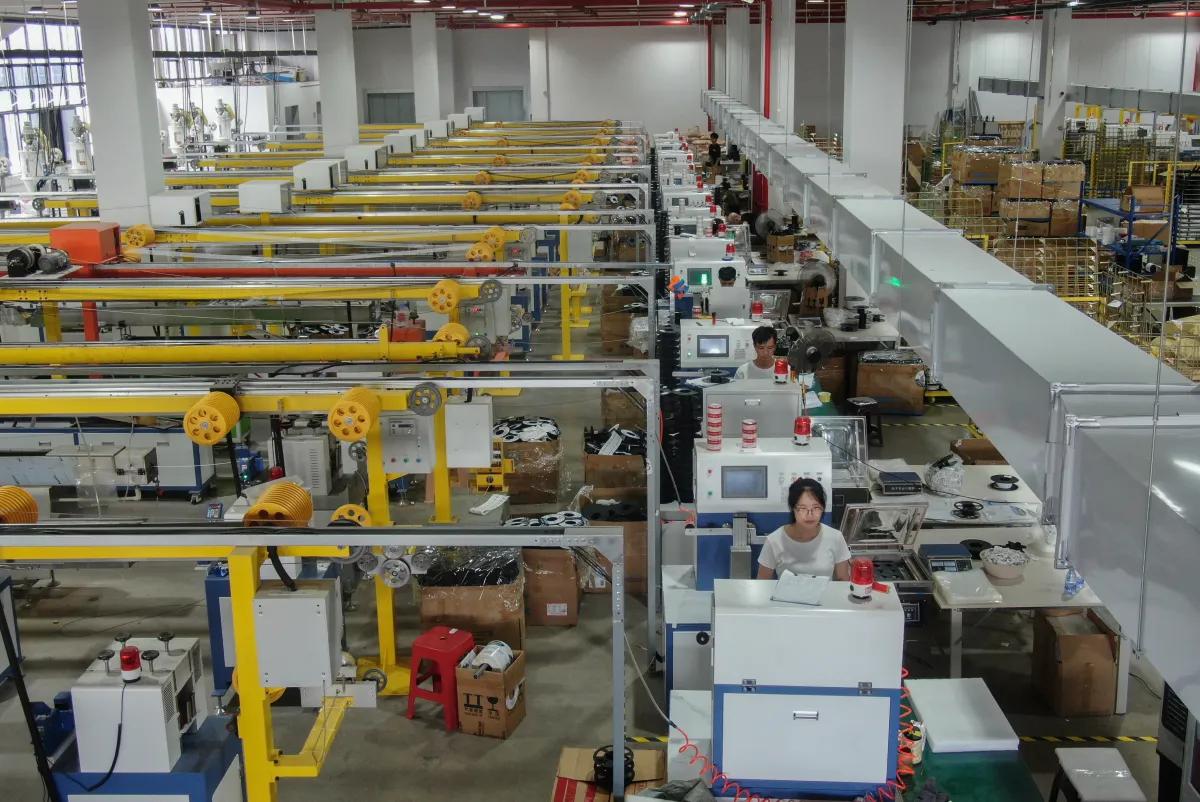
1. Imagine being able to print a physical object the way you print a document—except instead of ink on paper, it’s layers of plastic, metal, or even biological material building a real, usable thing from a digital blueprint. That’s the promise of 3D printing, more properly called additive manufacturing, and it’s transforming the way we make everything from drone parts to medical implants. But beneath the sleek promise of this technology lies a geopolitical story that is far less glamorous and far more urgent. This is the story told in the latest edition of China Decoded, Newsweek’s in-depth newsletter about China’s growing influence on the world. Written by senior correspondent Didi Kirsten Tatlow and China editor John Feng, the newsletter goes beyond the headlines to explore how Beijing thinks, how its policies extend beyond its borders, and what that means for the United States and its allies. The latest edition focuses on a phrase that might sound like science fiction but is already reality: China is printing the future. And it’s doing so using a familiar playbook—one that combines state subsidies, industrial planning, military-civil fusion, and a relentless focus on becoming the dominant player in yet another critical technology. For anyone who cares about fair competition, national security, or simply the future of global manufacturing, this is a story worth understanding. And it begins with a simple but unsettling observation: China has decided that 3D printing is too important to leave to chance.
2. To understand why this matters, you first have to understand how China operates when it wants to dominate an industry. The playbook is well-worn and highly effective. Communist Party economic planners identify a promising new technology. They acquire it by multiple means, as their own phrase goes—through investment, partnerships, reverse engineering, and sometimes outright cyberespionage. Then they supercharge it with subsidies and industrial support that go far beyond what any other country offers. The technology is woven into state development plans and into China’s military-civil fusion system, which deliberately blurs the line between civilian and military research and manufacturing. The goal is not just to catch up, but to create dependency—so that as Chinese manufacturing expands, the rest of the world becomes reliant on Chinese products, Chinese standards, and Chinese supply chains. That’s exactly what’s happening with additive manufacturing, according to a revelatory new study titled Blueprinting the Future: Mitigating the Risks of Chinese Hegemony in Additive Manufacturing, published by the Czech think tank Sinopsis. The authors—David Gardáš, Michal Thim, and Filip Urban—warn that China’s growing dominance in 3D printing is turning a manufacturing revolution into a question of economic and national security. The technology itself is remarkable. It’s fast, flexible, and incredibly valuable in time-sensitive or supply-constrained environments like defense, disaster response, and crisis situations. But the way China is approaching it is deeply strategic. Policy is clear. People work hard and fast. Products are well-priced and good. But little is left to chance. Control is king.
3. Now, you might ask: is this fair? Perhaps fairness isn’t the right lens. Perhaps it’s just sour grapes from countries that didn’t move fast enough. But consider the numbers. In 2023, China spent an astonishing 4.4 percent of its GDP on supporting its industrial policies—through cash subsidies, tax breaks, subsidized land, and preferential credit. That’s three times more than any other major economy. That’s not free trade; that’s a state-driven industrial juggernaut. And additive manufacturing sits right at the center of it. After about three decades of careful policy integration, AM is now classified as a strategic industry in China. The country’s AM sector spans everything from cheap desktop printers to advanced industrial systems for high-performance metal and polymer components. Leading companies like Bambu Lab, Xi’an Bright Laser Technologies, and Farsoon Technologies are expanding rapidly. Even Norinco Group, the giant defense conglomerate, operates its own Additive Manufacturing Technology Research and Application Center. The defense applications are not theoretical. The war in Ukraine has shown just how valuable 3D printing is for rapid production of drones and related components. Bambu Lab printers have reportedly been used in Ukraine and by the British army. This isn’t just about gadgets and hobbyists. It’s about building a “soup to nuts” ecosystem—from raw materials to software to final products—designed for long-term dominance. And as that ecosystem grows, the risks for the rest of the world grow too. The study’s authors warn that intellectual property loss, technology transfer, and the security of sensitive data are becoming increasingly consequential. Chinese companies benefit from non-market measures that favor localization, scale, and domestic substitution. They receive disproportionately high levels of state support compared to competitors in OECD economies. The result is a significant distortion of competition. Chinese firms expand abroad rapidly while foreign firms find it much harder to enter the Chinese market. New Western entrants in AM are struggling to gain a foothold, secure venture funding, or compete at all.
4. So what should the rest of the world do about it? The study offers seven recommendations, and they boil down to three broad principles: protect your technology, work with your friends, and make yourself stronger. First, classify additive manufacturing systems as sensitive technology. That means treating them with the same seriousness as other dual-use technologies that can be used for both civilian and military purposes. Second, apply targeted export controls and procurement safeguards, and coordinate these measures with allies. The point is to avoid a situation where controls in one country simply push acquisition activity to another. If the United States restricts something but Europe doesn’t, then China will just go where the door is open. Third, invest in competitive open innovation ecosystems. That means supporting research and development, technical education, and workforce expertise in industrial software, materials, and secure digital workflows. It means building domestic and allied capacity so that the West doesn’t become dependent on Chinese machines, Chinese spare parts, and Chinese know-how. The message is not to panic or retreat into protectionism. It’s to be strategic, deliberate, and cooperative. The future of manufacturing is too important to be ceded by default. And the longer Western countries wait, the harder it will be to catch up. China didn’t become dominant in 3D printing overnight. It took decades of policy planning, investment, and patience. The rest of the world needs to show the same kind of long-term thinking—not to copy China’s playbook, but to build a resilient alternative that preserves innovation, security, and fair competition.
5. The data behind this story is just as striking as the policy analysis. The Chinese government recently valued the country’s additive manufacturing industry at 70 billion Chinese yuan—just under $10.5 billion. China’s top 3D printing companies shipped nearly 40 percent of all AM devices sold last year, and about 90 percent of those in the consumer sector. But here’s where the story gets more nuanced. Additive manufacturing isn’t a single industry; it’s a spectrum. Industry researchers at CONTEXT divide 3D printing equipment into four price categories: entry-level up to $2,500, professional up to $20,000, midrange up to $100,000, and industrial over $100,000. The real money—and the real strategic value—is in that final tier, where you find medical implants and aerospace engine parts. And in that tier, Western companies still lead. The global AM market was valued at $30.6 billion in 2025. North America had the largest revenue share at 32.8 percent, and the market is projected to grow to $168.9 billion by 2033. U.S.-Israeli firm Stratasys leads with 11.5 percent market revenue share, followed by Germany’s EOS at 7.8 percent. Three other American firms round out the top five. So while China is shipping most of the world’s desktop machines—the ones that mostly print plastic trinkets and prototypes—Western first movers are still making over 70 percent of all hardware revenue in the high-value industrial sector. It’s a familiar pattern, one we’ve seen in industries like artificial intelligence: China leads by volume, but the United States leads by value. For now. But nobody should mistake that for comfort. China has made it clear that it intends to compete in the highest-value sectors too. With its mature manufacturing playbook, massive subsidies, and strategic patience, it’s only a matter of time before Chinese companies push into the premium industrial tier. The question isn’t whether they will try. It’s whether the rest of the world will be ready when they do.
6. In the end, this story is not just about 3D printing. It’s about the nature of competition in the twenty-first century. China is growing into a superpower like no other. Its importance to the world—or rather, the world’s dependence on it—was created by design, through a heavily subsidized manufacturing sector and a relentless focus on strategic industries. Global economies are finding it hard to wean themselves off Chinese goods, Chinese supply chains, and Chinese technology. Additive manufacturing is just the latest example. It may not be as dramatic as semiconductors or AI, but it’s just as important. The ability to print a replacement part for a fighter jet, a medical device, or a drone in hours instead of weeks is a strategic capability that no country can afford to lose. And yet, many Western governments are only beginning to pay attention. The authors of the Sinopsis study make a powerful case for urgency. They call for protecting sensitive technology, coordinating with allies, and investing in innovation ecosystems. But more than that, they call for awareness. The future will be printed. The only question is who will control the printers—and the standards, the data, and the supply chains that come with them. This is the kind of story China Decoded exists to tell. It’s not just about what China is doing. It’s about what that means for the rest of us. And it’s a reminder that in the race to shape the future, complacency is the most dangerous strategy of all. The good news is that it’s not too late to act. But the window is narrowing. And as China’s additive manufacturing ecosystem continues to grow, the rest of the world must decide whether it wants to be a partner, a competitor, or a customer. The smart choice is clear: work together, invest in innovation, and make sure the future isn’t printed in only one place.