


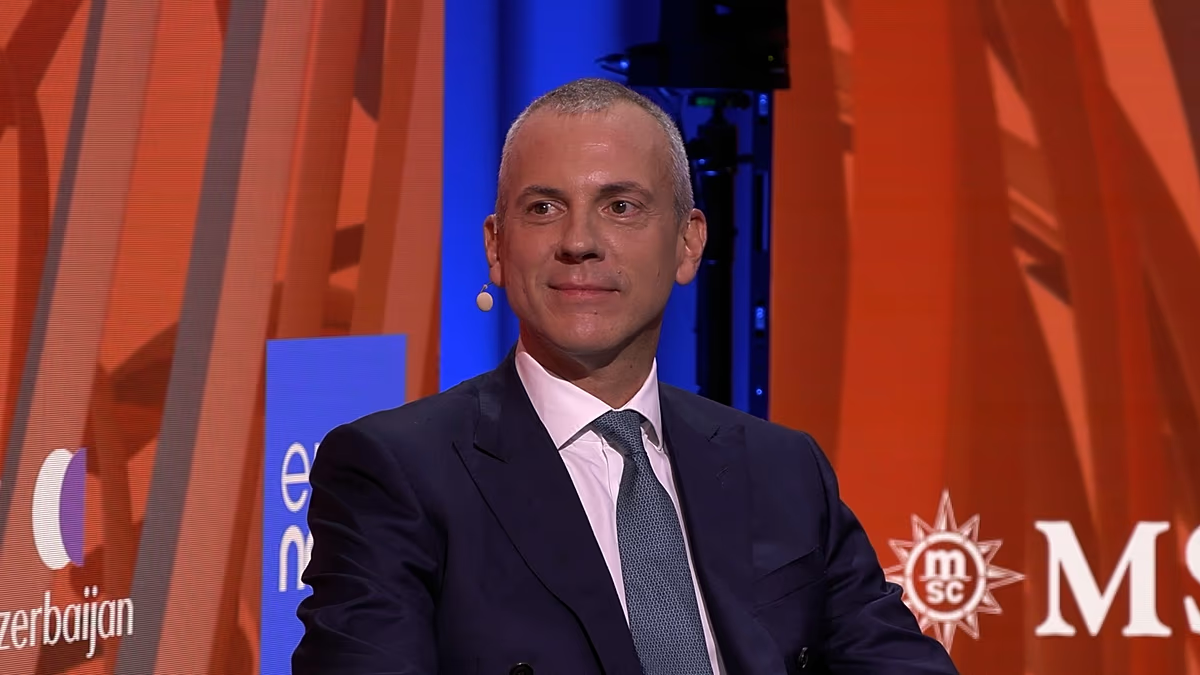
Paragraph 1: A quiet sort of astonishment has followed Florian Sengstschmid for more than two decades. When he first set foot in Baku in 2001, he was just beginning a long career that would take him to destinations across the world. Now the Austrian-born chief executive of the Azerbaijan Tourism Board, he might be forgiven for thinking he has seen everything the travel industry can offer. Yet he insists the country still manages to surprise him. In his view, the South Caucasus as a whole is badly underrated. Too often, he says, its countries are lazily grouped together under a post-Soviet label, with their deep individual histories and cultures overlooked. Azerbaijan, where Europe meets Asia, holds a particular thread that few visitors ever expect. There are bridges built by the Siemens brothers that people can still walk across. German heritage villages such as Helenendorf still stand, offering a glimpse of a chapter that seems almost impossible to reconcile with the usual images of the Caucasus. In towns and cities across the country, a mosque, a church and a synagogue can be found side by side, not as museum pieces but as living places of worship. The largest Jewish settlement in the country, with its distinctive red-tiled roofs, is believed to have been the only entirely Jewish settlement outside Israel and the United States, and one of the world’s last surviving shtetls. For Sengstschmid, this blended culture and faith is not an abstraction but part of daily life in Azerbaijan. He also believes the ongoing regional peace process, including the initial deal signed in Washington in August 2025, could open the door to multi-country journeys across the South Caucasus. That would make the region far more accessible for long-haul travellers and raise its profile in a way that individual countries alone may struggle to achieve.
Paragraph 2: Baku, the capital by the Caspian Sea, has learned how to welcome the world with confidence. Just days before the regional summit that drew attention to the peace process, the city hosted a Formula 1 weekend that brought in more than 17,000 international visitors, alongside the Azerbaijan Investment Forum. Sporting spectacle and business diplomacy happened in the same breath, and the city handled both with ease. Sengstschmid traces this capacity to a deeply rooted culture of hospitality, in which visitors are treated not as customers but as guests invited into the home. He remembers how Baku’s international profile first grew with the Eurovision Song Contest in 2011, a moment that introduced the city to millions who had barely heard of it. Then came the enormous logistical test of COP29 in 2024, a global climate summit with tens of thousands of delegates, security requirements, media infrastructure and endless small details. That experience, Sengstschmid says, proved something essential. “Who can host a COP can host any other meeting and conference,” he said. It is a simple sentence, but behind it lies a great deal of pride. The same city that once seemed like a remote curiosity on the edge of maps has transformed into a cosmopolitan hub, with a skyline of flame-shaped towers, a seaside promenade that seems to go on forever, and a food scene that draws on both Turkish, Persian and Russian traditions. Yet the real strength of Baku is not its architecture or its restaurants. It is the warmth with which strangers are received. Visitors who arrive for a grand prix or a summit often leave with something they did not expect: a sense that they have made friends.
Paragraph 3: Still, Sengstschmid is quick to urge visitors not to stop in Baku. The real depth of Azerbaijan lies beyond the capital, along the old Silk Road, where side valleys and hidden villages wait between the mountains. Among them is Shaki, a UNESCO-listed town in the foothills of the Greater Caucasus, famous for its Khan palaces, ornate stained-glass windows and a history that feels like a living storybook. There is a growing wine route that reveals a viticulture tradition far older than most outsiders imagine. There is also a wellness cluster built around unusual natural resources, including naftalan oil, a thick brown mineral oil that has been used for skin treatments for centuries. The country spans a remarkable range of climate zones, from dry desert landscapes to alpine peaks reaching four thousand metres, and this diversity gives every journey a change of scene that can feel like crossing continents in a matter of hours. Winter tourism has become another focus of national ambition. A five-year partnership with the International Ski and Snowboard Federation (FIS) is bringing international races and World Cups to Azerbaijan, including FIS World Cup finals in freestyle moguls and dual moguls in the Shahdag mountains in March. This is not a token effort; it is a serious attempt to put Azerbaijan on the winter sports map. For visitors who prefer calm to competition, there are countless mountain villages where life moves at the pace of the seasons, where tea is served with jam, and where the silence is broken only by the sound of water and wind. Sengstschmid speaks of these places with the enthusiasm of someone who has not grown tired of exploring, and his advice is consistent: give yourself time, go beyond the airport city, and let the country reveal itself slowly. The rewards are not the kind you can capture in a photograph; they are the memories you carry long after your shoes have dried and your suitcase is unpacked.
Paragraph 4: Connectivity and accessibility have long been the quiet obstacles to tourism in the South Caucasus, and Sengstschmid is blunt about them. “Connectivity and accessibility are the key bottlenecks in tourism,” he said. But those bottlenecks are being removed, piece by piece. Baku airport now holds a five-star Skytrax rating, a distinction shared by only a handful of airports in the world. Azerbaijan Airlines is taking delivery of new aircraft this year, modernising its fleet with an eye to longer and more comfortable journeys. From 8 May 2027, the carrier will fly four times a week between Brussels and Baku, a significant step for European travellers looking to reach the country without awkward connections. Entry is also straightforward. For major events such as the Formula 1 weekend, a passport and a valid ticket are enough to get in, which makes spontaneous travel easier than most people expect. For other visitors, the e-visa system works simply online, with standard processing within three days and urgent visas issued within three hours. That combination of direct flights, fast visas and modern infrastructure is exactly what a destination needs to move from the margins of travel plans to the centre. Yet Sengstschmid is careful to say that accessibility is not an end in itself. It is only worthwhile if it brings people who truly want to experience Azerbaijan, not merely to check it off a list. The growth in air routes, he notes, is a way to lower the threshold for curiosity. Once the practical barriers are gone, the country itself has to do the work of convincing visitors to stay longer, travel deeper and return again. And that, he believes, is something Azerbaijan can do naturally, through its landscapes, its food, its history and, above all, its people.
Paragraph 5: Behind this growth lies a carefully written state program that runs to 2030, designed to shape tourism in a way that benefits both visitors and residents. On the demand side, the program aims to stimulate interest through incentives for charter airlines, support for new routes and cooperation with tour operators. On the supply side, it encourages quality, green-built accommodation in the regions, and it gives direct help to micro and small entrepreneurs who want to share their own corners of the country with visitors. Transport, customs and every other part of the visitor journey are being asked to pull in the same direction. But Sengstschmid says that protecting local life comes first. He cites the mountain village of Basgal, a historic centre of silk printing along the Silk Road that had been largely abandoned as young people left and old crafts faded. After investment in infrastructure, families began to return. Today, the village is a living place again, with small tea houses and food stalls, while women practise traditional silk printing in workshops that double as cultural experiences. Visitors do not simply watch from behind a rope; they take part in village traditions alongside the people who live there. This is the kind of tourism that Sengstschmid believes in, not because it is fashionable but because it works. In 2025, tourism contributed seven billion manat, roughly €3.5 billion, or 5.4 percent of GDP. The target is twelve billion manat by 2030, a significant rise. Yet the plan does not depend on an explosion of visitor numbers. Currently just under three million people visit Azerbaijan each year, and the target is only a modest increase. The real aim is longer stays and greater economic impact. Fewer tourists who stay longer, spend more and leave a lighter footprint are worth more than crowds who pass through in a single day. This is a mature way of thinking about tourism, one that measures success not simply by counting heads but by the health of the places and communities that make a destination worth visiting in the first place.
Paragraph 6: When asked to share a secret, Sengstschmid chose a tiny place called Sim, a village in the south of the country that he describes as a fairytale. Moss covers the old wooden buildings and their balconies, water runs through the heart of the village, waterfalls tumble nearby, and a UNESCO-listed forest begins at its edge. It feels, he says, like a jungle, and yet you are still in Azerbaijan, a country whose name is usually associated with dry plains and oil fires. That combination of the unexpected and the beautiful is, for him, the essence of the place. Asked to sum up the whole country in three words, he did not hesitate: real, warm and uplifting. Warm, because of the people and their instinctive hospitality. Real, because he believes the pace of development has left much of the country genuine and intact, rather than polished into a theme park version of itself. And uplifting, because Azerbaijan still has new things to show him, even after all these years. There is a quiet power in that statement. Florian Sengstschmid first arrived in Baku in 2001, long before the flame towers, before Eurovision, before the grand prix and before the world’s attention turned to the Caspian. A quarter of a century later, he can still be surprised by the country he helps promote. That may be the strongest endorsement of all. It is one thing for a visitor to be charmed by a place after a single week. It is another thing entirely for someone who has spent twenty-five years walking its streets, climbing its mountains and sharing its stories to admit, with genuine pleasure, that there is still more to discover.