


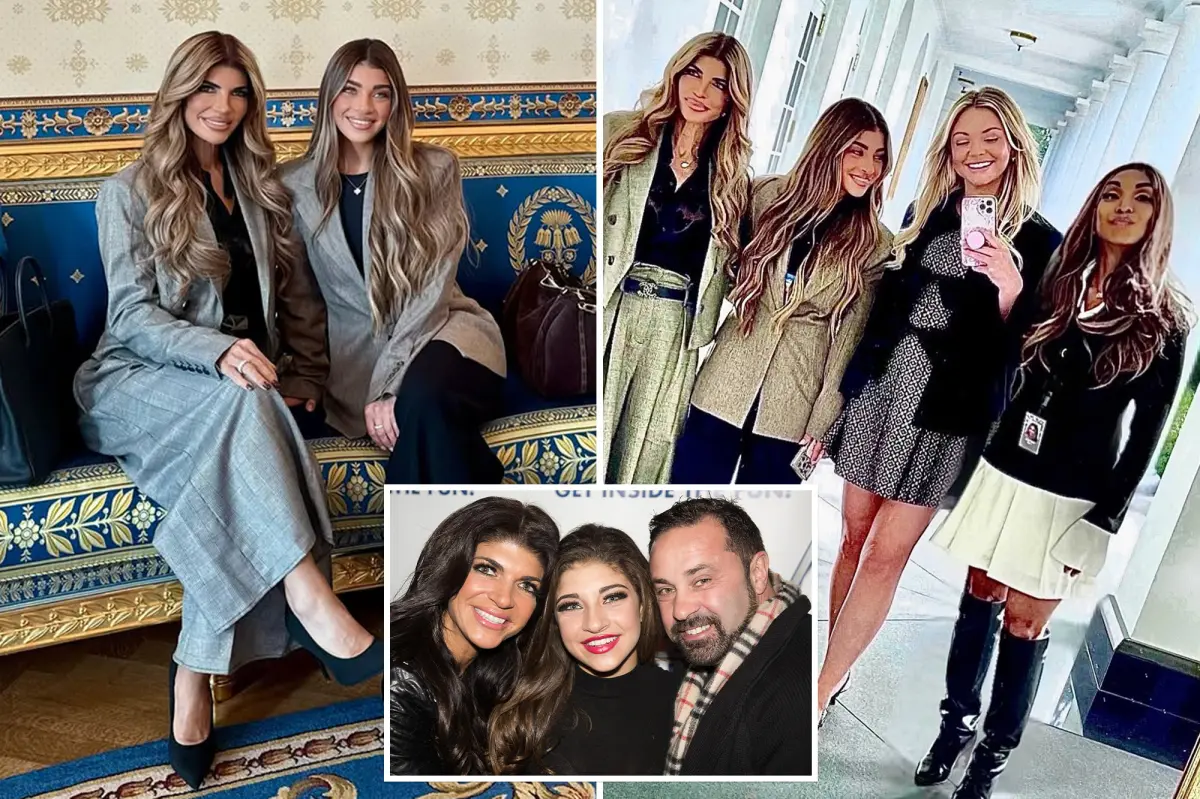
On a crisp autumn Friday in Washington, D.C., the White House opened its doors to an unexpected pair of visitors: Teresa Giudice and her eldest daughter, Gia. The two women, famous for their starring roles in Bravo’s “Real Housewives of New Jersey,” stood outside the Oval Office, smiling for a photograph that would soon circulate across social media. The occasion was Columbus Day and the celebration of Italian-American heritage, and they had been invited by President Donald Trump and First Lady Melania Trump. But for anyone paying attention, the visit was about far more than cultural pride. Teresa and Gia arrived carrying a quiet, desperate hope: that the President might grant a pardon to Joe Giudice, the family’s patriarch, who has been deported to Italy and separated from his daughters for years. The image of the two women in the corridors of American power felt surreal, a strange collision of reality television and presidential politics. Yet there they were, not as characters in a scripted drama, but as real people, hoping that proximity to power might translate into mercy.
The story of the Giudice family has always been larger than life, but it has also been painfully real. Teresa Giudice first became a household name in 2009, when she infamously flipped a table during an emotional outburst at a dinner party, instantly cementing herself as one of reality TV’s most iconic and volatile personalities. The show made the Giudices rich and famous, but it also exposed the cracks beneath the glamorous surface. Joe Giudice, Teresa’s husband at the time, was later convicted on charges related to fraud, including schemes to obtain $5 million in loans and failing to report $1 million in taxable earnings. He served 41 months in federal prison. When his sentence was complete, the government deported him to Italy in 2019, a country of his heritage but not his home. Joe had spent most of his life in America, and being sent to Italy meant being torn away from everything he knew, especially his four daughters. For Teresa, the public unraveling of her marriage and family was broadcast in real time, as cameras captured her struggles, her tears, and her attempts to hold things together. She has since remarried, finding new love with Luis Ruelas, but the scars of the past remain. The family’s story is not just a cautionary tale about fame and fraud; it is a deeply human story about loss, loyalty, and the bonds that survive even the worst mistakes.
Gia Giudice, the eldest daughter, has grown up in the spotlight, but she has also become her father’s most vocal advocate. She has spoken publicly about how much she misses him and has repeatedly asked for a pardon, hoping that the President might see her father as more than the crimes he committed. During the White House visit, Gia stood beside her mother, a composed young woman carrying the weight of a family’s hopes. The subtext of the visit was unmistakable, even if no one said it outright. Lynne Patton, the White House Deputy Assistant to the President for Coalition Policy and Engagement, shared the photo on Instagram and confirmed that the Giudices were at the White House at the invitation of the President and First Lady. But Patton was also careful to explain the limits of her own role. “I am not in charge of pardons,” she wrote. “Nor do I decide who receives them. That is the President’s sole decision based upon recommendations from the White House Pardon Czar, [Alice Johnson], and White House Counsel.” It was a polite but firm reminder that a photo opportunity is not the same as a promise. Still, the very fact that Teresa and Gia were there, dressed beautifully and smiling in front of the most famous doorway in America, suggested that they understood the power of visibility. In a world where public opinion can influence even the highest offices, being seen at the White House might be the strongest case they could make.
Patton, however, went further than a simple caption. In a heartfelt post, she opened up about her own struggles with addiction and her belief in redemption. “I believe deeply in second chances,” she wrote. Then she addressed Joe’s case directly. “Do I believe that Joe deserves a second chance? Unfortunately, it is not my place to decide,” she admitted. But she did not stop there. She added, “But what I do know is that one of his beautiful daughters desperately needs him now more than ever. And even God supports that.” Those words carried a weight that transcended politics. Patton, who has worked closely with the Trump administration and has been open about her own journey from addiction to recovery, was speaking not just as an official but as a human being who understands what it means to need grace. Her reference to a daughter desperately needing her father pointed to a painful truth that had been lingering behind the scenes: the Giudice family is not just dealing with legal and immigration issues, but with a genuine crisis of mental health and emotional well-being. Patton’s post suggested that this was not a matter of whether Joe Giudice deserved forgiveness, but whether a father’s presence could save his child. It was an appeal to something deeper than the law, a reminder that even in the halls of power, love and family are never far away.
The mention of a daughter in desperate need was not vague. Milania Giudice, 20, has recently admitted to struggling with her mental health after a series of public breakdowns. She is currently receiving treatment at a facility, and the family has been open about the challenges she faces. For Gia, the eldest sibling, the burden has been immense. She has watched her parents’ marriage collapse, her father be deported, and her younger sister spiral into crisis. Through it all, she has remained a steady presence, often speaking for the family when others could not find the words. Her presence at the White House, then, was not just a publicity stunt. It was an act of love. Standing next to her mother, Gia was doing what she has done for years: trying to hold her family together. The emotional weight of the moment must have been staggering. Here was a young woman who had grown up on television, who had experienced loss and shame and public scrutiny, and who was now standing at the door of the most powerful leader in the world, hoping that he might see her father as a human being rather than a felon. The fact that Milania needed her father now more than ever made the visit feel urgent, almost desperate. This was not about celebrating heritage; it was about saving a family.
In the end, the Giudices’ visit to the White House is a story about many things: Italian-American pride, the strange intersection of celebrity and politics, and the power of a public appeal. But at its heart, it is a story about family. Joe Giudice was deported to Italy, a country he hardly knew, while his children remained in America. The irony of celebrating Italian-American heritage while a father is exiled from his family was not lost on anyone. For Teresa and Gia, the White House invitation was an opportunity to remind the President and the public that behind the headlines and the tabloid stories, there are real people struggling to stay connected to the people they love. Whether President Trump will grant Joe Giudice a pardon remains uncertain. The decision rests in his hands alone, guided by his advisors and his own judgment. But no matter what happens next, the image of Teresa and Gia standing outside the Oval Office will linger. It is a reminder that even the most famous reality TV stars are not merely characters in a show. They are mothers and daughters, fathers and sisters, people who make mistakes and people who pay for them, people who hope and people who love. And sometimes, all they can do is show up at the door, ask for a second chance, and wait to see if the world will be merciful.