


Some names are not merely written into the record books; they are etched into the very soul of a sport. Mike Ditka was such a name. When the Ditka family announced on Friday afternoon that the Hall of Fame head coach and tight end had passed away at 86, it felt less like a news bulletin and more like the closing of an era. You cannot tell the story of the National Football League without him. From the moment he stepped onto the field as a fearsome tight end to the years he prowled the sideline in dark sunglasses and a Bears vest, Ditka was one of those rare figures who seemed bigger than the game itself. He was brash, unyielding, and utterly authentic. He didn’t just coach football or play football; he embodied it. The game had its share of great athletes and brilliant strategists, but Ditka was something different. He was a force of nature, the kind of man who made everyone around him raise their standard, whether through fear, respect, or sheer admiration. And even though he is no longer physically present in the world of football, his fingerprints remain all over the sport. His legacy will be felt not just in the highlights and trophies, but in the way generations of players and coaches approach the game. For Chicago, for Dallas, for the NFL, Ditka was a pillar. Now, with his passing, we pause to remember a life that was lived with passion, fire, and an uncompromising commitment to winning.
Before he ever became the leather-clad legend standing on the sidelines of Soldier Field, Ditka was a menace in the middle of the field. Long before the Bears vest, there was the tight end who changed what the position could be. He grew up in western Pennsylvania and played his college football at the University of Pittsburgh, where he was an All-American and finished sixth in the Heisman Trophy voting in 1960. That was a rare honor for a tight end, a position that was viewed primarily as a blocking role in those days. But Ditka was never content to be just a blocker. He wanted the ball. The Houston Oilers selected him with the eighth overall pick in the 1961 AFL Draft, but Ditka chose the established NFL instead. A month later, the Chicago Bears drafted him with the fifth overall pick, and he packed his bags for the Windy City. What followed was historic. In his very first season, Ditka became the first tight end in NFL history to record 1,000 receiving yards in a single season, hauling in 56 catches for 1,076 yards and 12 touchdowns. Those numbers may not look eye-popping by today’s standards, but in 1961 they were extraordinary. Opposing defenses simply had no answer for a tight end who could both crush defenders as a blocker and outrun them as a receiver. He was a Pro Bowler in each of his first five seasons and an All-Pro in 1963 and 1964. Over his first four years, he averaged 62 receptions, nearly 918 yards, and 7.5 touchdowns per season. He was also part of the Bears’ 1963 NFL Championship team, a title that ended Chicago’s long drought. After six seasons with the Bears, Ditka spent two years with the Philadelphia Eagles and then finished his playing career with the Dallas Cowboys. There, he helped the Cowboys win their first Super Bowl in 1971, catching a seven-yard touchdown pass from Roger Staubach in the fourth quarter of Super Bowl VI. That moment was a perfect coda to a playing career that redefined the tight end position and announced Ditka as a winner.
Coaching was always a natural next step for Ditka, because football was never just a job to him; it was a calling. He spent nine seasons as an assistant coach and special teams coordinator under legendary Cowboys coach Tom Landry, learning the nuances of the game from one of the finest minds in NFL history. Meanwhile, up in Chicago, the Bears were struggling. They had suffered through losing records in three of their previous four seasons, and after the team fired head coach Neill Armstrong in 1982, the door opened for a familiar face. Ditka interviewed for the job and got it, returning to the franchise where he had made his name as a player. It was not an immediate success. The strike-shortened 1982 season saw the Bears go 3-6, and 1983 was only marginally better at 8-8. Ditka was on thin ice, and critics wondered whether the fiery assistant could handle the pressure of being a head coach. But he believed in what he was building. In 1984, the Bears broke through with a 10-6 season, winning their division for the first time since their championship days and advancing all the way to the NFC Championship Game. They were shut out by Bill Walsh’s San Francisco 49ers, who would go on to win the Super Bowl, but the loss only sharpened the hunger in Chicago. The pieces were in place. The defense was young, fast, and ferocious. The offense had a legendary running back and a confident young quarterback. Ditka had finally assembled a team that reflected his own personality, and the rest of the league had no idea what was coming.
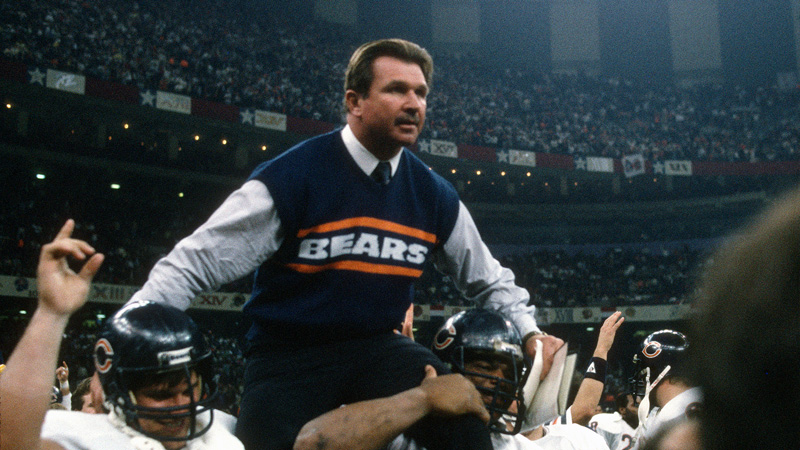
The 1985 Chicago Bears were not just a team; they were a phenomenon. They stormed through the regular season with a 15-1 record, the lone blemish being a Monday Night Football loss to Dan Marino and the Miami Dolphins. That season has become legendary for its sheer dominance. The Bears defense recorded an astonishing 70 sacks, following up on a 72-sack campaign the year before. They pitched two shutouts during the regular season and held opponents to ten points or fewer in eleven of sixteen games. In the playoffs, they threw a shutout over the New York Giants, then shut out the Los Angeles Rams in the NFC Championship Game. By the time they reached Super Bowl XX, they were playing with an almost unstoppable swagger. They dismantled the New England Patriots, 46-10. That defense boasted four Hall of Famers, including Richard Dent, Mike Singletary, Steve McMichael, and Dan Hampton. It also had Pro Bowl playmakers like Otis Wilson, Wilber Marshall, and William Perry, the beloved “Fridge,” who occasionally made offensive appearances and became a national sensation. The secondary was deep and opportunistic, with Leslie Frazier, Gary Fencik, Dave Duerson, Mike Richardson, and Ken Taylor combining for 23 interceptions. Many still argue that the ’85 Bears defense was the best ever assembled. On offense, Ditka leaned on the immortal Walter Payton, protected by Hall of Fame tackle Jimbo Covert and a gritty offensive line, while the ever-confident Jim McMahon directed the show. The Bears were not just champions; they were cultural icons. They had the Super Bowl Shuffle, the personality, and the look. And at the center of it all was Ditka, barking orders, demanding perfection, and refusing to settle for anything less than greatness.
The 1985 championship was the pinnacle, but Ditka’s coaching legacy went far beyond that one magical season. The Bears never made it back to the Super Bowl under him, and after the departure of defensive coordinator Buddy Ryan, who left to coach the Philadelphia Eagles, the team still won 14 games in 1986 and consistently remained in contention. Over the course of his twelve seasons as head coach of the Bears, Ditka led the team to double-digit wins in seven of them and made the playoffs in multiple years. His overall coaching record stands at 121 regular-season wins in the NFL, placing him among the more successful head coaches in league history. He also coached the New Orleans Saints from 1997 to 1999, though he could never quite recapture the magic of Chicago. But the numbers tell only part of the story. Ditka is tied with George Halas for the most playoff victories in Bears history, and he ranks second in franchise history with 106 regular-season wins. As a player, he remains high on the Bears’ all-time lists, ranking fourth in receiving touchdowns, fifth in receiving yards, and sixth in receptions. These achievements are remarkable in themselves, but they are made even more special by the fact that Ditka accomplished them in different eras and different roles. He is a member of the Pro Football Hall of Fame, having been inducted both for his playing career and, later, enshrined as part of a legacy that few can match. He was a player who changed the tight end position, and he was a coach who built one of the most iconic teams in sports history. There have been great players who became coaches, and there have been great coaches who once played, but very few have reached the summit in both capacities. Ditka did.
Beyond the wins and losses, beyond the statistics and championships, Mike Ditka was a cultural touchstone. His image is forever tied to that dark leather jacket, those dark glasses, and the unmistakable Bears vest that fans still wear to Soldier Field and across the country. He was a character in the best sense of the word. The 1985 Bears were a larger-than-life group, and Ditka was the larger-than-life figure at the center of it all. He wasn’t in “The Super Bowl Shuffle,” but he inspired one of the most beloved sketches in “Saturday Night Live” history, “Bill Swerski’s Super Fans,” where a group of die-hard Bears fans gather at “Ditka’s” and revere their coach like a deity. He was an actor too, famously appearing in the movie “Kicking & Screaming” as a tough soccer coach opposite Will Ferrell, playing a character that was essentially an exaggerated version of himself. For decades, Ditka was more than a coach; he was a personality who transcended sports and became a part of American pop culture. People who never cared about the Bears knew who Mike Ditka was. They knew the scowl, the passion, the unapologetic intensity. There was something beautifully human about him. He wore his emotions on his sleeve, loved deeply, fought hard, and never pretended to be something he wasn’t. In an age of polished, media-trained coaches, Ditka was refreshingly raw. He was a link to a tougher, simpler time in football, and his passing marks the end of an era. But as we mourn the loss, we also celebrate the life. Some people are great players. Others are great coaches. Mike Ditka was both, and his legacy will live on in every tight end who stretches the field, every coach who demands excellence, and every fan who proudly wears a Bears vest in his honor.