


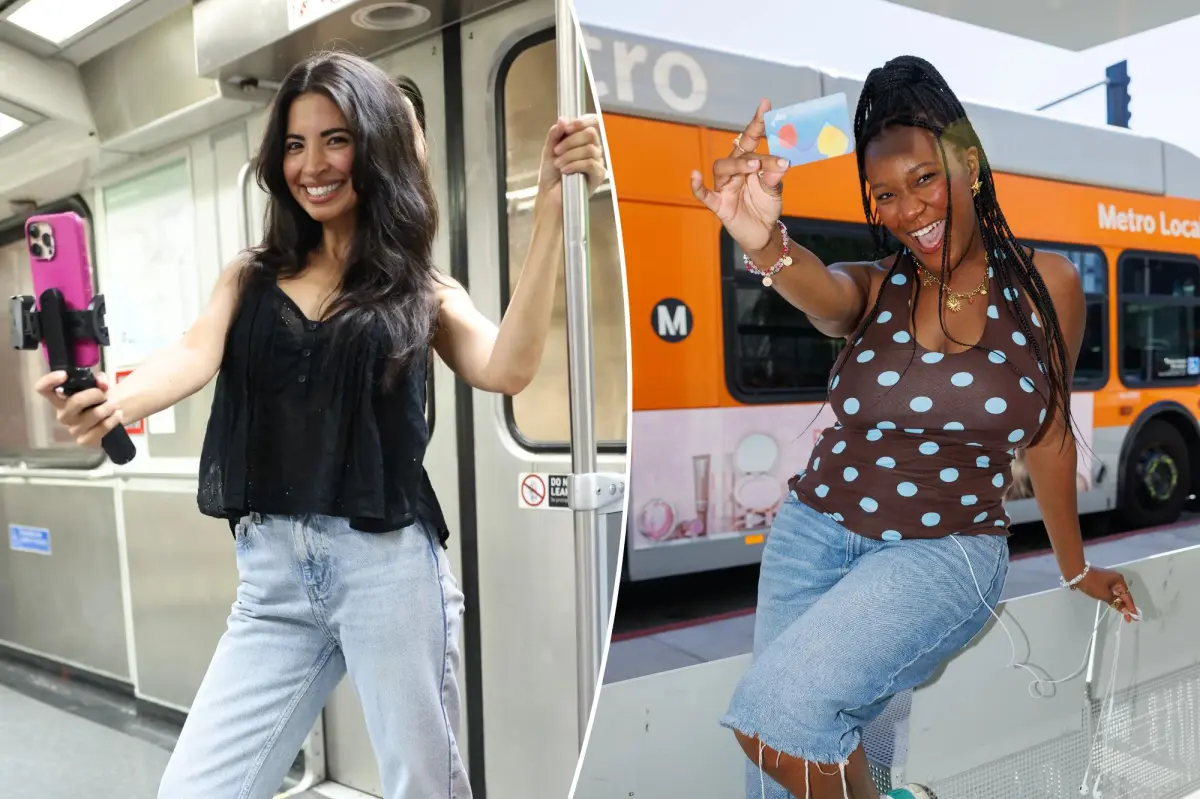
Forget Erewhon, with its cold-pressed juices and $18 smoothie bowls. The latest status symbol among Los Angeles’s chronically online, chronically car-dependent set is not a wellness tonic or an invitation-only supper club. It’s a molded plastic bench underneath a humming fluorescent shelter, where a bus—not a black SUV—will eventually rumble up. With gas prices climbing like a Santa Ana heat wave and parking as precious as a beachfront bungalow, a small but growing tribe of “transit baddies” are trading car keys for TAP cards and discovering their own city from the window of a Metro bus or rail car. For decades, LA’s identity has been built on freeways; to admit you ride the bus has often felt like confessing to a failure. But an emerging group of young, mostly female influencers is recasting public transit as something cool, even radical:a way to opt out of the soul-crushing loop of traffic, gasoline, and valet parking. They are filming themselves waiting at stops, transferring between lines,and marveling at how a $1.75 fare can open up neighborhoods they never knew existed. In the process, they are challengingthe tired narrative that LA is a city you can only love from behind a steering wheel. “I almost feel like I’m rediscovering LA,” says Julianna, better known by her handle Hot Girl Transit. She is not a paid Metro spokesperson; she is not an influencer with a multi-city brand collab contract. She is simply a former driver whose car died,and whose social media videos have accidentally turned her into an evangelist for the city’s oft-maligned public transit system. This is the new LA influencer circuit: not Erewhon, but the bus stop, where the hottest ticket in town is a seat on a Metro line and the only velvet rope is the cord passengers hold as the bus lurches toward downtown.
For Julianna, the journey began not with a vision board but with a dead engine. After eighteen years in Los Angeles—most of them spent gripping a steering wheel, easing into traffic, circling blocks for parking—she found herself suddenly carless in June, forced to confront the city’s public transit system for the first time. Thatfirst ride unfolded like a heady urban discovery tour. “It’s incredible where the train and the bus can take you. It really can take you all over town,” she says. “I just started discovering new communities, new art spaces, third spaces, new places to eat,and it’s been really awesome.” She began documenting her rides on TikTok, starting with a simple trip to Koreatown. The video caught a wave; views and comments poured in, with strangers issuing recommendations like curbside tour guides: “Oh, next time try this place” or “Try this line.” Encouraged, she kept going, riding the bus and rail from her West Hollywood base to destinations across the country’s most sprawling metropolis. Four months later, she has no plans to return to car ownership, despite having the means to buy another vehicle. “Could I get another car right now? Sure, but I would be stressed out,” she says. She rattles off the familiar litany of LA driver anxieties: gas prices, lease payments, an endless hunt for parking. Then she cites the mathematics of transit: “There’s no world where I’m gonna sit in 40 minutes of traffic on the way to downtown when I can get there in 17 minutes and not worry about parking.” She is careful not to sound like a zealot. She has no interest in shaming drivers or forcing anyone to abandon their automobile. “I’m never one to say ‘get rid of your car,’” she insists. “But people should have mixed use and try it out.” The word mixed is key: not an all-or-nothing divorce from the automobile, but a flexible, intentional relationship with the city—sometimes driving, sometimes riding, sometimes walking,and letting the journey itself become part of the pleasure rather than a prelude to it. For Julianna, the bus stop has become a portal, not a comedown.
Julianna’s enthusiasm flies in the face of conventional wisdom. LA Metro system, an enormous network of 165 bus routes and six rail lines, has long occupied an awkward place in Southern California’s psyche. For generations, Angelenos have regarded it as a last resort—unreliable, unsafe, dirty—a symbol of civic failure rather than a public good. “I think most Angelenos ignore Metro,” says Juan Matute, deputy director of the UCLA Institute of Transportation Studies. “People are still figuring out what it means to them—and so we’re very muchin this transitional period in LA of what transit means to the city.” That transition may be rooted in hard evidence that the system is improving. Violent crime on Metro fell 6.7% in 2025 compared with 2024, reaching its lowest level since 2021. Ridership is climbing, too: weekday ridership grew 8.4% between June 2025 and June 2026, according to LA Metro. The agency has been aggressively courting drivers. In August, Metro launched the second phase of its One Car Challenge pilot program, paying eligible LA County households up to $600 to park one vehicle for five weeks and rely instead on transit, biking, walking, or carpooling. It’s a financial incentive disguised as a dare:can you survive LA without your second car? The payoffis not just cash but perhaps a new relationship with the city. Infrastructure is also expanding. In May, the D Line stretched westward, adding three new stops through Mid-City, with more scheduled to open on Beverly Drive and Century City in spring 2027,and to Westwood in fall 2027. The message from Metro is clear:we are building a system worthy of being a first choice, not a fallback,and we want influencers to help spread the word. But while Metro does set aside funds for influencer marketing, the women at the center of this story insist they are unpaid, independent voices—not plants, not shills, simply converts whose testimony happens to look a lot like joy.
One such convert is Celine Milien, a New York transplant who moved to LA a year ago without a car. As an actress living in Downtown LA and often commuting to Studio City for auditions and gigs, she discovered that transit was not a limitation but a liberation. “I like just being able to be free and travel,” she says. Her enthusiasm is contagious enough that she has become a one-woman recruitment agency. “I have roommates that have cars,and I’ve made them take the bus with me,” Milien laughs. They climb aboard skeptical, expecting grime and delays,and instead find themselves muttering,“Wait, actually,that wasn’t that bad.” She replies,“Exactly.” For her,a night out is transformed when no one has to sober up to drive or circle blocks fora parking spot. “Especially after a night out,you don’t want to look for parking,” she points out. The affordability helps,too:a standard one-way fare is $1.75,including free transfers for up totwo hours in one direction—cheaper than a gallon of gas, cheaper than most parking meters,a price pointthat makes spontaneity possible. Milien calls the nascent movement“transit baddies”—a fleet of young, stylish, unapologetic women who treat the Metro map like a fashion accessory. They are not sanitizing the experience; they are reimagining it. Alaina Graham,another influencer,turned her hour-and-a-half commute from Santa Monica to West Hollywood fora night out into content,documenting two buses and captioning it:“Saving gas and $$$ but not necessarily time.” Her honesty is part of her charm; the challenge is real. London native lucylovestransport,whose handle itself broadcasts her passion,racked up over 600,000 views fora video of her journey from Downtown LA to Santa Monica,a trip that clearly startled viewers accustomed to the car-centric caricature of the city. “I assumed LA did not have a train system because all everybody talks about is the traffic,” one commenter wrote,unwittingly exposing exactly how much the broader culture has underestimated what Metro can offer. For every skeptic who dismisses buses as uncomfortable,these women offer another frame:transit as an adventure,a small act of rebellion,a chance to see the city differently
None of this is naive escapism. The “transit baddies” know that riding LA’s buses and trains can require more than a TAP card;it demands situational awareness. “It doesn’t matter what city it is. If you’re in a city,you have to be aware of your surroundings,” Julianna says. She has codified her safety rituals:one headphone in,one headphone out; always sitting or standing in the first car,directly behind the conductor,where help is closest. For Milien,vigilance issocial as well as spatial. “I think no matter where you are,public transportation might be ‘unsafe,’ but I think the best thing that you can do is stay vigilant,” she says. Her friends share her location,“so they always know where I am,” she explains,“and I’m just making sure that I’m staying aware and staying present.” These precautions are born from real concerns;commenters under their videos are quick to remind them of the system’s darker corners. “I love public transportation,but it must be done with a lot of caution. A lot goes down in thesubways!” one warned. “If you only knew what really happens in the Metro and buses. Oh well,” another added. The influencers do not dismiss such warnings;they simply refuse to let fear dictate their mobility. They are also accustomed to a different kind of skepticism:the suspicion that they must be paid shills. It’s a testament to how thoroughly car culture has colonized LA’s imagination that genuine enthusiasm for public transit is treated as suspicious. “People think I secretly work for the city,or I’m a plant for the Metro,” Julianna says,laughing. “And I’m like,‘Oh, okay,I’m still waiting on my check.’” The joke carries a sting:“Like,no one can believe I would be riding it,and I find that so offensive. It’s an incredible underutilized resource,and my goal is to show and to normalize it.” She is not encouraging anyone to be reckless;she is invitingthem to be curious,cautious,and open
What is happening in Los Angeles is bigger than a TikTok trend or a viral bus video. It is a slow, stubborn,often awkward cultural readjustment—a city that spent a century building itself around the automobile beginning to remember it has bones,routes,and shared spaces beyond the freeway. The influencers are not claiming Metro is perfect;they are not pretending every ride is scenic or every transfer seamless. They are simply showing that it exists,that it can work,and that using it does not make you a second-class citizen. In a region where asking someone to take the bus can feel almost unpatriotic,these women are performing a quiet act of citizenship:they are normalizing public infrastructure,one video,one commute,one skeptical roommate at a time. Their message is not anti-car;it’s pro-choice—not political choice,but transportation choice,the freedom to move through the city without a metal cocoon. They want Angelenos to know that a life with fewer miles on the odometer can be richer in other ways:more conversations,more walking,more noticing,more neighborhood joints discovered by accident because the bus happened to stop at their corner. When Julianna beams into her phone’s camera after alighting at some unfamiliar intersection,she is doing more than documenting a commute;she is testifying that a city can be known from the inside out,not just through windshield glass. “I’m still waiting on my check,” she jokes,but the real compensation is visible in her face:the elation of rediscovery. Forget Erewhon. The hottest new scene in Los Angeles is nowhere,and it’s coming every 15 minutes. You just have to be willing to wait at the bus stop,tap your card,and see where the ride takes you.