


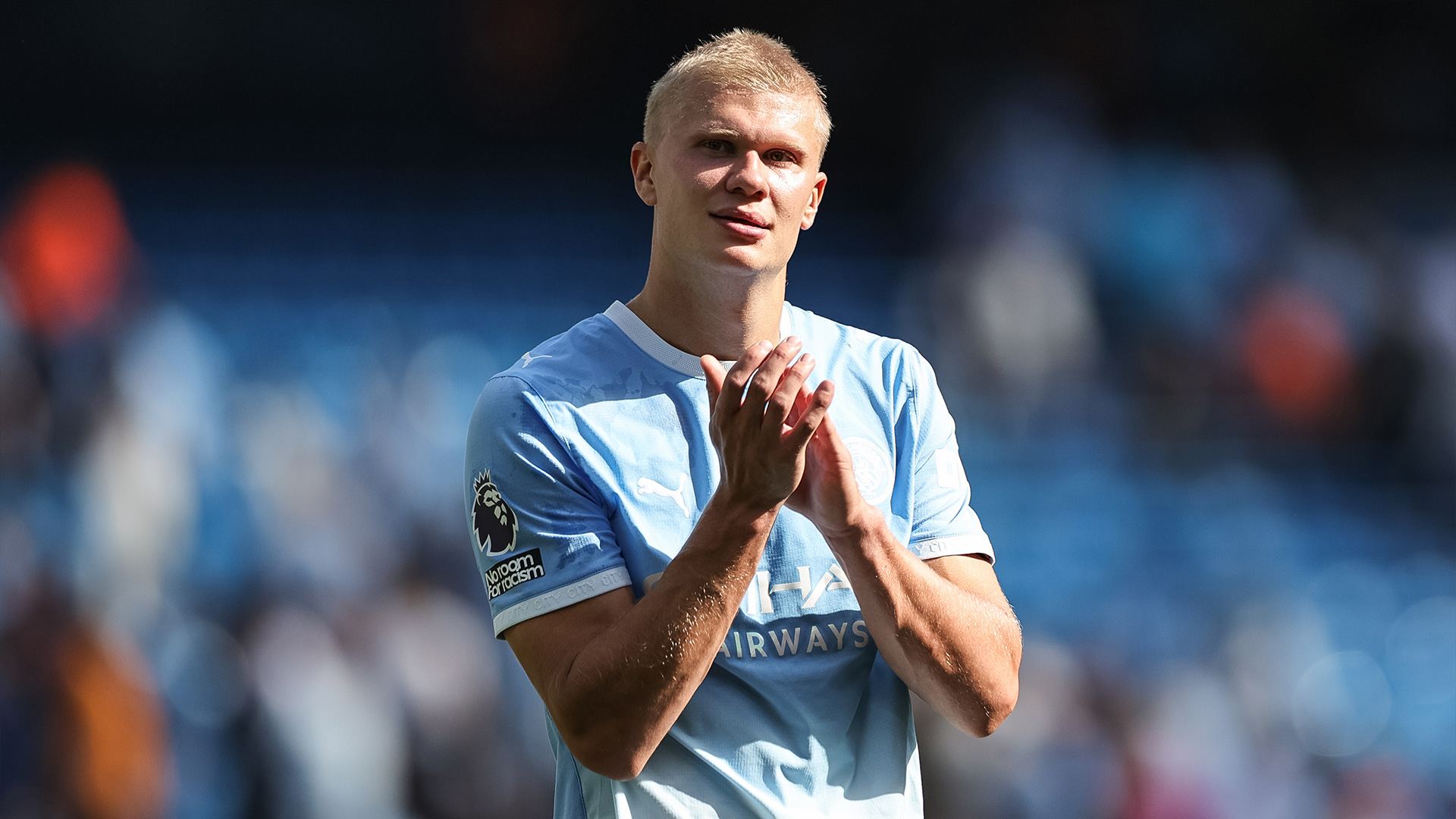
There are moments in sport that feel bigger than the game itself, moments when the noise around the pitch becomes louder than the action on it. For Erling Haaland and Manchester City, that moment has arrived with the force of a thunderstorm. On Thursday, Haaland broke his silence in his first public comments since an independent panel found Manchester City guilty of serious, large-scale financial rule-breaking in the Premier League. Instead of offering a defiant defense of the club’s innocence, or a calculated legal argument, Haaland chose a simpler, more human message: stay together, stay positive, and keep smiling. In an interview with Sky Sports, he said, “We have to stick together and we have to spread the love to each other. So yeah, stick together, enjoy the ride and smile.” It was a striking response from a footballer often portrayed as a cold, relentless scoring machine. Here he was, in the eye of a storm, doing what any teammate or friend might do when the world seems to be closing in: reaching for unity and warmth. His words were not just for his club, but for the fans who have followed City through years of triumph and who now face the very real possibility that those triumphs could be stained forever. With a crucial match against Liverpool looming on Sunday, Haaland’s message was a plea not for justice, but for togetherness.
To understand why those words matter so much, you have to understand the enormity of what has happened. Manchester City, one of the most successful and wealthy clubs in world football, has been found guilty by an investigatory panel of artificially inflating its revenue by more than one billion dollars between 2009 and 2018. The Premier League brought 80 serious financial charges against the club, and the panel found City guilty on all of them. The purpose behind the inflated revenue, according to the ruling, was to circumvent financial fair-play rules that were designed to prevent clubs from simply buying their way to success. These rules existed to create a level playing field, to stop wealthy owners from pouring unlimited money into their teams and drowning out smaller clubs. City, the panel found, broke those rules on a massive scale, over the course of nearly a decade. The potential punishments are severe: fines, points deductions, stripping of titles, or even expulsion from the Premier League itself. For a club that has won four consecutive league titles and was until recently chasing a fifth, the very idea of expulsion is existential. And yet, as devastating as the verdict is, City has lodged an appeal. They have not accepted the ruling quietly. The appeal means the final chapter has not yet been written, but it also means the uncertainty will drag on, and that uncertainty is perhaps worse than any single punishment. When Haaland says “we have to stay positive,” he is not just giving a motivational speech. He is trying to hold together a club that cannot afford to fall apart emotionally, even as its legal foundation trembles beneath it.
There is something deeply human about Haaland’s response, a reminder that footballers are not just legal entities or statistics. He is a player who has scored goals at a rate rarely seen in the history of the sport, but he is also a man who can see what is happening around him. City’s season has been strange by its own impossible standards. They are not at the top of the league, and the aura of invincibility that surrounded them for years has quietly faded. Now, with the verdict hanging over them, every match feels like it carries extra weight. When he was asked what he would say to the City supporters traveling to Anfield, where a hostile reception awaits, Haaland did not speak about revenge or proving critics wrong. He said, “We have to stick together, we have to stay with each other and we have to stay positive. No matter what happens in life, we have always have to have a smile. So we have to stay positive, look ahead and try to win football games and then try to enjoy the situation and the game.” That last phrase is remarkable: “enjoy the situation.” It is not a natural thing to say when your club is facing charges that could end its place in the league. But Haaland seems to understand that football, at its core, is still a game. Maybe he is trying to push away the legal noise, to focus on the things he can control: his movement, his finishing, his connection with the fans. He is not a lawyer or a judge. He is a striker. And his job, as he sees it, is to bring people together with a smile, even in the darkest hour. Whether that will be enough to lift his teammates remains to be seen, but it is a reminder that the people inside the club are not just cogs in a corporate machine. They are human beings trying to do their jobs while the walls around them shake.
The next person to face the storm is City manager Enzo Maresca, who is likely to face severe questioning when he holds his pre-match news conference on Friday. It will be Maresca’s first public remarks on the scandal, largely because domestic soccer has been on hold for the past three weeks due to an extended international break. That break granted City a brief, artificial peace, a chance to train and prepare without the fury of the media. But the pause is over. The return of the Premier League means that Maresca can no longer hide behind the international calendar. He will have to stand in front of reporters and answer for the verdict, for the appeal, and for the mood inside the dressing room. It is an unenviable position. Managers are often judged on tactics and transfers, but now Maresca is being asked to be the public face of a club under existential threat. He must balance loyalty with honesty, confidence with humility. He cannot simply say “no comment” and expect the questions to stop. The Liverpool match, for Maresca, will not just be a critical test of title ambitions. It will be a test of his ability to lead a group of players who have heard everything, who know the verdict, and who still have to run onto a pitch and play football in front of millions of people. The atmosphere at Anfield is expected to be intensely hostile, with rival fans likely to sear City’s players with taunts and banners. All Haaland can do is smile and stick together. Maresca will need to deliver a much more tactical version of that same message, and he will have to do it without showing any cracks.
Across the rest of the Premier League, other managers are being asked the same question: what do you think about Manchester City? On Thursday, the responses were cautious, almost everyone choosing not to rush to judgment. Frank Lampard, the Coventry manager who played for City during one of the seasons under investigation, was willing to acknowledge the gravity of the news. “We’ve all seen the news. It’s obviously big news,” he said. But then he paused and offered a reminder that legal matters are not always as simple as they seem. City are appealing, he noted, and “what can you say when an appeal is going on? I’m not inside the story, I’m outside it completely — I played for Man City a long time ago, for one year — so we’ll wait and see what the result of the appeal is.” Lampard’s tone was measured, respectful, and perhaps a little weary. He knows how quickly football can turn on a club, and he also knows the danger of saying something premature. Other managers were even more evasive. Bournemouth’s Marco Rose said, “I’m a football coach, not a politician.” Newcastle’s Matthias Jaissle said he was “not able to judge” as a manager of another club, adding that “there are authorities taking care of it.” Leeds manager Daniel Farke said there were “more qualified people … able to speak about it.” The message from all of them was similar: this is not our fight, not our verdict, not our responsibility. In a way, that is the most telling reaction of all. City has spent years standing apart from the rest of the league, financially and competitively. Now, in the aftermath of the verdict, the other clubs are standing apart from City, refusing to offer comfort, refusing to condemn, and simply waiting to see what happens next. It is a lonely place for the club that used to have everything.
Still, there are those who believe the system will ultimately work. Speaking at the Leaders in Sport conference in London, Leeds chairman Paraag Marathe — who is also president of the club’s U.S.-ownership group, 49ers Enterprises — said he believed “the most just result, I’m sure, will be delivered.” He did not mention City by name, but his words carried a broader hope that sports leagues can remain fair. “In any sport, you know, everybody wants to play by the same rules,” he added. That is the heart of the matter. For all the talk of revenue, sanctions, and appeals, the Manchester City case is ultimately about whether football can trust its own rules. If a club can be found guilty of inflating revenue by more than a billion dollars and still survive without meaningful punishment, then the rules are meaningless. If, on the other hand, City faces severe sanctions despite its appeal, the verdict will send a chilling message to every club in the world: no matter how powerful you are, no matter how many titles you have won, no one is above the rules. Haaland’s message of smiling and sticking together is beautiful in its simplicity, but it cannot answer the deeper questions that the panel’s verdict has raised. Can football still be a fair game? Can fans believe what they see? And what happens to a club that has built its modern identity on success, if that success is officially declared illegitimate? These questions will not be resolved on Sunday at Anfield, nor by Haaland’s encouraging words. They will be resolved in courtrooms, appeal hearings, and boardrooms, far away from the roar of the crowd. But until then, football must go on. And Haaland, for one, intends to keep smiling. He will run out onto the pitch at Anfield, with the din of hostility all around him, and try to do what he does best: score goals, win games, and remind everyone that despite the chaos, the sport itself still has the power to lift the heart. Whether the sun will shine again on Manchester City is uncertain. But for now, there is a match to play, a season to finish, and a team that has been told to stick together. In times like these, perhaps that is the only thing anyone can truly do.