


So, what’s the answer to the question in the headline? Honestly, it’s the easiest question in the world: you should visit both. If you’re planning a trip to the Far East, Tokyo and Seoul aren’t rivals to choose between so much as two chapters of one great Asian adventure. Both cities have become global icons in recent years, drawing everyone from first-time backpackers to seasoned luxury travellers, and both have completely earned their place on the world’s most-wanted list. I’ve been lucky enough to spend time in each, and what strikes me most is how different they are while still being equally magnetic. Tokyo is enormous, electric, endlessly layered, a city that seems to go on forever in every direction. Seoul is sleek, creative, proudly modern yet deeply traditional, with a cultural wave that has turned it into one of the trendiest places on Earth. The one thing they truly share is the sheer overwhelming amount of things to see and do. You could spend a year in either and still feel like you’ve only scratched the surface. And that’s not an exaggeration. Whether you’re after ancient temples, futuristic skylines, incredible street food, world-class museums, quirky neighbourhoods, or simply the pleasure of getting lost in a city that feels alive at all hours, both Tokyo and Seoul deliver in ways that few other capitals can match. The real trick, I’ve found, is not to treat it as a choice at all.
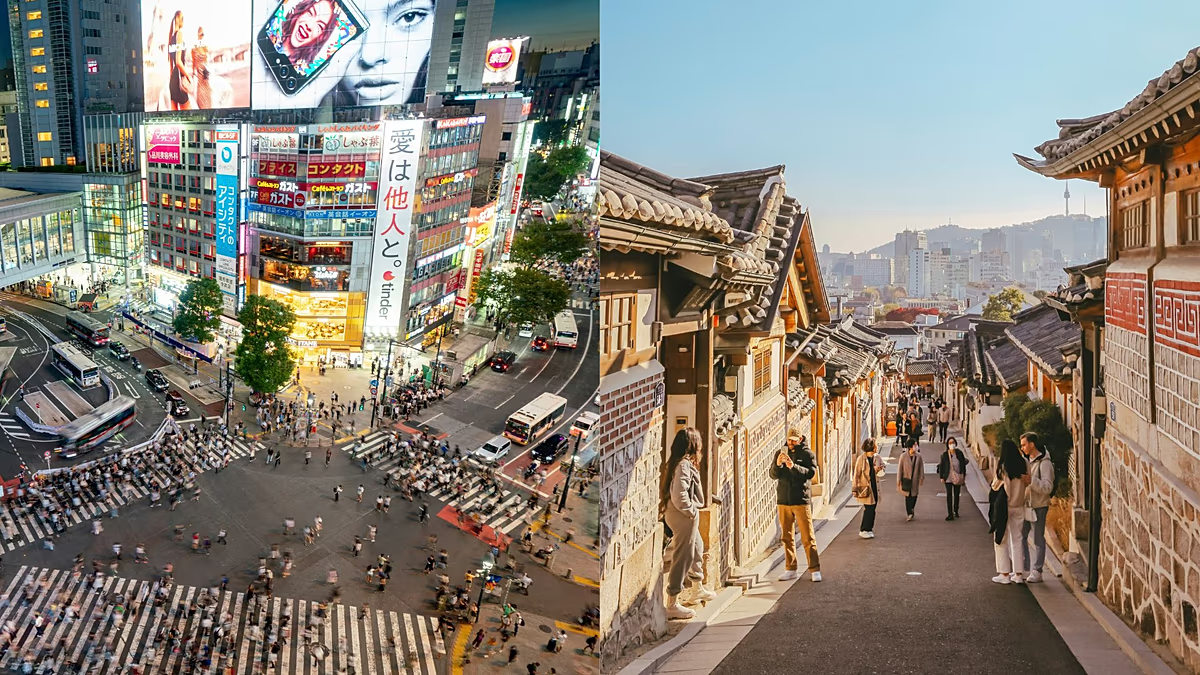
Let’s start with Tokyo, because few cities on the planet can compete with it for sheer scale and energy. In 2025, Japan’s capital welcomed a record 28.65 million international visitors, and you can feel that boomerang energy the moment you arrive. My own introduction was Shinjuku Station, which is an adventure all by itself. It’s the busiest train station in the world, serving more than 2.7 million passengers every day, and it has more than 200 exits. Yes, 200. I’ll never forget stepping out into the street and realising just how big and bewildering the city really is. But once you find your bearings, Shinjuku is a fantastic place to start: towering skyscrapers, endless shopping streets, tiny bars tucked into back alleys, and restaurants that seem to never close. From there, you can wander into Shibuya, home to the famous scramble crossing, a gloriously chaotic intersection that somehow feels choreographed. Nearby is Harajuku, where Tokyo’s young and stylish show off their fashion and creativity. A little further on, Akihabara is the heart of anime, manga, electronics, and pop culture, a buzzing district that feels like a window into the future. Then there’s Roppongi, with its skyscraper views from Mori Tower, and Ginza, where luxury shopping and high-end dining sit side by side. Tokyo is so huge that every neighbourhood feels like its own city, with a personality that changes completely from one street to the next. It’s neon-lit and restless at all hours, but it also has a quieter, more ancient side waiting just around the corner.
That quieter side is where Tokyo’s soul really shines. In the historic district of Asakusa, you’ll find Sensō-ji, the oldest Buddhist temple in Tokyo, and it is absolutely worth every step of the journey. The approach to the temple is lined with traditional shops and lanterns, and the atmosphere is a beautiful mix of pilgrims and curious travellers. Just as memorable is Meiji Jingu Shrine, tucked into a peaceful green forest next to Yoyogi Park in Shibuya. On the path leading to the shrine, there’s a wall of decorated sake barrels that makes for an unforgettable photograph. Honestly, your camera roll will fill up in minutes. And for anyone who loves food, Tokyo is nirvana. It has more Michelin-starred restaurants than any other city in the world, including eleven three-star and twenty-six two-star restaurants, but some of my most delicious meals were humble street bites that cost next to nothing. That’s the beauty of Tokyo: it can be as refined or as casual as you want it to be. You can spend an evening at an incredible omakase counter, then grab steaming ramen from a tiny shop in a back alley the next night, and both feel perfect. As wonderful as Tokyo is, it’s also impossible to see everything in a short visit. Even a week will barely scratch the surface, and that’s okay. If you have an extra day or two, do yourself a favour and head out to Mount Fuji and the Fuji Five Lakes region. Staying near Lake Kawaguchi, with its lakeside walks, hot springs, and panoramic views of Japan’s iconic peak, is a beautiful way to end a Tokyo trip. You get the neon city and the tranquil mountain, two completely different sides of Japan, and both are unforgettable.
Now let’s cross over to Seoul, which has been having a moment for a while now and shows no signs of slowing down. Much of that is thanks to K-culture: K-pop, K-dramas, Korean food, fashion, and beauty have transformed the South Korean capital into one of the hottest city break destinations in the world. The numbers back it up. Time Out called Seoul “a master of all trades” and ranked it ninth in its 50 Best Cities in the World for 2026, jumping a remarkable thirty-three places. Even better, the trendy neighbourhood of Jongno 3-ga was named the coolest neighbourhood on Earth, a place described as a maze of alleys, late-night food stalls, and rivers of makgeolli. Meanwhile, the Trazees awards named Seoul the favourite worldwide city among Gen Z and Millennial travellers for the fifth year in a row. International arrivals are booming too, with a record 8.23 million overseas visitors in the first half of 2026, up 21.3% from the previous year. But what makes Seoul so special is not just its trendiness. Like Tokyo, Seoul is a city of fascinating contrasts, where ancient palaces and modern skyscrapers sit side by side. Start at Gyeongbokgung Palace, the largest of Seoul’s five grand palaces, and try to time your visit for the colourful changing of the guard ceremony. From there, walk to Bukchon Hanok Village, a beautiful neighbourhood of narrow streets and traditional Korean hanok houses. That village, for me, was one of the absolute highlights of my entire trip. It feels like stepping back in time, while just beyond the rooftops you can see Seoul’s shimmering modern skyline. It’s that mix of old and new that makes the city so compelling.
And then there’s the other side of Seoul, the flashy, energetic, new-school side that has made K-culture a global force. You can’t visit Seoul without at least dipping into Gangnam, made world-famous by Psy’s 2012 hit “Gangnam Style,” though I’ll spare you the dance. It’s a district of skyscrapers, high-end shops, and a nightlife scene that hums until dawn. For shopping and street food, Myeong-dong is always a good idea, while Hongdae is known for its music scene, youthful energy, and eccentric cafés. Seongsu, meanwhile, has emerged as one of Seoul’s coolest neighbourhoods, full of indie fashion, pop-up stores, and stylish coffee spots. And food lovers will be in heaven: Korean barbecue, soju, and the glorious pairing of fried chicken and beer, known as chimaek, are essential experiences. Seoul also has forty-two Michelin-starred restaurants for those wanting a truly special meal, but honestly, the street food alone is worth the trip. What surprised me most about Seoul, though, was how much nature exists right alongside the urban buzz. The Han River cuts through the heart of the city, lined with parks that are perfect for long walks or bike rides, and a river cruise at night offers a completely different perspective of the skyline. If you want mountains, Bukhansan National Park is surprisingly accessible from downtown. And don’t miss N Seoul Tower, which gives you a sweeping view of the capital, or Cheonggyecheon, an eleven-kilometre restored stream that runs through the centre of the city like a peaceful green ribbon. Even the DMZ, the tense border zone between North and South Korea, is an easy day trip and a strange, thought-provoking experience that adds even more depth to a Seoul visit.
So, Tokyo or Seoul? Which one wins? If you force me to choose, I’d say Tokyo wins on sheer scale, endless exploration, and that feeling of being truly overwhelmed by a city. Seoul wins on cultural coolness, the irresistible pull of K-culture, and that wonderful mix of old and new energy. But the smartest answer, the one I always give now, is simply this: why not both? Direct flights between Tokyo and Seoul take only about two and a half hours, and there are multiple services every single day. The two cities are close enough that combining them into one trip is easy, and different enough that you won’t feel like you’re seeing the same thing twice. You can spend a few days getting lost in Tokyo’s towering neighbourhoods, then fly to Seoul and dive into palaces, barbecue restaurants, trendy alleys, and Han River breezes. That’s exactly what I did, and I’d do it again in a heartbeat. Both cities have changed me as a traveller, and they’ve each left me with memories I still think about all the time. So if you’re wondering where to go, don’t agonise over the decision. Go to both. Let Tokyo amaze you with its size and secrets, then let Seoul charm you with its energy and history. You’ll come home with a camera full of photos, a belly full of incredible food, and a new favourite city or two. The only problem you’ll have is trying to decide which one to visit first.