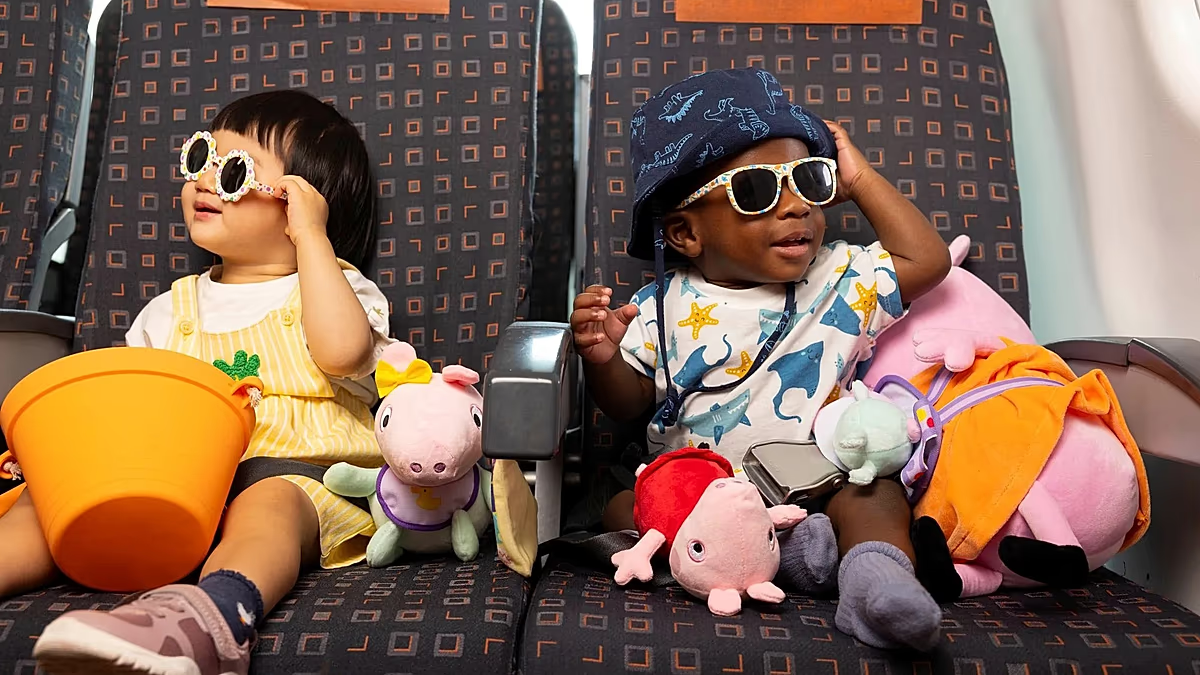



Imagine the familiar dread of booking a family flight: you’ve already paid for checked bags, seat selection is staring at you as an extra line-item, and your six-year-old is a little too small to be left alone three rows behind you. For years, parents across the UK were forced to pay whatever airlines demanded just to sit next to their own children. That is now changing. On 2 October 2026, new rules came into force in the UK that stop airlines from charging parents to secure a seat next to their child on a flight. The protection applies to children under the age of 14 who are travelling with a parent or an accompanying adult. Previously, a return trip could cost a family as much as £104 (€122) simply to guarantee two seats side by side. For many households, especially those already navigating high prices and travel costs, this fee felt like an unavoidable, infuriating penalty. It’s not about luxury; it’s about basic care. A parent needs to reach across, pass a snack, calm a frightened child during turbulence, or make sure a tired toddler doesn’t wander off. The new rule treats that as a fundamental need, not an optional add-on. There is a sharp, emotional relief in knowing that, at least for now, families can strap in without calculating whether they can afford to sit together.
The change goes beyond seating. The UK government also announced that airlines must now allow passengers to correct simple name errors on bookings free of charge. Previously, some carriers were charging up to £40 (€47) for what should be a minor administrative fix—a typo that turns “Sophie” into “Sohpie,” a swapped first and last name, or a missing letter on a passport match. These mistakes happen quickly and disappear even faster, but the punishments were often arbitrary and shockingly heavy. Under the new rule, passengers can have those errors fixed without pulling out a card. Transport Secretary Heidi Alexander framed the move as part of a broader effort to protect consumers from unnecessary charges. “Parents should not have to feel the pinch just to sit next to their child on a flight, or for amending a simple booking error,” she said. “That’s why we’re scrapping these unnecessary charges for all airlines—another everyday fix to help put money back in people’s pockets and give households more breathing room.” She also linked the reforms to safety, insisting that these common-sense changes will make flying safer for both staff and passengers by encouraging families to stay together and removing the stress caused by arbitrary fees. For many travellers, it’s a small but welcome reminder that rules can be written with real lives in mind, not just airline revenue spreadsheets.
But the UK is not acting in isolation. The European Union is moving in the same direction, and in some respects it is planning to go even further. Under the EU’s new air passenger rules, which have been proposed but are not yet in force, parents must be given a seat next to their child under the age of 14 free of charge. The same protection would apply to people accompanying a pregnant passenger, or anyone travelling alongside a passenger with a disability or reduced mobility. The proposed EU regulations would also allow free spelling corrections and administrative name updates, matching the UK’s approach. And there is another noteworthy layer: the EU wants to ban airlines from charging checked-in passengers for a printed boarding pass. That may sound minor, but for less tech-savvy travellers, older passengers, or anyone whose phone dies at the airport, the need for a printed pass should not become a price trap. If these EU rules come into effect next year, as expected, they would reshape the passenger experience across a market far larger than a single country. For now, the UK’s approach sets a national benchmark, but the broader political momentum across Europe suggests that the era of nickel-and-diming families may be coming to an end. Travellers will have to wait and see how the EU rules evolve, but the direction of travel is clear.
As always in the world of aviation, no good rule goes unchallenged. Ryanair’s outspoken chief executive, Michael O’Leary, reacted to the UK announcement with his characteristic bluntness, accusing the government of fabricating a problem. He claimed that Ryanair already has a 24-hour grace period for correcting minor spelling mistakes and stated plainly that there are no fees for children to sit with their parents on UK airlines. In his view, the transport secretary’s announcement was a distraction. O’Leary used the moment to attack the Labour government’s record on air travel, pointing to an increase in UK Air Passenger Duty (APD) to £15 (€17.63) per ticket—which he calculated as £60 (€70.53) for a family of four in 2026. He also reserved harsh words for Martin Rolfe, the CEO of NATS, the UK’s air traffic control provider, whose compensation package he highlighted at £1.4m (€1.65m). O’Leary noted that NATS has suffered four air traffic control system collapses in the last four years, while no other European ATC system has experienced collapses of the same kind. His argument was blunt: why is the government patting itself on the back for small ticket fees when bigger costs and failures remain unaddressed? It’s a classic aviation grudge match, and the truth is probably somewhere in the middle. Consumers, however, are unlikely to lose sleep over the political fallout. What matters to them is that, at the counter and online, the fees they used to pay are gone.
At the same time, the UK government is pushing forward on a more serious front: unruly passengers. In a separate announcement, it confirmed that it is working with airlines and trade unions to create a new system for sharing information about persistently disruptive flyers. The scale of the problem is larger than many people realise. Last year alone, airlines logged more than 1,000 serious disruptive passenger incidents. That includes the usual array of verbal abuse, refusal to follow crew instructions, drunken arguments, and in some cases physical altercations. Anyone who has ever sat through a flight with a hostile passenger knows how quickly a contained metal tube can start to feel tense and frightening. Cabin crew already carry an enormous amount of responsibility, and they often absorb the worst of this behavior. The new system would allow airlines to check whether a potential passenger has been banned by another carrier. If a disruptive passenger is banned from one airline, other participating airlines could extend their own ban if they think it is necessary. The goal is simple: stop the same offenders from simply hopping to a competitor’s flight and repeating the same behavior. For staff, this is a safety measure as much as anything else. For ordinary travellers, it offers hope that the small minority of problem passengers will no longer disappear into the system and resurface on another route. Shared information is not a dramatic headline, but it can be a powerful deterrent when the consequence is real and follows you beyond a single flight.
Taken together, these changes paint a picture of what modern air travel could feel like: less adversarial, more humane, and more focused on the shared experience of getting from one place to another. The scrapping of family seating fees and simple name correction charges takes some of the money stress out of booking. The proposed EU rules offer a vision of consistent passenger rights across borders, even if the details still need to be finalised. And the new information-sharing approach to disruptive passengers signals a serious effort to protect the comfort and safety of everyone on board. Of course, the road ahead is not perfectly smooth. Airlines will push back, as O’Leary demonstrated, and they will argue that fees are necessary to maintain strict pricing models or that changes to passenger rights create unfair burdens. There are still questions about how the UK rules will be enforced, what counts as a “simple” name error, and whether the cost of these adjustments will sneak back into ticket prices elsewhere. But for parents, caregivers, and travellers who simply want fair treatment, the recent announcements are genuinely meaningful. The small print used to feel like a trap; now, at least in some cases, it feels like it is being rewritten. Travel is already exhausting enough. Families should not have to do advanced mathematics just to sit together, and a typographical mistake should not cost a week’s groceries. These changes are not just about money. They are about respect—respect for parents, for passengers with disabilities, for travellers who are far from home, and for the people who work on the front line of aviation. In 2,000 words or in a single sentence, the message is the same: flying is for people, not just for profit.