


It may feel as though we have only just slipped into October, but the travel industry is already living somewhere far ahead of the calendar—somewhere around 2027, to be exact. Euronews Travel has already shared its own predictions for the year ahead, and now Hilton has joined the chorus with the release of its 2027 Trends Report. Based on a survey of nearly 15,000 travellers from the UK, Germany, Türkiye, the US, Australia and beyond, the hotel giant has identified five major shifts that it believes will define the way we move through the world in the near future. Together, they point to something Hilton calls “the great rebalance.” What that means, according to Chris Nassetta, Hilton’s president and chief executive officer, is that travellers are increasingly turning away from other people’s ideas of the perfect holiday. Instead, they are planning trips on their own terms, looking for experiences that fit into their real lives, help them recharge, and leave them with meaning long after they return home. There is something deeply human in that idea: we are not chasing postcard perfection anymore. We are chasing a sense of ease, of belonging, of feeling like ourselves again. And the more the world speeds up, the more we seem to crave travel that slows us down, expands us, and reminds us that we are not just cogs in a machine. The report captures this beautifully, and its findings are a reassuring reminder that the future of travel is less about impressing others and more about nourishing ourselves.
One of the biggest trends Hilton has identified is what it calls “the micro-travel mindset.” This is the growing desire for shorter, more frequent escapes—trips that are easier to plan, easier to execute, and easier to squeeze into the rhythm of a busy life. One in four travellers say they choose these shorter jaunts because they can fit them around work, while 29% love the spontaneity that comes with a quick getaway. Or maybe you are the type to pack your weekend with as much as possible, hopping from city to city because you want to taste everything at once. Hilton divides these micro-trippers into two camps: Selectors and Stackers. Selectors build their entire trip around one unforgettable experience—a concert by a favourite artist, a major sporting event, a once-in-a-lifetime restaurant reservation. For them, the journey is all about that single peak moment, and everything else is just the warm-up and the cool-down. Stackers, on the other hand, are all about abundance. They want to visit multiple cities in a single trip, cramming every hour with new sights, new tastes, and new experiences. Nearly 57% of those surveyed say they enjoy this kind of multi-stop adventure. What makes the micro-travel mindset so appealing is that it removes the pressure of the “big trip.” We no longer feel that we need two weeks off and a passport full of stamps to call ourselves travellers. Instead, we can take a long weekend, a single night away, or even a day trip that feels like a mini-vacation. It is travel designed for our actual lives, not for some imagined ideal. And in a world where burnout is all too common, the idea that we can steal small moments of joy throughout the year—rather than waiting for one glorious holiday—is both practical and deeply comforting.
The second trend is one that asks us to drop our perfectionism and embrace “the rise of ‘ish.’” It is a beautiful, forgiving concept: the idea that your vacation does not have to be flawless, and that it is okay if things go a little differently than planned. Travellers are becoming “healthy-ish,” keeping up some of their good habits while happily letting others slide. They are “adventure-ish,” with 28% saying they prefer to figure things out as they go, compared to just 18% who want a fixed itinerary. And they are “solo-ish,” with three in ten people travelling alone but meeting up with someone they know at their destination, and a further 20% joining group excursions with strangers. This is not about being indecisive or lazy; it is about giving ourselves permission to hold things loosely. It is a rebellion against the kind of travel that feels like a checklist, where every day is scheduled down to the minute and every meal has to be the most Instagram-worthy spot in town. The “ish” mindset says: maybe you will eat healthy, maybe you will have dessert for breakfast. Maybe you will follow your plan, or maybe you will wander into a random street and discover something magical. Maybe you will spend the whole trip alone, or maybe you will meet a group of new friends at a cooking class. This trend is a quiet but powerful challenge to the culture of achievement that seeps into our leisure time. It reminds us that travel is not a performance. It is a chance to be human, messy, spontaneous, and free. And by lowering the bar, we actually raise the joy. We become more present, more open, and more likely to say yes to unexpected opportunities.
The third major trend is the rise of “growth getaways,” and it speaks to our deep hunger for meaning and transformation. Travellers are no longer satisfied with simply seeing new places; they want to become new people. This has led to the popularity of “skillcations,” where the holiday is built around learning something tangible. You might take a language course in a sun-drenched courtyard, join a cooking class in a rustic kitchen, or spend a week at an art retreat in the mountains. These are not just idle activities to fill the time; they are the entire point of the journey. But skillcations are only part of the story. Travelers are also looking for experiences that shift their perspective, with 34% saying they want their travels to give them a new mindset. They are searching for moments that challenge their assumptions, expand their empathy, and help them see the world through fresh eyes. This is a profound evolution in what we ask of our holidays. We used to travel to escape, to relax, to tick off landmarks. Now we travel to grow. We want to return home with more than just souvenirs and photos; we want to return with new skills, new insights, and a greater understanding of ourselves. Growth getaways can take many forms—a silent retreat, a volunteer trip, a trek that tests your physical limits, a workshop that unlocks your creativity. What they all share is a focus on becoming. This trend reflects a broader cultural shift towards self-development and mental well-being. We are beginning to realize that true rest is not just about lying on a beach; sometimes it is about stretching ourselves in ways that feel scary and exhilarating. The best kind of holiday, it seems, is one that leaves us slightly different from how we were when we left. And that is an idea worth packing for.
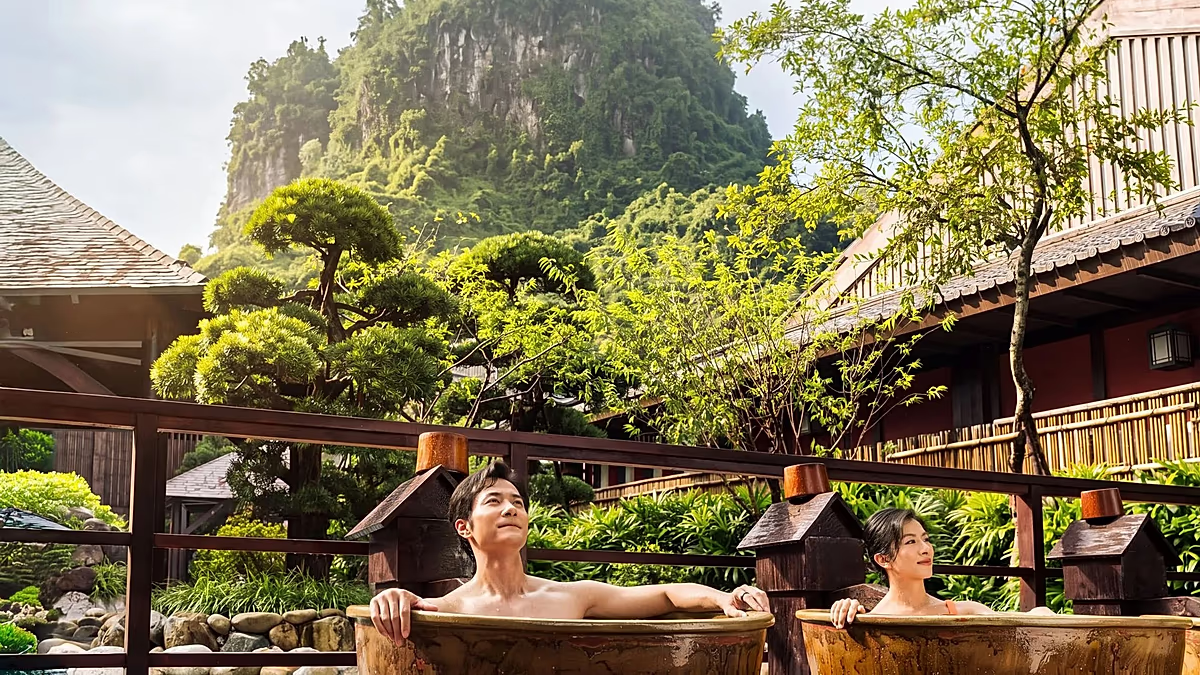
Closely connected to this is the fourth trend, which Hilton calls “wellness, rewired.” Wellness travel has been growing for years, but the way we approach it is changing. It is no longer just about spa treatments and green juice, although those certainly have their place. The new wellness travel is rooted in nature, in fresh air, in the outdoors, and in the simple, grounding experience of being outside. According to the report, 79% of surveyed travellers say fresh air and the outdoors are essential to relaxation, and more than half say they spend more time immersed in nature on holiday than they do at home. This is a powerful reminder that our modern lives are so often lived indoors, in front of screens, under artificial light. Holidays give us the chance to reconnect with the natural world, and with the part of ourselves that feels alive in the wind and the rain and the sunlight. Wellness, rewired is not about punishing workouts or strict detoxes; it is about hiking without a destination, swimming in cold water, sleeping under the stars, or simply sitting in silence in a forest. It is about letting nature do the healing work that no app or treatment can replicate. The report suggests that people are craving this more than ever, and that the most restorative trips are the ones that bring us back to our senses. We want to feel the ground beneath our feet, hear the birds at dawn, taste food that was grown nearby. This reconnection with nature is also a reconnection with ourselves. When we step outside the noise of daily life, we can hear our own thoughts again. We can breathe. We can remember what matters. Wellness, rewired is not a passing fad; it is a response to the growing stress and isolation of modern existence. It is a way of saying that health is not just about the body, but about the spirit, and that the best medicine is often a long walk in the open air.
Finally, the report explores “the travel trust equation,” and it offers a fascinating look at how we decide where to go and what to do in an age of artificial intelligence. There is no denying that AI is becoming more useful in the planning process—it can build itineraries, find hidden gems, compare prices, and answer questions in seconds. But even as technology improves, trust remains profoundly human. The survey found that 70% of travellers trust hotel staff for tips, while 87% turn to family members for advice. Outside of family, 50% of people are more likely to trust recommendations from someone who has loyalty status—a traveller like them, who has been there and done it. This is a beautiful reminder that, no matter how clever our algorithms become, we still crave the warmth of human connection. We want to hear stories from real people, not just see star ratings. We want to know that the restaurant someone recommended is the one where they celebrated an anniversary, that the walking tour was led by a guide who made them laugh, that the quiet beach was found by chance and treasured forever. AI can provide us with information, but it cannot provide us with experience—at least not yet. The travel trust equation shows that the future of travel is not about choosing between technology and humanity. It is about using technology to open doors, and then letting human wisdom guide us through them. We will let the machines do the heavy lifting, but we will go where our heart, our friends, our family, and the kind stranger at the front desk tell us to go. This does not mean we are afraid of innovation; it means we are deeply, wonderfully social creatures. We want to be helped, but we also want to be known. We want our travels to be shaped by the hands and voices of people we can trust, people who share their worlds with us generously. And in that sense, the great rebalance is not just about how we travel, but about why we travel: to connect, to grow, to heal, and to become more fully ourselves. The road ahead is not about perfection. It is about presence. And if Hilton’s report is any indication, that is exactly where we are headed.