


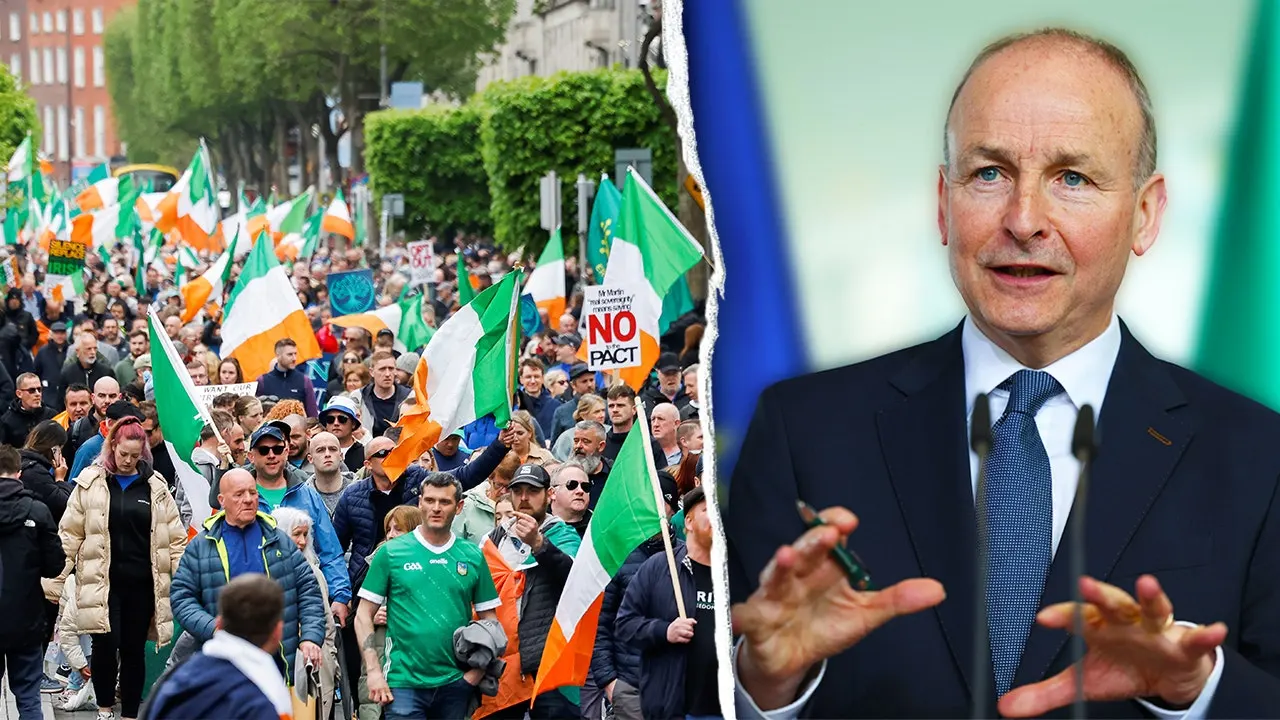
There was a time, not so long ago, when Ireland was known as a place people left. For generations, the story of the island was written in emigration ships, farewells at train stations, and the aching homesickness of those who built new lives in Boston, New York, and London. So when Irish Prime Minister Micheál Martin sat down in Dublin and looked at the Ireland of today, he saw something almost unthinkable by the standards of his own childhood: a country that people now want to come to, not flee. Nearly one in four residents of the Republic was born abroad, a staggering shift from just a generation or two ago. And in an exclusive conversation, Martin wanted to make one thing clear: this is not a story of a nation being overrun, but of a small, once-poor country that grew rich enough to become a magnet. “Ireland is not overrun in any shape or form,” he said, pushing back against a narrative that has become a political firestorm across Europe and, increasingly, in the United States. His comments came weeks after President Donald Trump stood beside him in Dublin and warned that Europe’s approach to immigration was self-destructive. “What you’re doing to yourselves, you’re just killing yourselves,” Trump said. Martin did not dismiss the concern outright. He acknowledged that migration has created real political pressures, and that Ireland’s system for handling asylum seekers was too slow for too long. But he insisted that the dramatic demographic change was driven largely by legal migration tied to economic success—by the work of building a modern economy that needed engineers, nurses, tech workers, and dreamers. “It’s a bit like America really, free movement for the states here,” he said, pointing to the European Union’s open borders. “Our economy’s expanded hugely.”
Martin was careful not to sound complacent. He admitted that the asylum system, after a record surge in applications, had failed to keep pace. “Our system was too slow in processing those seeking asylum,” he said. “That has changed.” He described a new strategy that includes accelerating applications and appeals, and he opened the door to tightening citizenship rules—proposals to increase the residency requirement from five years to eight, and to introduce language and economic self-sufficiency requirements. The message was nuanced: Ireland is not overrun, but it is not ignoring the strains either. “All over Europe it’s tightening up because of the pressures,” he said. “Obviously, illegal migration is the more potent issue.” For Martin, the challenge is to hold onto Ireland’s openness while proving that the system is fair, firm, and fast enough to maintain public trust. That is no small task in a country where housing is scarce, rents are brutal, and the cost of living has left nearly half of households struggling to make ends meet. The government is now developing a new migration strategy, and Martin signaled that the old days of slow, uncertain decisions are over. He promised that rejected applicants would face “fast movement” when it comes to consequences, and he made clear that the state is looking at every legal lever to tighten control. It was the careful language of a leader trying to walk a narrow path: acknowledging the anger, defending the record, and promising reform.
The anger has never been abstract. It exploded onto the streets of Dublin in November 2023, after an Algerian-born Irish citizen stabbed three young children and a childcare worker outside a school. The attack triggered riots, with anti-immigrant fury spilling into violence. Then this summer came the killing of Jamey Carney, a 43-year-old American mother from New York, found dead in her home in County Kerry. Her Jordanian boyfriend, the suspect, had applied for asylum in Ireland and been rejected, but he was appealing the decision and remained in the country. He fled to Turkey and then Jordan, where he was later arrested, and Irish police are seeking his extradition. The case seemed to expose a gap in the system: how could someone whose asylum claim had been rejected still be walking free? Martin did not dodge the question. “We’re looking at all of that in terms of tightening up the laws,” he said. “We will make sure that, particularly if people’s applications are rejected, that there’s fast movement in terms of the consequences of that.” But he also pushed back on the idea that crime has a nationality. “I don’t think crime is specific to any nationality,” he said. “But there are issues there, and in some cases, yes, there’s been horrific crimes committed, but not all by illegal migrants either.” For years, the debate over immigration and crime has been stuck in a fog of competing claims, because Irish crime statistics do not routinely publish nationality breakdowns. Martin said he has no problem with more data, including statistics broken down by nationality, because data can inform the debate and correct “distorted pictures.” It was a quiet but significant shift, a recognition that transparency might be the only way to rebuild trust.
Housing is where the immigration debate becomes most visceral. Ireland simply does not have enough homes, and the pressure is acute. In Dublin, figures released this month showed that 42 percent of the 15,005 households on the city’s social-housing waiting list were categorized as non-Irish. Nationally, 28.7 percent of social housing applicants—nearly 18,000 households—were non-Irish citizens in 2025, including almost 3,200 applicants from outside the EU with refugee status, up 64 percent from the previous year. At the same time, Ireland’s homeless population hit a record high. The numbers have fueled online fury and street protests, especially when the government has used hotels and other properties to house asylum seekers. The state spent about $1.4 billion on asylum accommodation and related services in 2025, and even bought the sprawling Citywest Hotel and Convention Centre for about $175 million. Martin acknowledged that legal immigrants add to housing demand, but he insisted the answer is not to close the door—it is to build more. He pointed to about 36,000 homes built last year, up more than 20 percent from the previous year and the highest annual total since 2011. And when asked whether Irish citizens should get preferential treatment for social housing, he backed the idea without hesitation. “Our position is basically its citizens get priority,” he said. It was a blunt statement, but it reflected the political reality: in a country where people are struggling to find a place to live, the government must be seen to put its own citizens first, even as it relies on immigration to keep the economy humming.
Ireland’s transformation has been breathtaking in its speed. Two decades ago, about one in seven residents was foreign-born; now it is nearly one in four, the fourth-highest percentage in the European Union. The change accelerated after the EU expanded eastward in 2004, when Ireland’s booming “Celtic Tiger” economy attracted workers from Poland, Lithuania, and beyond. Then came the tech giants—Apple, Meta, Pfizer, Johnson & Johnson—making Ireland a European base for American multinationals. More recently, a post-pandemic surge brought asylum seekers from Africa, the Middle East, and elsewhere, with applications jumping from roughly 3,500 a year before COVID to a record 18,561 in 2024, before falling nearly 30 percent last year. More than 120,000 Ukrainians also arrived under the EU’s temporary protection system, and Martin said roughly 80,000 remain, many now working and contributing. The economy grew by 8 percent in 2025, according to Ireland’s Central Statistics Office, but prosperity has not erased anxiety. Nearly 45 percent of households report difficulty making ends meet, and 64 percent identify housing and the cost of living as the country’s most pressing problems. Martin, who has been at the center of Irish politics since 1997 and served as prime minister in 2020 and again in 2025, sees the immigration debate through the lens of that economic story. “You can’t switch off an economy either,” he said. Skilled foreign workers are essential to industries like financial services and medical devices. More than half a million non-EU citizens were living in Ireland at the start of 2025, accounting for 9.3 percent of the population. For Martin, the challenge is to manage the pressures without killing the engine that made Ireland wealthy in the first place.
Martin also wanted to remind people of a longer history. Ireland had 8 million people in 1845, before the Great Famine, and then came the great wave of emigration to America. The island today has far fewer people than it did before that catastrophe, and the Irish have not forgotten what it feels like to be the ones knocking on someone else’s door. “We need to look at it through the broad sweep of history in a historical perspective,” he said. He also pointed out that EU free movement works both ways: Irish citizens are living and working all over Europe, just as Europeans come to Ireland. “That’s the other side of that story and that is something perhaps that we’re not as conscious of, but it is reality,” he said. In the end, Martin’s message was a plea for balance—a recognition that immigration has changed Ireland forever, and that the change has brought both blessings and burdens. He did not pretend that everything was perfect, or that the anger would simply fade away. He acknowledged failures, promised tighter rules, and defended the open, outward-looking Ireland that has emerged from decades of pain and progress. “Ireland is not overrun in any shape or form,” he said again, but this time the words felt less like a denial and more like an invitation to look at the whole picture: a country of emigrants that became a country of immigrants, a small island that found its place in the world, and a leader trying to write the next chapter without losing the plot.