


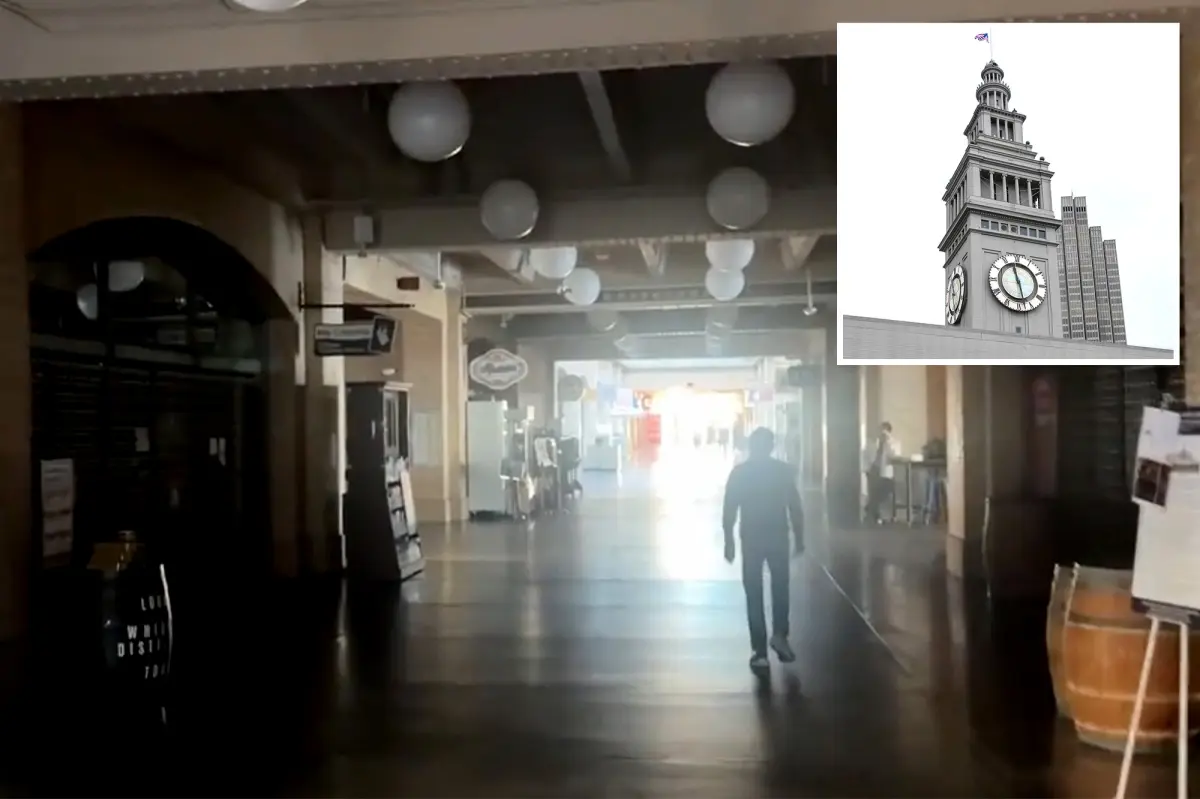
The morning rush at San Francisco’s Ferry Building should have been a familiar symphony of clattering coffee cups, hissing espresso machines, and the low hum of commuters hurrying toward ferries and trains. Instead, on Wednesday, the iconic waterfront landmark was swallowed by an unsettling silence and darkness. At 6:42 a.m., an unplanned Pacific Gas & Electric outage cut power to approximately 455 customers, leaving one of the city’s most beloved destinations without electricity for nearly three hours. Inside the historic building, morning businesses that depend on the early crowd—Blue Bottle Coffee, Red Bay Coffee, and countless others—faced shuttered gates and idle registers. Outside, nearby traffic signals and pedestrian crossing signs flickered out, turning the usual dance of cars, bikes, and walkers into a risky improvisation. For a building that draws roughly 24 million visitors a year and serves as a central transit hub on the Port of San Francisco waterfront, the blackout was more than an inconvenience. It was a gut punch to the daily rhythm of the city, and a reminder of just how fragile that rhythm can be when the power fails.
For the small business owners and workers inside the Ferry Building, the outage struck at the worst possible moment. Mornings are when the café counters are busiest, when commuters grab their lattes and pastries before catching a train, and when the market vendors lay out their produce with hopes of a strong day. Blue Bottle and Red Bay Coffee, two well-loved local roasters, had to power down their equipment and turn away customers who were already reaching for their wallets. Restaurant and retail staff stood behind dim counters, unable to process payments, brew coffee, or even open their doors. The financial damage is not just about the lost sales from a few hours—it is about the message it sends to entrepreneurs already struggling with slim margins, high rents, and the constant threat of another outage. Every minute the lights are out feels like a betrayal of trust, a reminder that even the most beautiful storefront cannot shield a small business from the consequences of an unreliable grid. And for the commuters relying on the Ferry Building’s transit connections, the darkness meant confusion, delay, and, for some, a missed day of work. Pedestrians approached intersections with extra caution, and drivers had to treat every signal as a four-way stop. It was not the dramatic, destructive chaos of an earthquake or a wildfire, but it was disruptive enough to reveal how completely modern urban life depends on electricity—and how quickly the absence of it erodes convenience, safety, and economic security.
What makes Wednesday’s blackout so difficult to accept is that it is not an isolated event. The Bay Area has been battered by a series of PG&E outages in recent weeks, each one leaving residents and business owners on edge. In late July, a sudden power failure in San Francisco knocked out electricity for nearly 9,400 customers, hitting neighborhoods with the kind of unplanned darkness that forces people to toss out food, cancel plans, and wonder why the utility seems so unprepared. Restaurant owner Ben Pang, whose business was caught in that broader outage, voiced the frustration of many when he told CBS News, “This really hurts the older small business. We’re losing so many customers. Why only Geary Street? Why always this area?” His words echo across the city, where communities have begun to feel singled out by an infrastructure that cannot keep pace with their needs. About two weeks before the Ferry Building incident, another PG&E failure near the Oakland Coliseum BART station caused major train delays when a wire fell across the tracks. That incident was not a wildfire prevention measure or a response to extreme weather—it was another piece of the region’s aging electrical system giving way under pressure. For many Bay Area residents, the pattern is unmistakable: a handful of days may pass without incident, but the anxiety never fully fades. Every flicker of the lights, every notification from PG&E’s app, every emergency alert is enough to send people back to that place of uncertainty, waiting to hear whether their block will be next.
PG&E, for its part, has defended the situation by pointing to the unavoidable causes of many unplanned outages. According to the utility’s website, outages can be triggered by car accidents, wild weather, or tree branches falling onto power lines. In some cases, they are the result of Enhanced Powerline Safety Settings—a technology designed to reduce wildfire risk by automatically cutting power when a problem is detected, even if the problem is as minor as a single branch brushing against a wire. It is a safety-first approach, and one that no reasonable person would argue against entirely, especially in a state where a single spark can ignite a catastrophic fire. But there is a growing sense that safety and reliability have become a false trade-off. When the lights go out in the middle of a busy morning, leaving hundreds of businesses in the dark, it is hard to hear the explanation about fire prevention and system protection. Instead, people see a utility giant that seems to have normalized the unacceptable, and a community that has been asked to accept fragility as part of life. The Ferry Building outage, PG&E said, was still under investigation, and crews were dispatched to inspect the electrical system and repair damaged sections. But for many, the response feels reactive rather than preventive—a bandage on a wound that keeps reopening, while the underlying injury remains unaddressed.
By Wednesday afternoon, PG&E’s outage map showed two other power outages still underway in the San Francisco area, each affecting between 50 and 499 customers. The numbers are small, almost negligible compared with the thousands affected in late July, but they are a reminder that the grid’s struggles are not limited to one landmark or one neighborhood. They are happening all the time, in places that rarely make the news, to people who are just trying to get through their day. The Ferry Building blackout lasted only about three hours—long enough to disrupt the morning, but not long enough to cause permanent damage. Yet the psychological impact is longer lasting. Every small business owner who had to turn away a customer during those dark hours will think twice about how much inventory to keep, how much money to spend on equipment, whether to hire another employee or hold back until they feel more secure. Every resident who had to navigate a dark intersection will remember that sense of vulnerability. And every visitor who arrived at the Ferry Building expecting to see it alive with light and energy will carry away an impression of a city struggling with the basics. The steady recurrence of outages—unplanned, unexplained, and often unavoidable—has eroded public confidence in PG&E’s ability to deliver one of the most essential services of modern life.
And yet, in the midst of the frustration, there is also resilience. The Ferry Building has survived earthquakes, fires, economic downturns, and a global pandemic. It has been a gathering place for more than a century, and it will not be permanently dimmed by a few hours without power. The coffee shops will brew again, the shops will raise their gates, and the ferries will continue to glide across the bay. But the questions raised by Wednesday’s outage will not disappear so easily. How long can a utility company continue to blame the weather, the traffic, and the trees? When will the investments in modernization, undergrounding, and maintenance actually deliver a grid that does not fail at the slightest provocation? The people of the Bay Area deserve more than explanations and apologies—they deserve action. They deserve to know that when they walk into a business, the lights will come on; that when they cross the street, the signals will work; that when they send their children to school, the train will run on time. Until that day, every morning brings a little bit of uncertainty, a quiet tension behind the ordinary routines. The Ferry Building stands again, beautiful as ever, but the memory of those three dark hours lingers—a reminder that in this modern age, light is never guaranteed, and the systems we depend on are only as strong as the people and policies holding them together.