




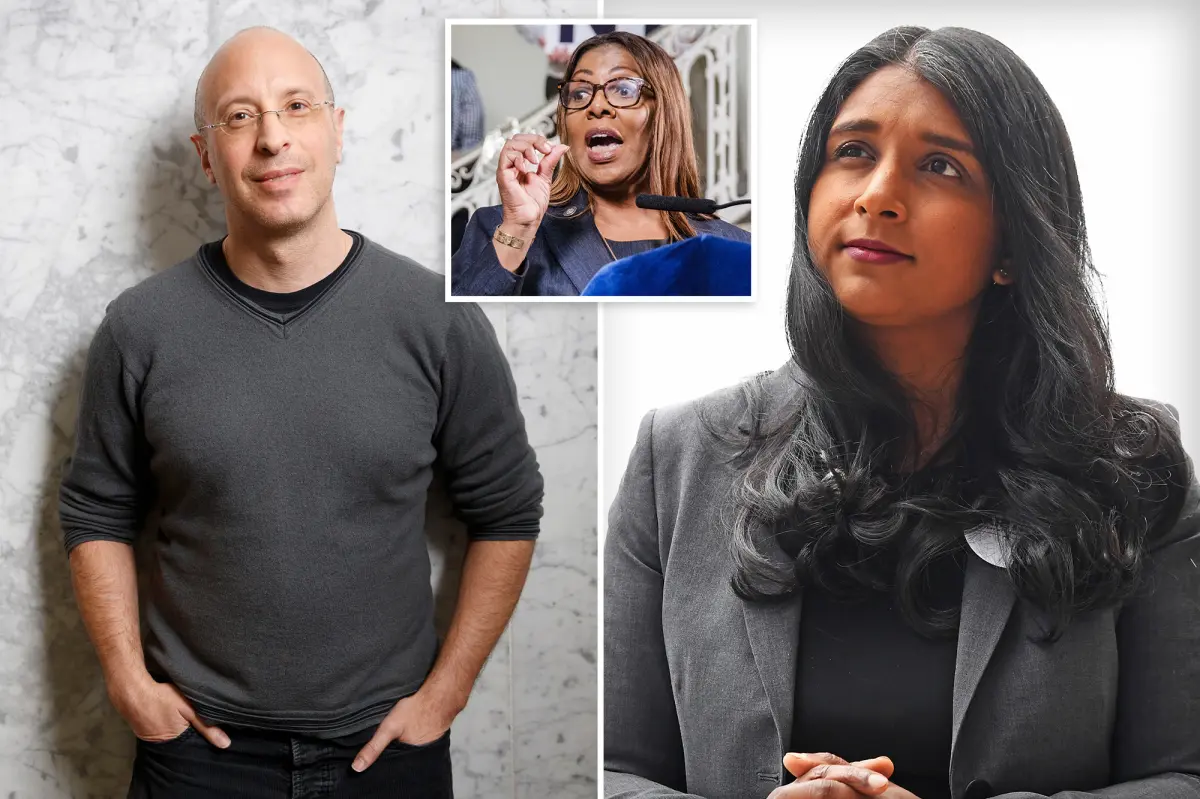
There are moments in politics when a campaign endorsement feels like something more than a strategic move—when it carries the weight of memory, grief, and a moral inheritance. That was the case on Wednesday, when Elisha Wiesel, the son of the late Holocaust survivor and Nobel laureate Elie Wiesel, publicly endorsed Republican Saritha Komatireddy in her race to become New York’s attorney general. Wiesel, who now chairs the Elie Wiesel Foundation for Humanity, posted a photograph of himself standing beside Komatireddy on his social media accounts. His words were brief, but they cut deep. “The only way to stamp down on antisemitism in NYC is to prosecute it,” he wrote. “I stand with @sarithaforny as she campaigns for the critical post of NY Attorney General!” For anyone who knows the story of Elie Wiesel—the author of Night, the native son of Sighet, the survivor of Auschwitz and Buchenwald—those words were impossible to read without feeling their historical weight. This was not a routine endorsement. It was a son taking up his father’s unfinished work and aiming it squarely at the current occupant of the attorney general’s office, Democrat Letitia James. The endorsement was immediately seen as a blow to James, an incumbent who has long presented herself as a champion of the vulnerable and who had been widely expected to cruise toward a third term in a deeply blue state. But for Wiesel, it seemed more personal than political. He was looking at a New York City where antisemitic attacks have become a nightly fear, where Jewish people are targeted as they walk to synagogue or cross campus, and where he believes the state’s top law enforcement officer has failed to use her authority to stop it. The image of a Holocaust survivor’s son standing beside a Republican candidate in New York was startling in itself. But it was the message behind the image that truly changed the conversation.
Komatireddy, a former federal prosecutor, lost no time in turning Wiesel’s support into a broader argument against the incumbent. She thanked the activist and then delivered a message that has come to define her campaign. “Jewish New Yorkers are being attacked on the street, outside their synagogues and at school,” she said. “The Attorney General has the legal authority to stop it. Letitia James hasn’t used it. I will.” Those are fighting words, especially in a state where the Democratic candidate usually has a stranglehold on statewide office. But Komatireddy backed them up with a string of statistics that were hard to ignore. According to her campaign, hate crimes in New York have doubled under Attorney General James, and antisemitic incidents have tripled. The numbers are staggering: Jewish New Yorkers make up roughly 12 percent of the city’s population, yet they are the targets of 57 percent of hate crimes recorded this year. Confirmed hate crimes against Jews, she noted, have continued to climb. “Her record is indefensible,” Komatireddy said. The challenger also used Wiesel’s endorsement to highlight a recent press release she issued in response to Zohran Mamdani, a mayoral candidate and critic of Israel who had laid out a strategy to combat antisemitism. Komatireddy offered a grudging acknowledgment. “I’ll give the Mayor this much: the plan acknowledges that antisemitism is real and growing in this city,” she said. But she argued that more security funding and additional NYPD hate-crime work would not be enough. “Someone has to make sure that we take that case into a courtroom and win it,” she added. That simple sentence captured the central thesis of her campaign: the problem is not only that hate crimes are happening, but that those crimes are not being met with real legal consequences.
The race itself is anything but even. Letitia James is a towering figure in New York Democratic politics, and the institutional machinery of the state leans heavily in her favor. Before becoming attorney general, she served as New York City’s public advocate and as a councilwoman from Brooklyn. She has spent years building relationships with the constituencies that matter most in a Democratic primary and a general election in a state like New York. But her campaign was quick to respond to Wiesel’s endorsement and to defend her record with the Jewish community. A spokesperson for James said that she “has stood shoulder to shoulder with the Jewish community at every step of her career.” The statement cited her work fighting housing discrimination against Jewish families in Chester, holding price gougers accountable for schemes that targeted Jewish communities, and condemning antisemitism in all its forms. “Attorney General James has been a steadfast ally to Jewish New Yorkers,” the spokesperson said, “and she will never stop fighting to keep them safe from hate.” That defense is a reminder that the race is not a simple question of who cares more about antisemitism. It is a question of whose approach Jewish New Yorkers trust, and whether the legal activism that James has become famous for can be turned inward, toward the streets of the city she serves. Wiesel’s endorsement does not automatically move thousands of votes, and Jewish New Yorkers are not a monolith. Many have supported James for years and will continue to do so. But in a year when antisemitism has moved from the margins into the headlines, the symbolism of a survivor’s son endorsing a Republican in a deep-blue state is significant. It reframes the conversation and puts James on the defensive.
The two candidates bring sharply different backgrounds to the race. Komatireddy’s resume is built on courtroom experience, not elected office. As a federal prosecutor in Brooklyn’s Eastern District of New York, she handled some of the most challenging and high-profile cases imaginable: international terrorism, cybercrime, narcotics trafficking, money laundering, and public corruption. That background gives her a distinctive voice when she talks about enforcing the law. She argues that the attorney general’s office should be a prosecutor’s office, not just a platform for political statements. James, on the other hand, has made her national reputation through a bold, aggressive use of the office. She personally pushed for and secured a civil fraud judgment against former President Donald Trump and his company, a case that earned global attention and cemented her status as a leading antagonist of the former president. She has also filed numerous lawsuits against the Trump administration, including one filed just last week alleging that the administration had provided energy companies with $1.4 billion to cancel four critical offshore wind projects. In addition, she commissioned the sexual misconduct investigation into former Governor Andrew Cuomo that ultimately triggered his resignation in 2021, even as Cuomo denied wrongdoing. These are not modest accomplishments. They have made James a star among progressives and a hated figure among conservatives. But Komatireddy’s campaign, with Wiesel’s endorsement now attached, raises a pointed question: What does all that power mean if it is not being used to protect Jewish New Yorkers who are being attacked on their own streets? That question is central to the campaign, and it is not simply about competing records. It is about competing priorities.
Behind the press releases and political strategy, there is a deeply human story. In New York City, a Jewish family walking home from Sabbath services, a student wearing a Star of David, a child on the way to Hebrew school—these are not symbols in a debate. They are real people living with real fear. The statistics Komatireddy cites are not abstract. They represent men and women who have been shoved, spat upon, threatened, and beaten simply because of who they are. The fear is made worse by a growing sense that the institutions meant to protect people have not responded with the urgency the moment requires. That is why Elisha Wiesel’s voice carries so much authority. He is not a polished surrogate with a list of talking points. He is the son of a man who survived the Holocaust and spent the rest of his life bearing witness. When Wiesel says that the only way to stamp down antisemitism is to prosecute it, he is drawing on a legacy that is impossible to fake. His father wrote Night so that the world would never forget what happens when hatred goes unchecked. Elisha Wiesel’s endorsement is, in many ways, a continuation of that testimony. It says that remembrance is not enough. There must be action. There must be accountability. There must be a legal system that treats a hate crime against a Jew as a crime against the soul of the city. That is a moral argument, and it gives the race an urgency that ordinary elections seldom have. It is not just about budgets, management, or political careers. It is about whether New York will be a place where Jewish life is protected with the same seriousness as any other life.
In the end, Wiesel’s endorsement may not determine the outcome of the election. Letitia James remains heavily favored to win a third term. She has the Democratic base, the institutional support, the name recognition, and the demographic advantages that come with running for statewide office in New York. But the endorsement guarantees that the question of antisemitism will be front and center in the months ahead, and that the incumbent will be forced to answer for her record in specific, concrete terms. It also reveals how much has changed in American politics. The fight against antisemitism was once considered a shared, bipartisan value. Now it has become a wedge issue, a point of partisan fracture, and a deeply personal matter for communities that feel abandoned by both parties at different moments. Wiesel’s decision to stand with a Republican challenger is a reminder that no community’s allegiance can be taken for granted, no matter how blue the state might be. For Jewish New Yorkers, the conversation is not about ideological purity. It is about safety. It is about walking into a synagogue without worrying who might be waiting outside. It is about sending children to school without the fear that they will be targeted for who they are. It is about knowing that the state’s chief legal officer, regardless of party, will treat hate crimes with the seriousness they deserve. Elisha Wiesel’s message on Wednesday was a reminder that the weight of history presses down on every decision, every endorsement, and every election. The only question now is who will carry that weight into the future.