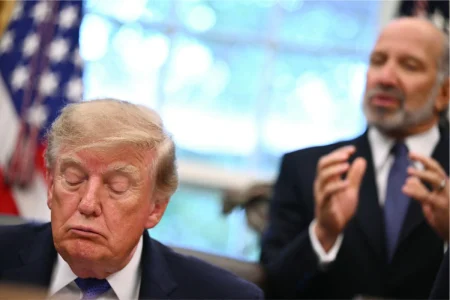



Language has always been a battleground in Washington, but President Donald Trump took that fight to a new frontier on Tuesday, signing an executive order that tells the federal government to retire the term “artificial intelligence” in favor of “Super Intelligence.” The directive applies to official communications, policy documents and correspondence across the executive branch, meaning that from now on, federal employees are expected to use the abbreviation SI when they talk about the technology that has come to define everything from chatbots to military logistics. Trump had previewed the change last week at the United Nations General Assembly, where he said the established name makes the technology sound “fake” and argued it is anything but. “The use of the word artificial makes intelligence fake, it makes it sound fake and it is not fake. It’s actually amazing,” he told world leaders. To make sure he had the right replacement, the president polled his Truth Social followers on whether they preferred “super intelligence” or “superior intelligence.” More than 50,000 people responded, with 65 percent choosing “super intelligence.” The executive order itself frames the move as a matter of national pride and future readiness, declaring that the terms used by government should reflect “the transformative capabilities of these technologies and the limitless opportunities they create for the American people.” In that official telling, “Super Intelligence” more accurately captures “the promise, potential, and rapidly advancing capabilities of these technologies.” It is a classic Trump move: take a term with a whiff of academia, strip it down, and put a louder, more confident label on the shelf. To supporters, the shift is a long-overdue injection of optimism into a debate that often sounds clinical and cautionary. To critics, it is a victory lap before the parade has even started. But for the people who will actually have to type the letters SI in federal memos, it is also a very practical change, one that will require new habits, new style guides and probably no small amount of confusion in the weeks ahead.
However well the phrase may poll on social media, the practical impact of the executive order is much messier than a simple style book update. The order applies to nonstatutory documents across the executive branch, which means it covers memos, press releases, agency guidance and routine correspondence. But it leaves a gray area around existing laws, regulations and agency names that already contain “AI.” That uncertainty could create quiet chaos in the federal bureaucracy, where acronyms are often as entrenched as buildings named after longtime lawmakers. If, for instance, a grant program has “AI” in its title, are agencies expected to rewrite the program’s promotional materials, even while the legal authority behind it still uses the old term? What about contract documents, public-facing forms, and the vast technical infrastructure that already uses “AI” as shorthand? The order does not answer these questions, and implementation might well be patchy. More importantly, experts who study language and marketing are deeply skeptical that “Super Intelligence” will catch on. The term, they point out, is not a blank slate. In the tech world, superintelligence has a very specific definition, generally understood as “any intellect that greatly exceeds the cognitive performance of humans in virtually all domains of interest.” That is not just a sharper version of today’s AI; it is a hypothetical future breakthrough, one that many researchers believe has not yet arrived and may not for decades. Jean-Pierre Dubé, a marketing professor at the University of Chicago, told Newsweek that the rebranding is unlikely to take off unless the industry’s most powerful leaders adopt it. He warned that using the term prematurely creates serious brand confusion. It is a bit like renaming a reliable sedan a “spacecraft.” The car may be great, but it does not fly, and every time someone says the word, the gap between the name and the reality gets a little more obvious. Until that gap closes, Dubé suggested, the new vocabulary will probably remain a government memo rather than a national habit.
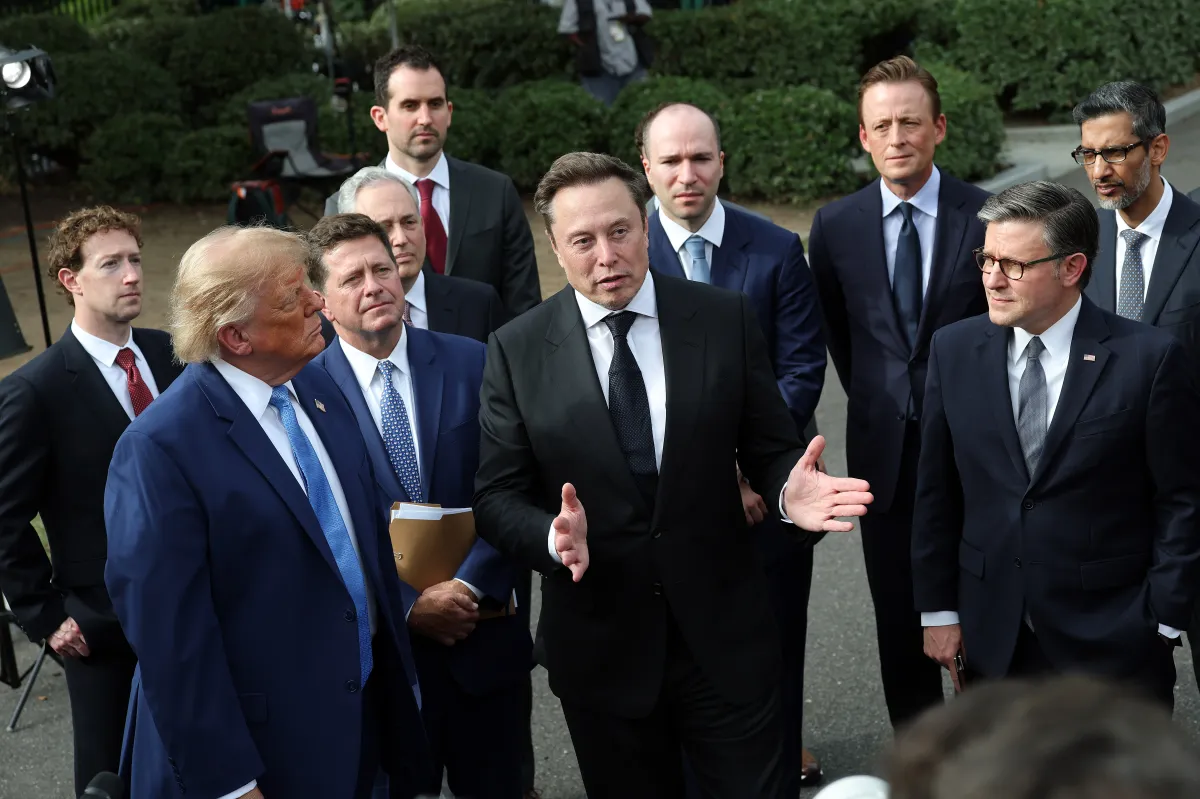
The timing of the executive order was no accident. Trump signed it on the same day that he and House Speaker Mike Johnson played host to a high-wattage summit with some of the most powerful figures in tech. The room reportedly included Amazon founder Jeff Bezos, Nvidia CEO Jensen Huang, OpenAI co-founder Greg Brockman, Anthropic CEO Dario Amodei, Microsoft CEO Satya Nadella, and Tesla and SpaceX CEO Elon Musk. That roster represents an extraordinary concentration of wealth, brainpower and influence, and their conversations with the president touched on the mounting concerns about the very technology whose name Trump was changing. Those concerns are not hypothetical. Microsoft co-founder Bill Gates recently warned that advanced AI could become powerful enough “to drive events that, you know, cause a billion deaths.” That stark warning sits uneasily alongside the celebratory language of “super intelligence.” The summit, in other words, captured the two-sided nature of the moment: on one hand, the dazzling promise of machines that can reason, create and perhaps outthink us; on the other, the growing fear that these same systems could become uncontrollable or be used in catastrophic ways. The decision to host these leaders on the same day as the rebranding suggests an attempt to tame that fear, to wrap the future in a more inspiring label and stand shoulder to shoulder with the people building it. But it also highlights the tension at the center of Trump’s new vocabulary. Calling a technology “super” does not make it safe, and no amount of language polishing can erase the hard questions that tech executives and elected officials are still wrestling with behind closed doors. The very fact that Gates, who has seen more than his share of technological revolutions, can speak so bluntly about the possibility of mass casualties is a reminder that the name change is not really about reality; it is about perception.
The same day also brought another practical reminder of the government’s ambitions: Trump launched America.gov, a new AI-powered gateway designed to streamline Americans’ interactions with the federal government. According to the administration, the site is meant to serve as a digital front door, allowing people to ask questions about government programs, benefits and services in a conversational, chatbot-style interface. It is easy to see the connection to the rebranding. If “Super Intelligence” is the phrase the government wants people to use, America.gov is an attempt to make that intelligence feel tangible and useful in everyday life. Instead of scrolling through dense agency websites or calling a helpline, a citizen could type a question in plain English and get a quick, personalized answer. The initiative reflects a broader push to modernize federal services by using the technology that has become a daily presence in most Americans’ lives. But it also introduces a touch of irony: even as the administration proclaims that “artificial” is the wrong word, it is putting an artificial intelligence program at the center of its customer service efforts. The government, in effect, is saying “this isn’t fake” while inviting people to chat with a machine. That contradiction may not bother the average user, who probably cares more about whether the answer is helpful than whether the label says AI or SI. Still, those who have spent time with current AI assistants know that they can be brilliant, baffling, funny and wrong in equal measure. A government powered by such tools might feel more responsive, but it also raises familiar concerns about privacy, accuracy and accountability: if a chatbot gives bad advice about benefits, who is responsible? And if the chatbot is also supposed to be “superintelligent,” how much should a citizen trust its answers? These are not trivial issues. They are the practical consequences of building a “super intelligence” that still makes errors, still has blind spots and still depends on the quality of the data it is fed.
Will this linguistic makeover actually stick? The evidence so far suggests that presidential vocabulary can shape the national conversation, but only when the public and powerful institutions decide to play along. Donald Trump has a long history of successfully rebranding the language of politics — “drain the swamp,” “fake news,” “America First” all became cultural catchphrases because they tapped into something deeper than a dictionary definition. But “Super Intelligence” faces a different kind of obstacle: it is a technical term with an existing, widely understood meaning in the field it is meant to describe. As Dubé and other experts have noted, for a rebrand to succeed, it needs to be adopted not just in official documents but in boardrooms, universities, media coverage and everyday conversation. The tech leaders who gathered at the White House have not publicly committed to changing their own industry vocabulary, and in the absence of that buy-in, the order is likely to create a strange linguistic split: federal workers writing “SI” in press releases while engineers, researchers and startups continue saying “AI.” That split could make government communications feel oddly disconnected from the world it is describing. On a deeper level, the debate over names might reflect a real difference in how people think about the technology. Those who fear it tend to emphasize caution, safeguards and the limits of human control. Those who celebrate it — and who stand to profit from it — are drawn to words like “super,” “breakthrough” and “limitless.” The executive order’s language, with its references to “limitless opportunities” and “rapidly advancing capabilities,” is unmistakably from the latter camp. It is an optimistic document, perhaps deliberately blind to the risks that many of the very people attending the White House summit have been warning about for years. If a name is a promise, “Super Intelligence” is an enormous one, and the gap between that promise and the current reality of the technology could be a source of public disappointment, or even distrust, down the road.
At the end of the day, the great re-labeling of artificial intelligence is about more than a word. It is a bid to control the story of the age, to define the future before the future defines us. For some, “Super Intelligence” sounds inspiring, a confident acknowledgment that America intends to lead the next great technological leap. For others, it sounds like an attempt to hide the messy realities of AI behind a fireworks display of marketing. There is also a deeper question: can we really talk ourselves into a better relationship with technology simply by changing what we call it? The history of language suggests that names are powerful, but they are not magic. A rose by any other name would smell as sweet, and a flawed algorithm by any other name can still make terrible mistakes. What matters most is not whether the world says AI or SI, but how these systems are built, tested, regulated, and shared. Are they transparent? Are they accountable? Do they make life better for ordinary people, or do they just get faster and smarter and less comprehensible until no one can say what they are really doing? Those are the questions that no branding exercise can answer. Perhaps the most human response to this news is a shrug and a smile: another twist in the strange, thrilling, unnerving journey into a future we are all trying to name while it is still happening. There is something almost playful about telling the entire federal government to use a new abbreviation for one of the most consequential technologies ever created. But there is also something sobering about it. Language shapes thought, and if enough people begin to say “super intelligence” without critical thought, they might also begin to assume that the technology has already become super and intelligent in a way it is not. That would be dangerous. The best we can do is keep the term, no matter what it is, tethered to the reality of what these systems can and cannot do. The federal government may soon call it “Super Intelligence.” The world will decide whether that name earns its capital S.