

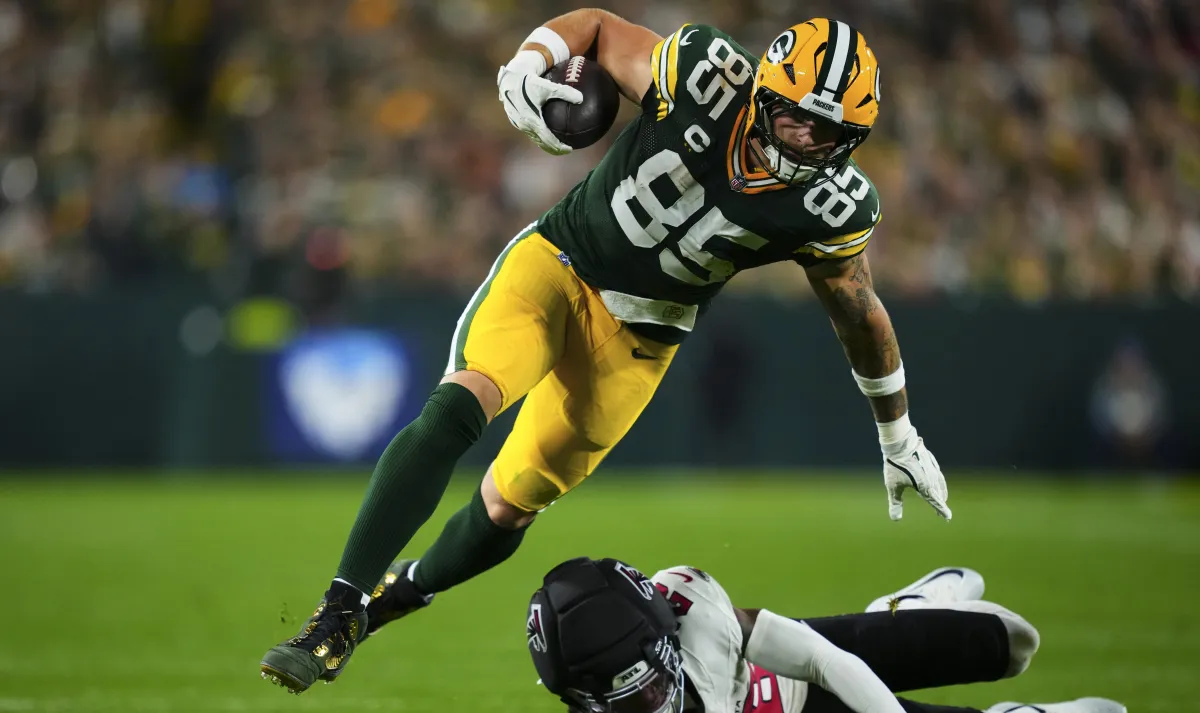
Lambeau Field is supposed to be one of the last places in sports where time moves differently. The cold autumn air, the hallowed grass, the ghosts of Lombardi, the idea that something sacred happens when the Packers play at home — all of it usually gives Green Bay an advantage that no other team can simply buy or scheme away. But on a brutally revealing Thursday Night Football in Week 3, Lambeau did not feel sacred. It felt like a theater where the actors had forgotten the lines. The Atlanta Falcons, a team that had not won a game all season, walked into Wisconsin and left with a 35-14 victory that was never as close as the score suggested. The Packers were booed at halftime. They were booed again when the final whistle arrived. The game had been billed as a chance for Green Bay to steady itself after a painful stretch, a chance to prove that a difficult season could still be salvaged. Instead, it became the latest footnote in a spiraling chapter that began, in the story that has unfolded around this franchise, with the loss of star edge-rusher Micah Parsons to an ACL injury last season. Since that injury, Green Bay has won exactly once in eight games — and that lonely win came only in overtime against the New York Jets, the kind of victory that felt less like a breakthrough and more like a tiny bandage on a wound that was still bleeding. This was supposed to be the home opener, a fresh start under the lights, and the people of Green Bay had come expecting to believe again. Instead, the home crowd witnessed their team get thoroughly outplayed by an opponent that had entered the night winless and left with the kind of easy confidence that comes from watching another team fall apart in real time.
The hardest part was not the final score, though that was bad enough. The hardest part was watching the players try to process what happened in front of their own faithful. Tucker Kraft, the tight end who finished with only four catches for 26 yards, stood at his locker afterward with the look of a man who had been through something more personal than a football game. He did not have a long list of excuses. He did not blame the scheme, the officiating, or the injury list. What he wanted to talk about was the sound of the crowd — the booing that rained down from seats that had once held nothing but devotion. “That’s pretty tough,” Kraft said, trying to keep his voice even. “Like everyone pictures Lambeau Field and not boos. I don’t picture boos. I picture my home stadium. That’s tough. It’s pretty disappointing, especially for a home opener. It’s pretty disappointing. It’s not going to help us win.” There was a rawness to those words that cut through the usual postgame clichés. Players are often taught to ignore the noise, to treat the stadium as if it were empty, to play with tunnel vision. But athletes are not machines. They are human beings who can feel the mood in a building shift from hope to anger in a matter of minutes. For a young player like Kraft, the booing did not feel like tough love or accountability. It felt like a rejection from the exact people he wanted to make proud. And when he added that the team was grown men, mentally strong enough to get back on the field and play ball, he was not saying that the criticism could not hurt him. He was saying the opposite: that he heard it, felt it, and knew the booing was making an already difficult moment even heavier.
Head coach Matt LaFleur has been around enough football to know that booing comes with the territory. Coaches get booed. Coordinators get booed. Quarterbacks get booed. But Lambeau Field is not just any stadium, and booing there carries an emotional weight that is difficult to describe to people who have never experienced it. LaFleur stood before the media after the game with the kind of quiet resignation that comes after a long night of failure. He did not take the bait when asked about the fans. He did not scold them or demand better from them. He simply admitted what the entire football world could see: the Packers are nowhere near where they need to be, and if they keep playing like this, the noise is only going to get louder. “Three games in, certainly, we’re nowhere near where we need to be,” LaFleur said. “We know it’s going to get loud. You got to ignore the noise and just focus on what we can do better.” Then he added the line that felt the most honest and the most damning: “It was a humbling night. We got to find solutions and just come back ready to work and try to figure out what we do well because, right now, I don’t know what we’re doing well offensively.” There is a particular kind of humility that can only come from being stripped bare in front of your own supporters. LaFleur has won a lot of games in Green Bay. He has been to the playoffs. He has felt the roar of a full stadium when everything is going according to plan. But on that Thursday night, he was not a celebrated coach with all the answers. He was a man standing in the wreckage of a game that had exposed every weakness his team had tried to hide. His words were not dramatic or defiant. They were simply honest, and sometimes honesty is the most human response to failure.
To understand why the boos came, it helps to understand how far this team had fallen. The losing streak that began after the injury to Parsons — the defensive engine, the pass rusher who was supposed to single-handedly change the energy of every snap — was not just a statistic. It was a slow erosion of identity. Green Bay had once been a team that could rely on its defense to keep games close, to create chaos in the backfield, to turn the tide with one violent strip-sack or one huge third-down stop. Without that edge-rusher pressure, the defense became reactive, soft, and vulnerable. Opposing quarterbacks had time, vision, and confidence. Opposing offenses realized they could move the ball at will. And while the offense tried to carry the load, it was not nearly good enough to overcome the strain. The lone win over the Jets had briefly suggested that the Packers might have turned the corner. But it was a false dawn, the kind of victory that feels good for a few days and then disappears the moment the next opponent shows up. Against Atlanta, the failures came in every area: missed tackles, missed assignments, stalled drives, penalties at the worst possible times, and a general sense of chaos that teams simply cannot survive in the NFL. The Falcons, winless and hungry, took advantage of every mistake. They did not need to be great; they just needed to be steady while the Packers collapsed around them. By the time the game was decided, the players on the field looked like strangers who happened to be wearing the same uniforms, disconnected from each other and from the fans who once believed in them. That is what makes a streak like this so painful. It is not just losing. It is losing the sense of who you are supposed to be.
The relationship between a team and its fans is one of the most fragile things in sports. Fans pay for tickets, jerseys, time, and emotional investment. They wake up on game day full of irrational hope. They scream when their team makes a big play and sink into despair when things go wrong. But booing is a line that many players feel should not be crossed — not because the players do not deserve criticism, but because booing has a way of pushing a team further away rather than pulling it closer. Kraft’s point was simple: How is being yelled at by 70,000 people supposed to help a group of men who already know they are struggling? It is not that they need excuses or empty encouragement. It is that they need to feel as though the home crowd is still fighting alongside them, that the roar of support can carry them through the dark moments. There are times when a boo can be a motivational tool, a shock to the system that reminds everyone how much this city cares. But there are also times when booing becomes a weapon, and when thousands of people choose to use it at the same time, it can destroy the last bit of confidence a struggling team has left. The fans of Green Bay are not bad people. They are passionate people who have been spoiled by generations of excellence. They remember what it feels like to watch a Super Bowl contender, and they see a team that is now miles away from that standard. Their frustration is understandable. But frustration and cruelty are not the same thing, and the line between pushing a team and turning on it is thinner than anyone wants to admit. Lambeau Field has always been a cathedral, and a cathedral full of boos feels less like motivation and more like a kind of grief that cannot be processed in real time.
The season is not over. That sounds like a cliché because it is a cliché, but it is also true. Week 3 is too early to write the obituary for a franchise that has survived far worse. The Packers have talent in the locker room, a coach willing to look into the mirror, and a schedule full of opportunities to prove the narrative wrong. But the next step cannot be about pretending that everything is fine. It has to be about finding the smallest attainable success — one block, one stop, one completed pass — and building from there. LaFleur said the team needs to figure out what it does well offensively. That will not happen overnight, but it can happen. It starts with humility, the same humility he felt at that podium in the middle of the night. It starts with players hearing the boos and deciding to turn them into fuel instead of excuses. And it starts with a community remembering that football, for all its importance, is still just a game played by human beings who need support more than they need scorn. Kraft wanted those 70,000 people behind the team rather than against it. He may get that wish, but only if the team gives them a reason. The boos will stop when the effort and execution stop being so disappointing. The cheers will return when the Packers find their identity again. That is how this story ends if it ends well: not with a single magical moment, but with a slow, grinding climb back to respectability. Lambeau Field has been loud before, and it will be loud again. The only question is whether that sound will be made by people celebrating a team that refused to quit, or by people mourning a season that slipped away too soon. For now, the Green Bay Packers are still standing, still breathing, still working. The road back is not going to be easy, but football has always rewarded the teams that are willing to walk through the noise.