


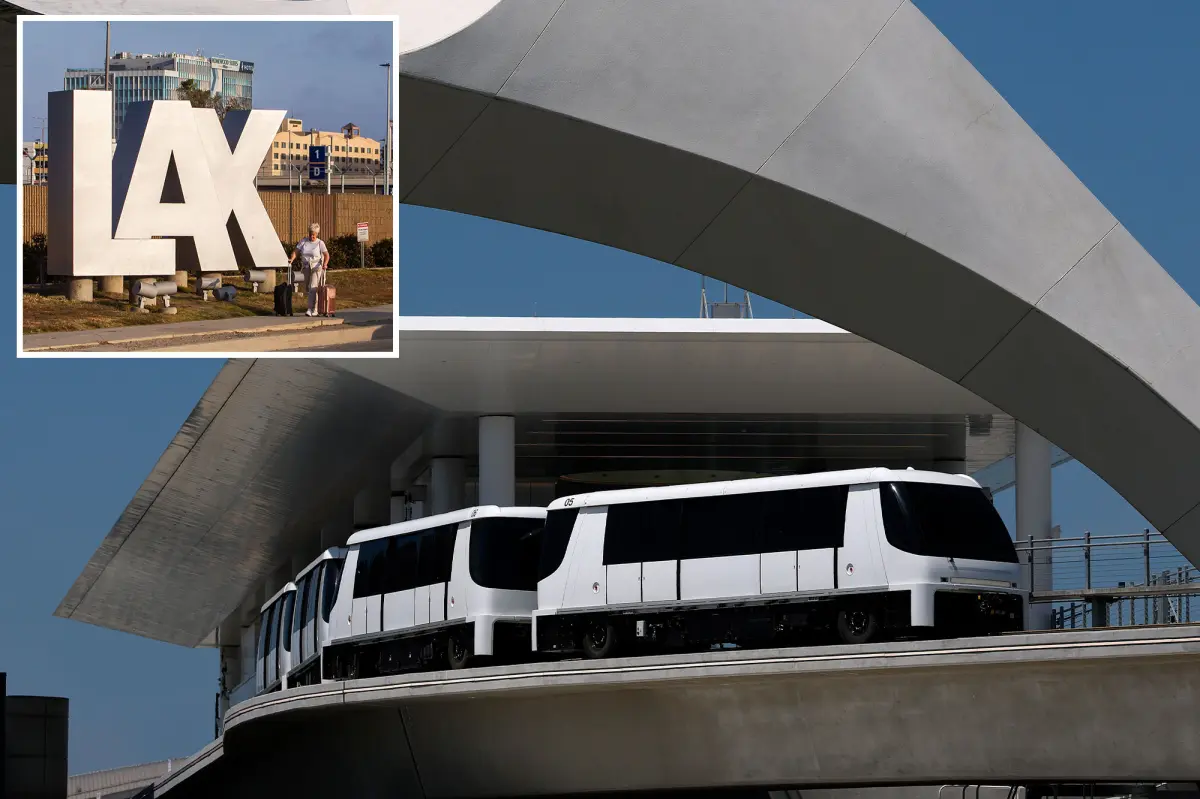
If you have ever inched along the horseshoe-shaped roadway at Los Angeles International Airport, stuck behind a shuttle bus, a rideshare sedan, and a massive tour coach, you know exactly why the promise of a People Mover has been so tantalizing. The idea is simple: an automated train, running along a 2.25-mile elevated track, gliding between terminals and connecting the airport to the rental car center, economy parking, and the Metro Transit Center. It would mean no more frantic shuttle sprints, no more armfuls of luggage awkwardly bounced on a crowded bus, no more praying that the driver actually remembers to stop at Terminal 4. But the train, known as the LAX Automated People Mover and branded as SkyLink, has once again disappointed. Its opening, already delayed more times than anyone can count, has been pushed back from October to some time in January. That announcement landed with a familiar thud of resignation among travelers who have heard the promises before. The project was originally supposed to welcome passengers in 2023. Instead, Angelenos have watched construction cranes rise, fall, and rise again, while the airport remained a construction zone in a state of nearly permanent transition. The latest word from contractor LAX Integrated Express Solutions, in a September disclosure, was blunt: there is still work to be done, and even a December completion deadline may not be met. Now, officials say the train could begin carrying passengers as early as January 6, but they are quick to add a caveat. “There can be no assurances that achievement of the Passenger Service Availability Date will not be delayed further,” the contractor said in a filing, using the kind of carefully hedged language that has come to define this project. For the weary traveler, it is just another in a long line of “almost there” moments.
To understand how a 2.25-mile train turned into a $3.34 billion odyssey, you have to go back to 2019, when construction began with an original projected budget of $1.9 billion. At the time, the automated People Mover was supposed to be the centerpiece of a long-overdue transformation of LAX, a way to finally unclog the infamous loop of roads in front of the terminals. It was supposed to move people efficiently between terminals, connect to a new consolidated rental car facility, and serve as a critical link to the regional transit network. But somewhere along the way, the dream got tangled in the very traffic it was meant to relieve. Delays piled up, contract disputes festered, and the price tag ballooned. Today, the project’s cost has grown to $3.34 billion, including about $1.34 billion in additional city payouts. That is the kind of number that makes elected officials wince and taxpayers sigh. The contractor consortium, LINXS, remained responsible for delivering the system, but the relationship between the company and the city became increasingly adversarial. Budgets were renegotiated, deadlines slipped, and the project’s completion date seemed to recede like a mirage in the desert. The People Mover had become something more than a train: it was a symbol of how difficult it can be for a major American city to finish a major public works project, especially when the original price tag is based on a version of the future that no longer exists. Supply chain issues, labor shortages, design changes, and the pandemic all played a part. But perhaps the biggest culprit was simply the stubborn, unglamorous reality of building something huge and complicated in the middle of one of the busiest airports in the world. The people who work and travel through LAX have been patient, but patience wears thin after four years of delays.
Before SkyLink can open, quite a bit still has to go right, and none of it is simple. The train still needs 30 days of successful consecutive testing, which in the world of automated transit is not just a formality but a crucial guarantee that the system can operate safely, reliably, and without surprise breakdowns. In addition, the contractor must undergo an independent overview and receive an assessment from Los Angeles World Airports, the municipal agency that runs the airport. There is also a utility agreement with the city’s Department of Water and Power that needs to be finalized, which is the kind of bureaucratic detail that rarely makes headlines but can easily delay a project just as surely as a cracked rail or a faulty signal. The contractor has floated January 6 as a potential start date, but even that date is not guaranteed. “There can be no assurances,” the contractor reminded the public, making it clear that the timeline remains fluid. Los Angeles World Airports, for its part, has responded with a carefully worded statement that sounds both reassuring and firm: “We will not compromise on these stringent safety protocols, as delivering a system that safely, dependably and durably serves Los Angeles and our upcoming global events is our primary focus.” That is the right thing to say, of course. No one wants a train that opens too soon and then breaks down in front of the world. But the repeated delays are also a reminder that when a project is nearly complete, the final stages can be the hardest. Every system must be tested, every potential failure anticipated, every contingency considered. For travelers stuck in the old shuttle buses, the wait feels interminable. But the people responsible for the system are determined to get it right, even if that means letting the calendar pages turn one more time.
What makes the delay all the more frustrating is that the project is actually more than 99 percent complete. The track is built. The train cars are there. The stations are largely finished. Yet the last 1 percent has been remarkably expensive, not just in dollars but in goodwill. The project has been embroiled in a bitter legal fight, with the contractor consortium suing the city over unresolved contract and delay disputes after hundreds of millions of dollars in additional payments were already made. At one point, an additional $880 million was paid to the contractor consortium to settle claims and keep the project moving, but the dispute still ended up in court. Lawsuits are rarely good for public confidence, and this one was no exception. The conflict created an atmosphere of mutual suspicion, with each side blaming the other for the failures. The city pointed to missed deadlines. The contractor pointed to changing requirements and unforeseen conditions. In the meantime, passengers had to navigate a terminal area that often felt less like an airport and more like a construction site. Anyone who has flown into or out of LAX in recent years knows the feeling: walking through long corridors, past temporary walls, around cones and barriers, with the promise of a state-of-the-art train tantalizingly close but still out of reach. The project’s enormous cost overruns have also been a source of public anger. A train that was once supposed to cost $1.9 billion now costs nearly double that amount, and there is no guarantee that the final number will not climb further. The legal disputes are not just a distraction; they are a warning about how fragile large infrastructure projects can be when the relationship between public agencies and private contractors breaks down.
All of this matters because LAX is about to be in the international spotlight. If the People Mover opens in January, it will face an immediate test with the Super Bowl in February at nearby SoFi Stadium, an event that will bring an enormous influx of visitors to Los Angeles and put the airport under intense pressure. The train has already missed out on the World Cup, which was another major opportunity to show off a modern, efficient airport experience. Local officials have been keenly aware that the eyes of the world will be on Los Angeles, and they do not want the train to be a punchline. But the delay has not surprised the people who actually fly through LAX. Airport travelers, when asked about the latest news, responded with a kind of weary resignation that speaks to how accustomed they have become to construction-related setbacks. “Like anything with construction, probably there’s going to be more delays,” traveler Robin Metz told KTLA, summing up in one sentence what many have been thinking for years. There is something almost philosophical about that response. It is not rage or shock. It is acceptance, born from experience. At this point, the People Mover has become a sort of local legend, a train that everyone knows is coming but no one quite believes will ever actually arrive. The Super Bowl would be a perfect debut for a sleek, automated train gliding above the traffic, whisking visitors to their flights with effortless grace. But if the train is not ready, the shuttle buses will carry the load once again, and the airport will do what it has always done: adapt, improvise, and get people where they need to go, with all the stress that entails.
In the end, the story of the LAX People Mover is a story about the difference between dreaming and building. Every city wants magnificent infrastructure. Every traveler wants a seamless journey from curb to gate. But the journey from blueprint to reality is never a straight line, and in Los Angeles it has been especially winding. The original promise was a train in 2023. The reality has been years of delays, billions in cost overruns, and a contractor and city that have spent as much time fighting each other as they have building the system. And yet, when the SkyLink finally does open—whether in January, February, or later—it will still change the airport experience in profound ways. It will move people through the airport faster, reduce the chaos of shuttles and traffic, and connect LAX to the broader transit network in a way that was previously impossible. The challenge is that trust has to be rebuilt, and every delay makes that trust harder to restore. The officials say they will not compromise on safety, and that is exactly what they should say. The travelers say they will believe it when they see it, and that is exactly what they should feel. Somewhere in between, a nearly completed train sits waiting, its cars gleaming, its stations empty, its future just out of reach. For now, Angelenos can only wait, hope, and perhaps take the shuttle bus one more time. But the day will come when the People Mover is more than a promise. It will be a train, carrying passengers through the air, above the madness, toward the terminals, and into a new era for Los Angeles International Airport. Until then, the construction cones remain, the testing continues, and the city holds its collective breath.