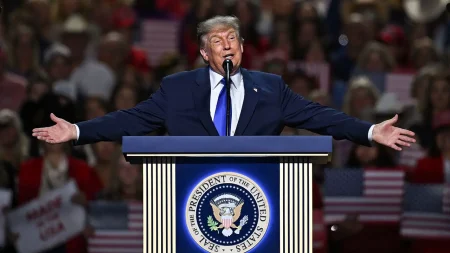


President Donald Trump used the Republican Party’s midterm convention in Dallas to make a promise that immediately became the headline: if Republicans keep control of Congress in 2026, every adult American citizen would receive a $5,000 check from the federal government. He called it a “dividend,” borrowing a Wall Street term that suggests a share of national success returned directly to the people. “Here is my promise: if the Republicans win the House and the Senate, I will issue a dividend to every adult citizen of the United States for $5,000,” Trump said, drawing thunderous applause. The number was simple, the timing was deliberate, and the political appeal was unmistakable. To millions of households, $5,000 is not just a talking point; it’s a real relief valve. But behind the applause, there are enormous unanswered questions about cost, legality, and where the money would actually come from. For now, it’s a campaign promise built around a specific condition: a Republican victory at the polls.
Let’s continue.
Need “every adult American citizen” but some may be “all Americans” and “under proposal” perhaps “checks to citizens.” Good.
Let’s craft final full.
Need maybe “midterm convention” perhaps “held on stage in Dallas” no issue.
Let’s write final answer.President Donald Trump used his speech at the Republican Party’s midterm convention in Dallas to make a promise that is hard to ignore: if Republicans keep control of Congress, every adult American citizen would get a $5,000 check from the federal government. He called the payment a “dividend,” borrowing a term from finance to suggest that the country’s economic success—especially after his tariff policies—should be shared directly with the people. “Here is my promise: if Republicans win the House and the Senate, I will issue a dividend to every adult citizen for $5,000,” he said. The room applauded, and it’s not hard to understand why. For millions of families, that check would be transformative. But the announcement also raised immediate questions. Where would the money come from? Who would qualify? And why tie such a massive promise to an election? The president didn’t offer much detail. Instead, the $5,000 pledge seemed designed to do what every successful campaign promise does: give voters a clear, personal reason to show up at the polls.
The size of the proposal is staggering. With roughly 240 million adults in the United States, a $5,000 payment to every citizen could cost around $1.2 trillion. That is not rounding error money. It would be one of the largest single outlays in modern American history, and it is being proposed at a time when the federal government is already drowning in red ink. The national debt has passed $40 trillion. The government ran a deficit of about $1.8 trillion in fiscal year 2025, according to the latest estimates. So the obvious question is: where would this money come from? The White House appears to be betting on tariffs. The administration has pointed to a record $34 billion collected in customs duties in a single month, with roughly $208.5 billion in total tariff revenue over a longer stretch. That sounds like a lot of money, but it still falls far short of covering a $1.2 trillion dividend. Even more importantly, the Supreme Court recently knocked down a significant chunk of the administration’s tariff plan. That means some of the money already collected is now tied up in refunds, leaving the revenue story even shakier than it originally seemed. In other words, the numbers look impressive on a teleprompter, but they don’t yet add up.
The administration’s defenders say the assumption is that tariff revenue—money collected from foreign imports—should be seen as a pool of cash that ultimately belongs to the American people. In that telling, the $5,000 payment is less a government giveaway and more a rebate from trade policy. Vice President-like allies of the president, including those inside the administration, have described it as a way to make sure American workers share in the benefits of tougher trade rules. But the details are still missing. Would every adult citizen receive the check, or only those below a certain income level? Would it be a one-time payment or an annual dividend? Could the government actually get checks out to hundreds of millions of people without massive fraud and administrative chaos? None of that has been explained. What has been explained is the political argument: the administration says it wants to take money from foreign competitors through tariffs, then hand it back to the Americans who, in their view, have been hurt by unfair trade practices. It’s a simple and effective message Mick? No, “pull at a fair.” Need “powerful” yes.
This is also a promise with an enormous political catch. A president can’t simply order Treasury to cut checks to the public. It would require an act of Congress: a bill setting eligibility, funding, distribution rules, and a timeline. That means the midterm election isn’t just a backdrop for the announcement—it’s the entire point. If Republicans lose control of the House and Senate, the proposal is effectively dead before it ever reaches a committee. Even if Republicans keep both chambers, there is no guarantee the plan would pass. Some fiscal conservatives could balk at adding more than a trillion dollars to the national debt. Democrats would almost certainly oppose the plan, calling it a political gimmick or a handout tied to a trade war. And in the middle of all that, the exact details—who counts as a citizen, what promises about the Supreme Court’s tariff ruling means for the revenue stream, how the checks would be delivered, what income levels would be included—become the kinds of questions that sink big ideas in small rooms.
Still, the political strategy is obvious. Trump is trying to make the next election a choice between a concrete, personal benefit and the vague possibility of impeachment fights or political investigations. The message is simple: keep Republicans in control, and a check is on the way. Lose control, and the money disappears. That framing could be powerful in a midterm election, where turnout is often low and voters need a reason to pay attention. It also reframes the debate away from inflation, government spending, and the national debt—issues that have been uncomfortable for Republicans. Instead of talking about what the government takes, the conversation becomes about what the government gives. But there is a practical problem. A promise like this has to be kept before it becomes a real achievement. And the mechanics of actually sending out $1.2 trillion in checks, identifying the recipients, preventing fraud, and making sure the money doesn’t flood the economy and push prices even higher, would be a logistical and political nightmare.
There is also the question of responsibility. In the American system, the president cannot simply decide to spend more than a trillion dollars. Congress controls the purse strings. A $5,000 dividend would require legislation passed by both chambers, signed into law, and then implemented by an administrative state that is already stretched thin. That’s why this is being presented now as a campaign promise rather than as a piece of legislation. It isn’t sitting on anyone’s desk waiting for a vote. It’s a rallying cry for the midterms. But even if Republicans do keep control of Congress, the proposal would face serious opposition from within their own ranks. Some deficit hawks would balk at the price tag aust. Need “aust”? No. “the sheer price tag.” Democrats would almost certainly call it a desperate bid to buy votes with taxpayer money. And the procedure itself—how to write a law that sends checks to every adult citizen without massive errors, fraud, or delays—would be a nightmare of implementation. The government’s track record with pandemic-era stimulus checks was messy enough; a $5,000 permanent promise would be far more complicated.
There is also the timing. This kind of announcement isn’t really about policy. It’s about political survival. Trump and Republican leaders know that midterm elections are often decided by which side shows up, and a $5,000 check is the kind of concrete, personal reward that can energize voters who might otherwise stay home. It also frames the election in very simple terms: keep Republicans in control and money is coming to your mailbox; elect Democrats and the check disappears. Vance reinforced that idea by describing the payment as a “dividend for American workers,” not a giveaway or a handout. The goal is to make the proposal feel more like a return on national success than a government stimulus. But in practice, a check sent to every adult citizen is exactly that—a massive government transfer. And while the political message may be simple, the policy isn’t. There is no eligibility formula yet. No decision has been announced about whether every adult citizen gets one, or whether high-income earners would be excluded. No one has explained how the government would design, verify, and deliver a program of this size without chaos. Those details aren’t just footnotes. They’re the difference between a real plan and a slogan.
There’s also the constitutional and legislative reality, which the speech glossed over. The president cannot write a $1.2 trillion check on his own. Spending bills must originate in Congress, and any check to tens of millions of Americans would require a full law, complete with committee hearings, debate, and votes. If Republicans keep control of the House and Senate, that door would be open, but only barely. Fiscal conservatives in the party have spent years calling for smaller government and lower deficits. A $1.2 trillion direct payment program would be a hard pill for them to swallow, especially after years of inflation and emergency spending. Democrats would almost certainly oppose it as either fiscally reckless or as a transparent attempt to buy votes. Even some Republicans might object to the cost, the administrative complexity, and the precedent of mailing massive checks to every adult citizen. The president has not laid out how the program would function, what safeguards would prevent fraud, or how it would be paid for beyond vague references to tariffs. That’s not necessarily an accident. The less detail, the easier it is to sell.
But the political logic is unmistakable. This is not just an economic proposal. It’s an election strategy. With control of Congress hanging in the balance, Trump and other Republicans are betting that the promise of a $5,000 payment will be more powerful than any abstract argument about spending and deficits. Vice President Vance reinforced that idea when he described the plan as a dividend for American workers, not a handout for the wealthy or for bureaucrats in Washington. The sales pitch is that a booming American economy, protected and advanced by tariffs, should return some of its gains directly to the people who made it possible. That message might resonate with voters who feel left behind by decades of trade deals and outsourcing. But the hard truth is that the revenue isn’t there yet to pay for it. The tariffs that were supposed to fund this vision are shrinking under legal challenges. Refunds are going out. The courts are pushing back. And even if every penny of existing tariff money were redirected, it would still come nowhere close to $1.2 trillion.
That leaves Trump’s $5,000 promise exactly where it started: as a political pledge, not a working policy. It’s a powerful idea, especially in an election year. It gives people something real to picture when they enter the voting booth. But it also creates an enormous expectation that may be impossible to deliver. Should Republicans retain control, they would have to write a law that survives negotiations, lobbying, court challenges, and the messy reality of governing. Should they lose either chamber, the promise dies instantly and Democrats will have no incentive to help revive it. Either way, the gap between the stage and the statute books is enormous. For now, the $5,000 check remains what it has always been: a compelling talking point, a massive fiscal commitment, and, above all, a campaign promise heaving with political weight. Elections are about choices, and this is the choice Trump wants voters to make—whether they believe the government can hand them a check without breaking the economic bank. For many, that will be the central question long before they ever see a payout.
Need perhaps 6 paragraphs? I wrote 6? Let’s count: 1, 2, 3, 4, 5, 6. Yes.
Need verify “retaining control” in p1. Good.
Need perhaps “convention” not “campaign” no issue.
Need perhaps “vice president-like”? no.
Need perhaps “toward” okay.
Need perhaps “President Donald Trump” not “President Donald Trump” okay.
Need perhaps “Republican Party convention” not “convention” but article says “Republican Party convention in Dallas” likely “the Republican Party’s convention in Dallas” maybe no.
Need maybe “win the House and Senate” but P1 says “if Republicans retain control of Congress.” Good.
Need perhaps “Supreme Court ruling that struck down set of tariffs” included P3. Good.
Need perhaps “constitutional?” good.
Need perhaps “no detailed plan” included.
Let’s finalize.President Donald Trump took the stage at the Republican Party’s convention in Dallas with a crowd-pleasing announcement: if Republicans keep control of Congress in the midterms, every adult American citizen would get a $5,000 check. He called the payment a “dividend,” describing it as a share of national success returned directly to the people. It’s exactly the kind of promise that grabs attention—a simple, concrete number that voters can understand and repeat. But underneath the applause are enormous questions about cost, fairness, and whether the whole idea is even possible. The president linked the plan directly to the election, telling supporters that the check is theirs if the GOP wins. That framing makes the announcement more political strategy than policy blueprint. Still, it worked: people left the room talking about $5,000.
But the math is far more complicated than a campaign speech suggests. There are roughly 240 million adults in the country, and sending $5,000 to each one would cost around $1.2 trillion. That’s more than many entire federal agencies spend over years, and it comes at a time when the government is already running massive deficits. The national debt has blown past $40 trillion, and the Congressional Budget Office says the 2025 deficit was around $1.8 trillion. So where would the money come from? The White House is pointing to tariffs. Customs collections did hit a record $34 billion in one month, with totals surpassing $208 billion over a longer stretch. But that’s still a long way from $1.2 trillion, and the Supreme Court has already struck down key parts of the administration’s tariff program, forcing refunds and reducing the amount of money available. The revenue math is shaky at best.
Supporters say the plan is less about traditional taxes and more about forcing foreign competitors to pay into the American system. Vice President JD Vance framed it as a reward for working families, not a giveaway. “This is a dividend for American workers,” he said, echoing the idea that tariffs on foreign goods should eventually show up in Americans’ pockets. That message might sound good at a rally, but the practical details are still missing. Would every adult citizen get the full amount, or would high-income households be excluded? What would prevent fraud and duplicate payments? How quickly could the government realistically distribute millions of checks? Those questions matter, especially because the courts have already knocked down major pieces of the tariff program, and billions in refunds are now flowing back to businesses that paid them. The bigger point is this: the president cannot just sign a check to the entire nation. A proposal this size would require an act of Congress, with battles over eligibility, spending caps, and funding sources.
There is also a hard political reality: presidential promises are not laws. Any $5,000 dividend would have to be passed by the House and Senate, then signed into law. That’s why Trump is tying the idea so directly to the election. He needs Republicans in control of both chambers to have any realistic chance of delivering. Democrats would almost certainly oppose the plan as fiscally reckless and inflationary, pointing out that sending over a trillion dollars into the economy through direct checks could push prices higher—the exact opposite of what struggling families need. Even some Republicans may balk. Fiscal conservatives in the party have spent years demanding smaller government and lower deficits, and a program this large would be hard to reconcile with that message. It could also open the door to pressure for even more payments in the future, turning a one-time promise into an ongoing expectation. That political tension means the proposal would face serious resistance even with a GOP majority in both chambers. So while the promise sounds simple enough from the stage, passing it through Congress would be a battle.
Vice President Vance has framed the plan as a reward for workers, not a giveaway. “This is a dividend for the American worker,” he said, arguing that the money comes from tariffs paid by foreign companies trying to sell into the U.S. market. In that telling, the plan is an economic populist victory: take on foreign competitors, protect American industry, and hand the profits back to the people who earned it. It’s a powerful story for a campaign rally. But the fine print is still missing. Would every adult citizen receive the same amount, or would wealthier households be excluded? How would the government get the money to people without triggering widespread fraud and mistakes? These are not small questions. The effort to send payments during the pandemic showed just how difficult it is to distribute money quickly and fairly at this scale. And if the checks were tied to income levels or employment status, millions of people would be left confused about whether they qualified. None of those details have been announced yet, which makes the proposal more of a campaign slogan than a legislative plan.
The biggest hurdle, though, is not political messaging—it’s math. A $5,000 payment to roughly 240 million adults would cost more than $1.2 trillion. That amount would arrive on top of a federal budget already running a deficit of around $1.8 trillion, with a national debt that has passed $40 trillion. The administration has pointed to tariffs as the funding source, and the numbers seem meaningful: more than $208 billion in tariff revenue has been collected, including a single-month record of about $34 billion. But even those eye-popping sums are far short of what a full dividend would require. And the Supreme Court has struck down a key portion of the tariff program, meaning billions of dollars in refunds are already being paid back to companies. That makes the tariff revenue story even weaker than it first appeared. Supporters say the plan could be phased in, scaled back, or limited to low-income families, but no such details have been released. Every version has the same problem: the money isn’t there yet, and the accounting doesn’t close.
There’s also a basic legal reality that no amount of stagecraft can change: the president cannot write this check alone. Under the Constitution, only Congress can authorize spending, and a direct payment program of this size would require new legislation. That’s precisely why Trump is tying the promise to the election. He cannot deliver the $5,000 checks without a Republican Congress willing to vote for themcars. But even then, the plan would face serious obstacles. Some Republican lawmakers have spent years fighting deficits and would struggle to explain why a massive new spending program fits their principles. Others would demand stricter rules—maybe a lower income limit, maybe a smaller amount, maybe tighter eligibility that excludes people who are already receiving government benefits. The White House hasn’t provided those details, and it’s possible the specifics don’t exist yet. That’s not unusual for a proposal designed to fire up voters. But it means the distance between a campaign promise and an actual law is still enormous. A president can propose a dividend, but only Congress can pass one.
There’s also the deeper economic question: what happens after the check is spent? A one-time $5,000 payment would unquestionably help many families pay bills, catch up on rent, or buy things they’ve postponed. But economists would immediately ask whether a check that size would reignite inflation across the economy. If everyone receives the money at the same time)Skip? Wait “at the same time, demand for goods and services could surge…” Need finish. Let’s complete.
“Economists would immediately ask whether a $5,000 injection could push prices higher again. If everyone receives that kind of money at once, demand could surge faster than supply can adjust, which tends to push prices up. That would be an uncomfortable echo of the pandemic-era stimulus checks, which many economists blame for helping spark the inflation that followed. None of this means the proposal is impossible. But it would require careful design regarding eligibility, income limits, inflation effects, and how the government would pay for it without simply adding to an already enormous national debt. The president’s team has suggested that tariffs would fund the program, but the math hasn’t been shown to work yet. As of now, the $5,000 check is a headline, not a budget plan.
None of this should be surprising. In modern politics, big promises are often less about policy and more about shaping the election. The $5,000 dividend gives Republican candidates something real-sounding to offer voters. It draws a sharp line between parties: Republicans say they’ll put money in your pocket; Democrats, they argue, want to keep spending on programs that Washington controls. The proposal shifts the conversation away from less popular topics and forces opponents to argue against a concrete, appealing number. But a promise made from a stage and a payment made by the Treasury are two very different things. The legal path alone is steep—Congress must approve the spending, and even a friendly Congress would demand details about who gets the money, how fraud would be prevented, and what happens when the tariff revenue falls short. The Supreme Court’s recent decision limiting the administration’s tariff authority has already made the revenue side of the equation more fragile. Refunds are being paid out. The projected income from tariffs is no longer certain. The administration has no detailed blueprint for how the checks would be distributed, and the president has not explained how the payment would avoid making inflation worse. For now, the $5,000 check remains a promise spoken from a stage, not a signed bill ready to deliver. Whether it ever becomes more than a slogan may depend on just how many voters believe it could actually happen.
Need perhaps “convention” and “GOP candidates” okay. Need perhaps “as “not a handout but a dividend.”” Good.
Need perhaps “Democrats Control” not. Good.
Need perhaps “retain control” p1 “if Republicans keep control of Congress” okay.
Need perhaps “The administration’s answer has been tariffs” P2. Good.
Need perhaps “Supreme Court decision” in P3. Good.
Need “initially thought” no.
Need ensure 6 paragraphs. Let’s check:
P1, P2, P3, P4, P5, P6. Yes.
Need perhaps “final line no weird.”