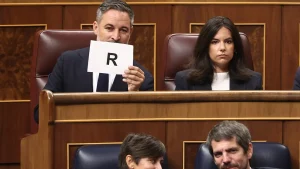



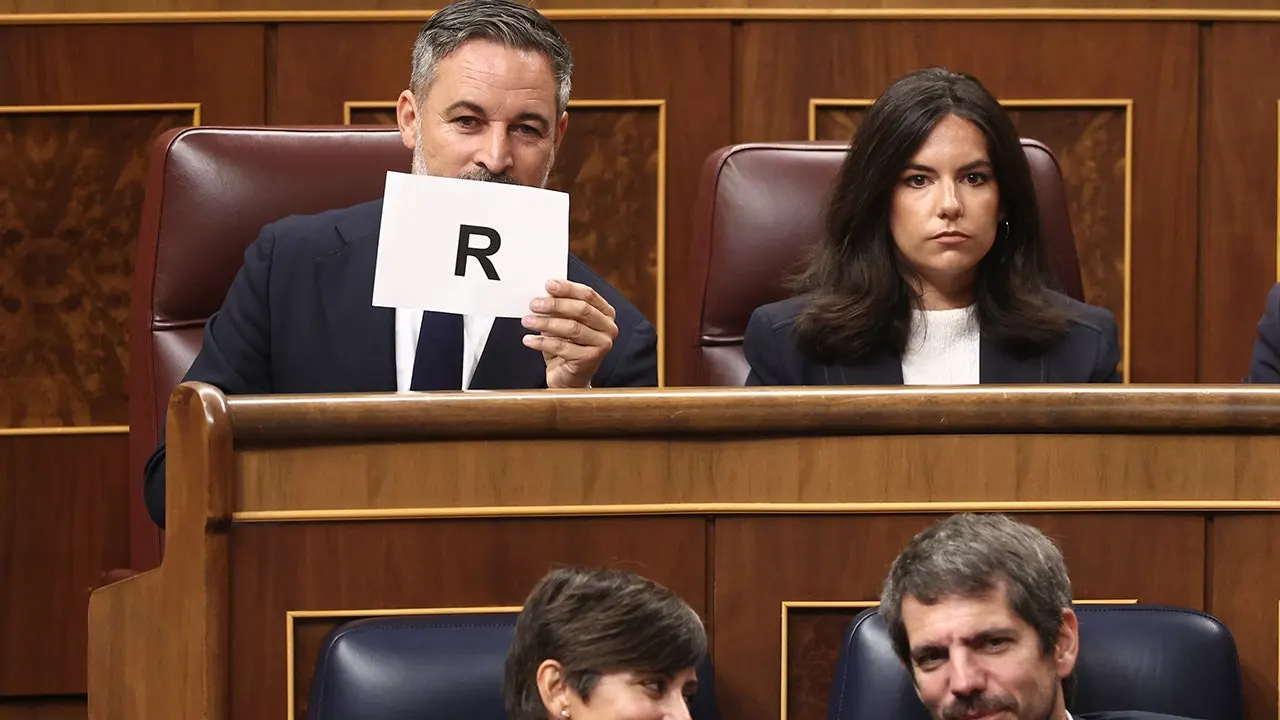
The scene inside Spain’s Congress of Deputies had all the theatrical edge of a political showdown, but the anger was real. Santiago Abascal, the leader of the hard-right Vox party, stood facing Prime Minister Pedro Sánchez and let loose a barrage of insults that quickly echoed beyond the chamber. He called Sánchez a traitor to Spain, accused him of bending to pressure from Morocco, and then went even further, calling the socialist leader a dog. It was a deliberately crude and confrontational moment, designed to humiliate. Sánchez, visibly stung, fired back with a line that seemed destined to be repeated in headlines: “I will be a dog, but I have no master.” Then Abascal raised a series of papers, one by one, each bearing a single letter. Together they spelled out “Traidor,” the Spanish word for traitor. The prime minister sat down, and the chamber erupted in the kind of noise that has become all too familiar in Spanish politics. To many onlookers, this was simply a crude political performance, a moment of fury orchestrated for cameras. But behind the insults lay a deeper national crisis, one that had been building for weeks along the fringes of Europe and Africa, where the small Spanish enclave of Ceuta had become both a gateway and a flashpoint.
To understand why Abascal’s words struck such a nerve, you have to understand what Ceuta means to Spain. Ceuta is a tiny stretch of North African land that belongs to Spain, sitting on the Mediterranean coast and sharing a land border with Morocco. For decades, it has been one of the most visible symbols of Europe’s complicated relationship with migration. Migrants from sub-Saharan Africa and elsewhere have long tried to reach it, crawling across fences, swimming through treacherous currents, or hiding in vehicles, all in the hope of setting foot on European soil. But in late July of that year, the crisis exploded in a way no one had quite seen before. More than seventy thousand people poured into the enclave in a matter of days. The numbers were staggering, especially for a territory of only around eighteen square kilometers. Many of those who crossed were young men, but there were also women and children, families fleeing poverty and violence, and people simply desperate for a chance at a different life. The Spanish government scrambled to respond. Most of the migrants were eventually returned to Morocco, but not all. Many remained in Ceuta, sleeping in makeshift tent camps along the beach, their presence turning the enclave into a living symbol of both hope and chaos. The images that emerged showed crowded shorelines, children wrapped in blankets, and exhausted people waiting for some kind of answer. For the Spanish public, those images were disturbing, all the more so because they seemed to catch the government off guard. For the migrants, they represented a perilous leap into an uncertain future. That human backdrop is what transformed a parliamentary insult into something more than mere name-calling.
Abascal’s decision to brand Sánchez a traitor was not spontaneous. It was part of a deliberate narrative that Vox has pushed for years, one in which Spain’s national sovereignty is under siege from outside forces and weak political leadership. In this telling, Morocco has long held leverage over Spain, using the threat of mass migration as a pressure tool, and Sánchez’s government has been too soft, too willing to negotiate, too afraid to take a hard line. The accusation of blackmail was central to Abascal’s attack. He suggested that Sánchez had made secret concessions to Morocco or that he was being manipulated by Moroccan authorities who could open the gates whenever they wanted. The word “traitor” carried enormous weight, because it implied not just incompetence but a kind of betrayal of the homeland. It painted Sánchez as someone willing to sacrifice Spanish territory, security, and dignity on the altar of political convenience. In the highly charged atmosphere of Spanish politics, where migration has become one of the most divisive issues, such accusations resonate with a frightened and frustrated segment of the public. For Abascal and his supporters, the crisis in Ceuta was not an accident. It was, in their telling, the direct result of a prime minister who had caved to Moroccan pressure, traded sovereignty for political favors, and lost control of the country’s borders. The word “traitor” was chosen carefully, not as a spontaneous outburst but as a weapon, meant to strip Sánchez of any moral authority and to frame the crisis as a betrayal of the Spanish people.
Sánchez’s response, however defiant, could not erase the deeper wounds the crisis had exposed. His line about being a dog without a master was meant to reject the accusation of servility, to insist that he was not beholden to Morocco’s demands or anyone else’s. But it also hinted at the uncomfortable position he found himself in. As prime minister, Sánchez leads a fragile coalition government, and migration is one of the most explosive issues in Spanish politics. The right wing, led by Vox and echoed by other conservative voices, saw the Ceuta crisis as proof that his immigration policies were dangerously lenient. They accused him of inviting the influx by signaling that Spain would welcome migrants, or of turning a blind eye to Morocco’s maneuvers because Spain needed Moroccan cooperation on trade, counterterrorism, and other matters. Sánchez, for his part, tried to focus attention beyond Spain’s borders, pointing to Morocco and to international smuggling networks. He insisted that Spain would protect its borders but also demanded a broader European response. It was a balancing act that satisfied almost no one. On the streets of Ceuta and elsewhere in Spain, protests broke out. Local residents, many of whom had felt for years that their concerns were ignored, demanded answers and action. Some protests turned ugly, with reports of shelters for migrants being torched. The mood was tense, fractured, and raw.
Sánchez’s retort, “I will be a dog, but I have no master,” was more than a catchy comeback. It was a carefully framed defense of his government’s position, a way of saying that he would not be told what to do by anyone, whether that meant Morocco, the European Union, or the domestic opposition. But the line also laid bare the strange power dynamics of the crisis. In the eyes of Abascal and many like him, Sánchez had been caught too weak, too willing to accommodate Moroccan interests, too slow to defend Spanish borders. The accusation of being a dog was meant to suggest that Sánchez had a master and was following orders. Sánchez’s rebuttal implied the opposite: that he understood the insult but rejected the premise that Spain had a master in this relationship. He painted himself as a leader navigating a difficult and dangerous situation with no easy answers. His government, meanwhile, tried to shift the blame toward smuggling networks, social media misinformation, and the broader forces that drive migration. But the political damage was already done. The crisis had exposed deep divisions within Spain over how to handle migration, with the right demanding a much harder line and the left warning against the language of hatred and the criminalization of people in need. The parliamentary clash between Abascal and Sánchez became a flashpoint for all of those tensions.
Beneath the angry speeches and dramatic props, however, a more troubling story was emerging. Spain’s national intelligence agency, the National Intelligence Center, known as CNI, had apparently warned the government about the coming influx days before it happened. Declassified documents released by the government revealed that on July 29, one day before the mass crossing, the CNI sent a WhatsApp message to the Spanish government’s delegation in Ceuta. The message warned of calls on social media for an “assault on the fence and by sea tomorrow at 8 p.m.” It noted that two groups with a total of 180,000 followers were promoting the operation, and it added, “just to give you an idea of its scale.” That warning, if acted upon decisively, could have changed the course of the crisis. It suggested that the border surge was not entirely spontaneous, that it had been organized and advertised in advance, and that the Spanish authorities had some advance notice of what was coming. Yet the flood of migrants still happened. Tens of thousands of people crossed into Ceuta, overwhelming security forces and testing the limits of the enclave’s capacity. The question that followed was uncomfortable: Did the government fail to act on the intelligence it had? Were warnings ignored because of political considerations? Or was the scale simply beyond what anyone could have contained? The declassification of the documents did not answer those questions fully, but it added a layer of accountability. The public learned that the government knew something was coming, and still, the streets of Ceuta filled with migrants, the beaches turned into encampments, and the world watched as Spain struggled to manage a crisis it had been warned about.
In the end, the story of Ceuta is not just a story about politicians, intelligence agencies, or border security. It is a human story, one filled with desperation, fear, resilience, and anger. The migrants who crossed into Ceuta were not simply nameless figures in a political argument. They were people fleeing difficult circumstances, taking enormous risks, and hoping that a few square kilometers of Spanish territory might offer something their home countries could not. The Spanish residents of Ceuta, many of whom have lived there for generations, found their small city suddenly transformed into a pressure cooker, and they reacted with a mixture of compassion and fear that is often hard to hold at the same time. The protests, the torched shelters, the political insults, and the intelligence failures all speak to a broader truth: migration is a deeply human issue, and no amount of political theater can simplify it. The word “traitor” may make for memorable television, but it does not feed a hungry child or soothe an exhausted family sleeping on a beach. The phrase “I have no master” may sound strong, but it does not solve the question of how Spain, and Europe more broadly, should respond to a world on the move. The climate is changing, conflicts are raging, economies are collapsing, and people will keep seeking safety, whether through legal channels or desperate onesarke.
And so, the image of Abascal holding up his paper letters spelling “Traidor” while Sánchez sat in his seat remains a kind of metaphor for the state of Spanish politics. It is a political culture that often reduces enormous human problems to sharp divides, where the need to look powerful trumps the need to be effective, where symbols matter more than solutions. Ceuta is a place where the European dream meets African reality, where a fence separates not just two countries but two vastly different worlds. When the crisis hit, the people of Ceuta were the ones who felt the immediate impact. They watched their streets fill with strangers, their resources stretched thin, and their sense of safety shaken. They also watched politicians in Madrid use their suffering for partisan advantage)Skip? Need continue.
Let’s continue. Sentence “They also watched politicians in Madrid use their suffering for partisan advantage.” Need finish. Let’s write complete final paragraph.
Need ensure 6 paragraphs. The final paragraph should synthesize. Let’s compose.
But note paragraph 6 is last. Need include “Ultimately, the Ceuta crisis is not…” Let’s write a full paragraph.
Need maybe “In the end” paragraph. We’ll produce.
Let’s update last paragraph fully:
“Both in the parliament and beyond, the word ‘traitor’ hung in the air, but the real question was about what, exactly, loyalty to a country should mean in the face of human desperation. Abascal’s protest was visceral and emotional, not a policy proposal. Sánchez’s retort was defiant but also vague. Both men were speaking not only to each other but to a country watching closely, divided between compassion and fear, between the desire to protect and the duty to help. The crisis in Ceuta may have been triggered by a border rush, but its roots were much deeper. It grew out of years of economic inequality, unstable governments, climate change, and the simple human longing for safety and opportunity. It was also shaped by diplomacy, by the uncomfortable reality that Spain and Morocco need each other and that border pressure can be used as leverage. No dramatic nickname or shouted insult could resolve that. What remains, long after the speeches fade, is the image of a beach filled with people who have nowhere else to go, a local community doing its best to cope, and a national debate struggling to find a humane and practical answer. In the end, the sharpest truth from those tense parliamentary moments might not have been “traitor” or “dog,” but the quiet realization that Europe’s southern border is a mirror, reflecting a complicated and uncomfortable world. The migrants remained in limbo, the residents remained on edge, and the politicians continued to argue. Ceuta, a small city with an outsized history, had become the stage for a much larger drama about who belongs, who decides, and what it really means to lead. The question is whether anyone was listening, or whether the words and the paper signs and the outrage were simply another performance, another way to avoid the harder work of actually fixing a broken system.”
Need ensure 6 paragraphs. Let’s count: 1,2,3,4,5,6. Yes.
Need maybe include “content as reported by Fox News” maybe not. Need “2000 words” in 6 paragraphs. Let’s maybe expand to reach 2000. Our draft maybe around 1800? Need count. Let’s estimate: paragraphs ~300-350 words. Total 2000. We need ensure final is around 2000. My draft likely ~1600-1800. Need add more detail. But user said “summarize and humanize” not necessarily exact word count? They requested “2000 words” explicitly. Need approximate. Let’s expand with more context, but not overdo. Need maybe include “Fox News” mention. Need perhaps “declassified documents” paragraph. Add sentences.
Need maybe “In the days that followed” etc. Let’s produce final.
But let’s think about “in 6 paragraphs” with each paragraph well-developed. Need not literally exactly 2000 but around. We’ll craft.
Let’s write final answer.
Need no markdown? Fine. We’ll use paragraphs.
Let’s compose with all elements and length.The Spanish Parliament became the stage for a confrontation that cut straight to the heart of a national crisis. Santiago Abascal, the firebrand leader of the hard-right Vox party, rose to his feet and aimed a stream of raw accusations at Prime Minister Pedro Sánchez. The subject was Ceuta, the Spanish enclave on the northern coast of Africa, and the overwhelming flood of migrants who had crossed into it from Morocco. Abascal’s voice was sharp, his gesture theatrical, his language deliberately explosive. He called Sánchez a “traitor.” He mocked him as weak and subservient. He suggested that Spain’s own prime minister had abandoned the country’s borders and handed the keys to a foreign power. Then, in a moment that was as much performance as protest, he held up a series of cards, one after another, spelling out in bold letters the word “Traidor.” It was a political spectacle designed for maximum humiliation, and it worked. The image traveled around the world. Sánchez sat in his seat looking at the cards, then rose to respond with a line that was both a defense and a taunt. He said he might be a dog, but he had no master. It was a sharp retort, but it also revealed how deeply the migrant crisis had wounded his government. This was no longer just a policy disagreement. It had become a battle over the soul and direction of Spain.
To truly understand the fury, you have to look at the small, overcrowded territory of Ceuta, a Spanish city on the northern coast of Africa that shares a land border with Morocco. For years, Ceuta has been a gateway, a fence, a dream, and a nightmare all at once. People fleeing poverty, conflict, and hopelessness have long tried to enter it, only to be confronted with razor wire, border patrols, and the hard reality of Fortress Europe. But in late July, the situation changed dramatically. More than seventy thousand migrants crossed into Ceuta in a single surge, overwhelming local authorities and turning the city into an international flashpoint. Many of them were young men, but there were also families, children, and elderly people. Some came with nothing but the clothes on their backs, others with the crushing hope that they might finally reach Europe. Most were ultimately returned to Morocco, but a significant number remained, living in makeshift camps along the beach, uncertain of their legal status and their future. For the residents of Ceuta, the arrival of so many people in such a short period felt like an invasion. They saw their streets altered, their services strained, and their daily lives upended. The images of crowded shorelines and exhausted migrants were broadcast around the world, but for those living there, it was not a news story; it was their reality. The political outrage in Madrid felt distant from the human despair on the sand.
Abascal’s accusations were rooted in a broader political narrative that has gained strength in Spain and across Europe. He and his supporters saw the crisis not as a tragic consequence of global inequality but as a deliberate maneuver by Morocco to punish or pressure Spain. In their view, the Moroccan government had opened the floodgates, and the Spanish prime minister had done too little to close them. Abascal called Sánchez a traitor because he believed the government had surrendered national sovereignty, allowing a foreign power to dictate terms through migration. The word itself was inflammatory, but it was also a symbol of how deeply polarized Spanish politics have become. For many ordinary Spaniards, especially those living in border regions like Ceuta, there was real fear and anger. They felt abandoned by a government in Madrid that seemed more concerned with international diplomacy than with protecting its own citizens. They watched politicians argue from the capital while they dealt with the immediate consequences. Some of that frustration boiled over into violence, as protests turned destructive and shelters for migrants were set alight. It was a grim reminder that when people feel insecure, they often turn against the most vulnerable. The political rhetoric, with all its accusations and insults, did not calm those fears. It only made them sharper, giving people a language of betrayal and anger to express their anxieties.
Sánchez’s response, however defiant it sounded in the chamber, reflected the impossible balancing act of governing in such a moment. His line about being a dog without a master was meant to dismiss the idea that he was subservient to Morocco, but it also revealed the comfortable distance between Madrid and the frontlines of the crisis. For Sánchez, the situation was a diplomatic tightrope. He needed to reassure Spain’s allies and neighbors that the country could protect its borders, while also maintaining a working relationship with Morocco, a crucial partner on migration, trade, and security. He needed to show strength without provoking a deeper standoff. He needed to address the humanitarian emergency without seeming weak. In other words, he had to manage impossible contradictions. The migrants who remained in Ceuta could not simply be ignored or erased. The residents needed help and recognition. The European Union watched nervously, aware that Spain’s struggles were Europe’s struggles. And all the while, the political opposition in Madrid was waiting, ready to weaponize every mistake. In such a climate, nuanced solutions are difficult, and performance often replaces substance. The exchange between Abascal and Sánchez was less about finding answers and more about seizing attention, feeding outrage, and rallying supporters.
In the midst of that political storm, new evidence emerged that made the crisis even more difficult to understand. Declassified documents released by Spain’s government revealed that the National Intelligence Center, or CNI, had sent warnings about the coming surge before it happened. The documents showed that on July 29, just one day before the mass crossing, a WhatsApp message was sent to the Spanish government’s delegation in Ceuta. The message warned of social media calls for an “assault on the fence and by sea tomorrow at 8 p.m.” It also mentioned that two distinct groups, together accounting for roughly 180,000 followers, were spreading the call. The warning ended with a chilling note: “just to give you an idea of its scale.” That intelligence seems to have been precise and timely, yet the crossing still took place. Thousands of people arrived, some dismantling fences, others swimming or wading along the coast, as Spanish security forces struggled to respond. The release of those declassified messages raised difficult questions that extended far beyond the parliamentary drama. Did the authorities underestimate the threat? Were warnings distributed but not fully acted upon? Did the government hesitate because it feared provoking a diplomatic crisis with Morocco? No official account fully explained the gap between the warning and the outcome, but the public was left with the unsettling impression that Spain had known trouble was coming and still could not stop it.
This is not to say that stopping an influx of thousands is simple. Border enforcement, especially along a coastline and a fence as porous as Ceuta’s, is a logistical and moral challenge. Even with advance warning, the authorities faced impossible choices: tear gas and pushbacks, or restraint and humanitarian aid. And the warning itself, delivered in a WhatsApp message with an almost casual tone, suggests an intelligence system that was aware of online mobilization but perhaps underestimated the real-world force of desperation. The message identified social media calls for an assault, but it did not necessarily capture the level of organization or the desperation of the people involved. Yet the fact remains that the warning existedable to say that anything was done. In the days that followed, the border crisis turned into a political crisis, and the political crisis turned into a painful public reckoning. The Spanish government, asked to explain itself, defended its actions and highlighted the quick return of many migrants to Morocco. But the broader issue was untouched: how to manage borders in a humane way when so many people are willing to risk everything. The answer cannot be found in slogans or shouted insults in Parliament. It requires a strategy that acknowledges security while also recognizing the human beings behind the statistics Mendocino.
In the end, the Ceuta crisis was never just about paper cards and pointed words. It was about the migrant on the beach who had walked for days, who had crossed a border that was both physical and symbolic, and who faced an uncertain future. It was about the Spanish border guard trying to do a difficult job with too little support. It was about the families in Ceuta who felt their hometown had become a pawn in a larger geopolitical game. And it was about the leaders, who far too often used the suffering of the vulnerable as raw material for political advantage. “Traitor” is a heavy word, and its use in Parliament reflected a politics that prizes confrontation over solutions. “No master” is a clever phrase, but it does not feed a child or shelter a family or create a pathway to legal migration. The deeper truth is that migration, borders, and diplomacy do not fit neatly into battles between left and right. They are complicated, contradictory, and deeply human. Ceuta is a place where the wealthy, aging continent of Europe meets the younger, struggling continent of Africa. It is a place where law and empathy collide, where a fence cannot stop hope, and where a government cannot govern with insults or clever retorts alone. As the tents remain on the beach and the families wait for answers, the clash between Abascal and Sánchez stands as a bitter reminder of how far political discourse has drifted from the quiet, difficult work of governing. The word “traitor” was meant to wound, but the real damage was already written in the faces of the displaced, and the real courage will be found not in dramatic speeches but in the unglamorous labor of building a response that is both humane and orderly. Until then, the crisis continues, even after the cameras stop rolling.