


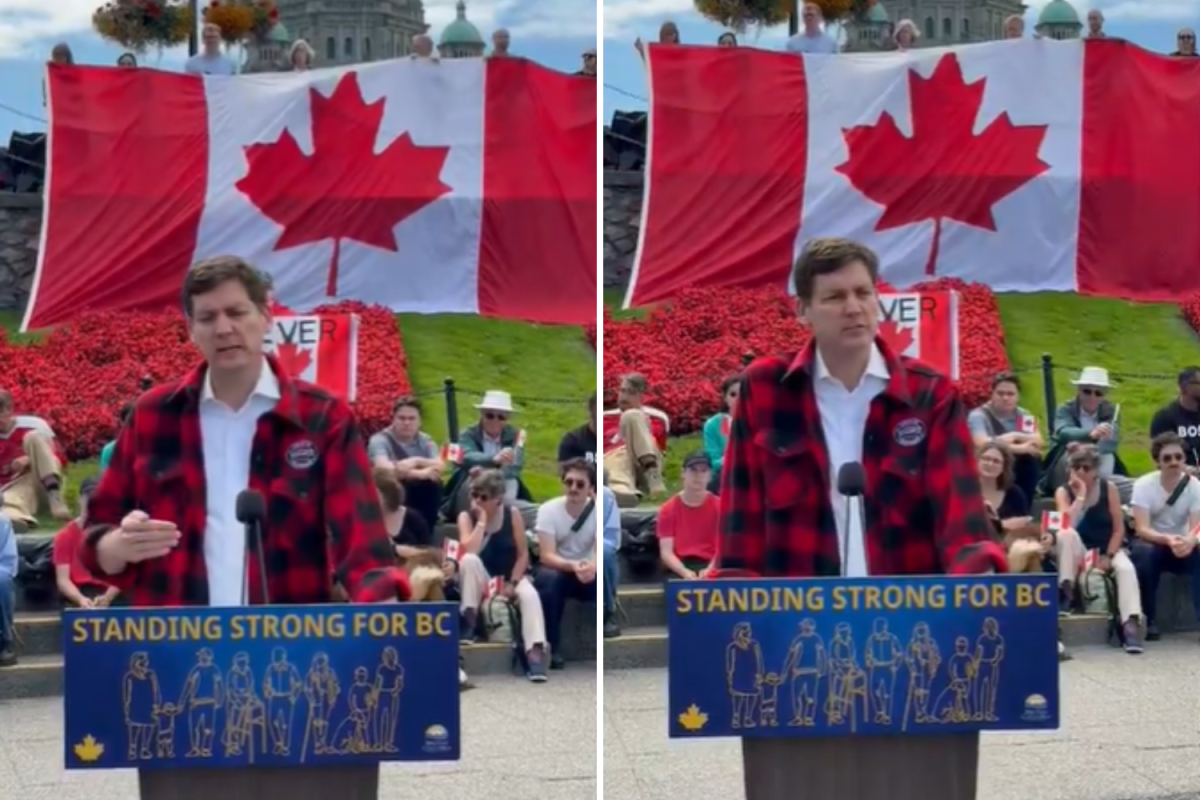
There’s something almost surreal about seeing a welcome sign that says “Strong, proud and will NEVER be the 51st state. Sorry!” It sounds like a punchline from a comedy sketch, but for British Columbia, it’s dead serious. Premier David Eby unveiled the sign during a news conference in Victoria on Tuesday, standing in front of reporters as officials laid out the province’s response to the ongoing trade dispute between the United States and Canada. The sign is a direct answer to President Donald Trump’s repeated suggestions that Canada should become part of the United States, and it comes after Trump shared social media posts and maps that depicted Canada as American territory. For many Canadians, those images were the last straw. What once seemed like an absurd hypothetical has started to feel like a genuine threat to national sovereignty. The sign campaign includes different versions, one of which welcomes visitors to British Columbia while listing local rules and ends with a final icon that says “Never 51st State.” There’s a distinctly Canadian flavor to the message: polite on the surface, with a “sorry” thrown in, but unmistakably firm underneath. It’s the kind of gesture that makes visitors smile, but it’s also a declaration that the province, and the country, will not be absorbed into its southern neighbor.
Eby didn’t hold back when talking about the president’s online behavior. “All I can say is that the president is clearly unhinged. Those memes are bizarre. They are disturbing. They are not befitting the leader of the world’s largest economy, the world’s largest army,” he said. Those are strong words from a premier who would normally be expected to tread carefully when discussing a foreign leader, especially one as powerful and unpredictable as Trump. But Eby made it clear that he sees this as more than just trolling. The maps and memes, he argued, are part of a broader narrative that treats Canada’s existence as negotiable. That’s why British Columbia decided to respond with a message that would have, in his words, “the least impact on British Columbians and the most impact on those who are coming after us, specifically the president.” He also said that Canada should use this moment to strengthen its own domestic economy and pursue more diversified trading relationships beyond the United States. It’s a recognition that relying so heavily on a neighbor who openly talks about absorbing your country is no longer a safe bet. The sign is a small act of defiance, but it carries a much larger message: Canada is proud, Canada is strong, and Canada is not for sale.
British Columbia is not alone in pushing back. Trump’s social media posts depicting other territories as part of the United States have triggered sharp responses from leaders around the world. Iceland’s Prime Minister Kristrún Frostadóttir warned that “there is nothing funny or normal about making fun of the sovereignty of states, especially today when it is not a given.” Mexican President Claudia Sheinbaum responded without directly naming Trump, but her message was unmistakable: “Mexico is neither nor will be a colony or protectorate of any foreign country.” Danish Prime Minister Mette Frederiksen reiterated that Greenland does not wish to become part of the United States, and her foreign minister, Lars Løkke Rasmussen, said the “disturbing” map showed that Trump “still harbors some kind of maximalist vision in his own mind.” These reactions are a reminder that Trump’s expansionist rhetoric is not being dismissed as harmless jokes. In a world already marked by war, instability, and shifting alliances, sovereignty is a serious matter. Leaders are no longer laughing along or brushing off the comments. They are responding with the gravity that the situation demands. The British Columbia sign is part of a wider chorus of nations saying, in their own ways, that they see what is happening and they reject it.
The sign also comes at a time of escalating economic conflict. The United States has imposed tariffs on Canadian goods, and Canada has responded with retaliatory tariffs of its own. The trade dispute has turned one of the closest economic relationships in the world into a battleground, and the rhetoric on both sides has grown increasingly harsh. Ordinary people are feeling the effects, from farmers and factory workers to families trying to make ends meet. Eby acknowledged this on Tuesday with a note of frustration. “Nobody wanted this trade war. Canadians sure didn’t start it, and working families on both sides of the border will be worse off because of it,” he said. But he insisted that backing down is not an option. “When our workers, our businesses, our economy, is targeted, standing up for Canada is not a choice. It is our responsibility.” That language reflects a deep sense of betrayal among Canadian officials. They believe the United States is treating a trusted ally and neighbor as an adversary, and they are struggling to understand why. The trade dispute is not just about dollars and cents; it’s about respect. And the welcome sign is a way of saying that Canada will not be bullied into submission, even if standing up comes at a cost.
For many Canadians, the current tension feels especially painful because of history. Eby reminded reporters that Canada stood with the United States after the September 11, 2001, terrorist attacks, offering support and solidarity in a moment of national crisis. That memory makes the present situation harder to swallow. The same neighbor that once grieved with America is now being told, through tariffs and memes, that it doesn’t really matter. The relationship between the two countries has always been close, but it has also been taken for granted. Canadians have grown used to being the loyal friend next door, the one who shows up when needed and doesn’t ask for much in return. Now, that loyalty feels unreciprocated. Canadian leaders are talking seriously about diversifying trade, strengthening domestic supply chains, and building a future that does not depend so heavily on the United States. That is a significant shift, and it is not just about responding to Trump. It is about preparing for a world in which the United States may no longer be a reliable partner. The welcome sign is a small symbol of that larger change. It is a reminder that Canada is a sovereign nation with its own identity, values, and future, and that no amount of pressure or mockery will change that.
In the end, the “Never 51st State” sign is both a joke and a warning. It is a tourist-friendly slogan with a serious edge, the kind of thing that makes people smile before they realize the point. But behind the humor is a real anxiety about what the future holds. Trump’s repeated references to Canada as the 51st state, his maps showing Canada absorbed into the United States, and the ongoing trade war have all combined to create a sense of unease that was not there before. Canadians are being forced to ask themselves what kind of relationship they want with their powerful neighbor. The answer, for now, is clear: they want to be friends, but not family. They want to trade, but not be taken over. They want respect, not ridicule. The sign in British Columbia is a small act of defiance, but it speaks to something much larger. It says that sovereignty is not something to be mocked, and that a country’s identity is not a punchline. As Eby put it, standing up for Canada is not a choice. It is a responsibility. And if that means putting up a sign that tells the world, in the politest possible way, that Canada will never be the 51st state, then so be it.