


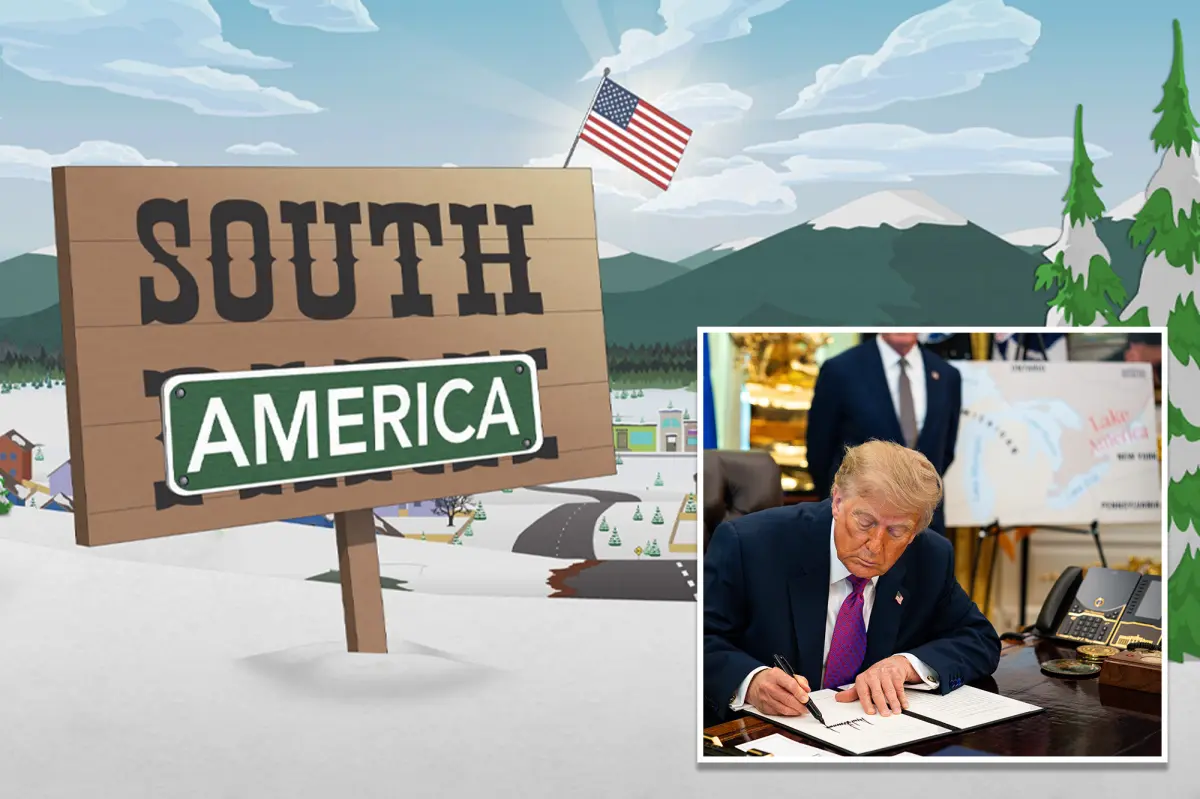
In the strange, glittering carnival of American public life, it can sometimes feel as though the entire country has fallen into a shared fever dream. Headlines collide with absurdity, and absurdity becomes policy. In such moments, one reliable cultural touchstone remains: “South Park.” For nearly three decades, creators Trey Parker and Matt Stone have done what few satirists manage to do — they have kept pace with a reality that seems to outrun comedy. Their latest punchline arrived with the precision of a well-aimed slap. On Tuesday, the official “South Park” X account announced that the beloved animated series would be rebranding itself as “South America.” The accompanying image showed the show’s familiar title, but with the word “America” plastered over “Park,” as if someone had slapped a patriotic sticker over a beloved old sign. The caption was pure, deadpan gold: “Inspired by the bravery and patriotism of Apple and Google, we are changing the name of South Park to SOUTH AMERICA.” The joke was, of course, a direct swipe at President Trump’s recent, relentless renaming spree. But it was also a reminder of what makes “South Park” so enduring: it doesn’t just report the absurdity; it becomes the absurdity. It renames itself. It plays the game. It holds up a grotesque mirror to the world and says, “Look at how ridiculous this all is.” And for fans, that’s both a comfort and a challenge. The announcement was classic “South Park” — equal parts juvenile, brilliant, and unsettling, like the show itself.
The joke did not emerge from thin air. It came from a very real, very bizarre chapter in American political theater. President Trump, in a burst of executive enthusiasm, had decided that American geography needed a patriotic makeover. The Gulf of Mexico, long known by that name across maps and atlases, was to be called the Gulf of America. Lake Ontario, another body of water that had never asked for any trouble, was rebranded as Lake America. The moves were framed as a celebration of national pride, but to many observers they felt less like statesmanship and more like an attempt to edit reality itself. What made the whole episode even stranger was the response from corporate America. Tech giants Apple and Google, in what they may have believed was pragmatic deference, quickly updated their mapping platforms to reflect the new names. Where once puzzled travelers might have looked for the Gulf of Mexico, they now saw the Gulf of America glowing innocently on their screens. The decision was framed by some as a quiet capitulation to presidential pressure, and by others as a harmless technological update. But “South Park” saw it differently. The show’s creators recognized the irony: two of the world’s most powerful corporations nodding along to a renaming fad because they were afraid of getting on the wrong side of the White House. And so, with all the gravity they could summon, Parker and Stone announced that their own little town in Colorado would now be known as “South America.” The absurdity was the point. If Apple and Google could be so eager to rewrite the map, why shouldn’t a cartoon town join the fun? The gesture mocked not only the president’s renaming frenzy but also the spinelessness of institutions that fell in line without a moment of reflection.
The announcement wasn’t just aimed at tech companies, though. It also took a sharp, delicious bite at the corporate parent that airs “South Park” itself. In the post, the show offered a thank-you to Paramount — but with a sneering parenthetical: “A Skydance Capitulation.” The phrase is a clever, cutting twist on the company’s full corporate identity. Paramount had recently undergone a major transformation, merging with Skydance to become Paramount Skydance. But the word “capitulation” carries far more weight than any corporate merger. It is an accusation, a confession, and a punchline all at once. The backstory is steeped in political tension. Trump had filed a lawsuit against Paramount Global and CBS, alleging that CBS News had deceptively edited a “60 Minutes” interview with Democratic presidential candidate Kamala Harris to make her seem more favorable. The president’s legal pressure was relentless, and ultimately Paramount agreed to a settlement of sixteen million dollars. For many observers, the payout looked less like an admission of guilt and more like a surrender. “South Park” creators, who are themselves part of the Paramount family, turned that surrender into a sharp jab at their own bosses. The phrase “A Skydance Capitulation” is brilliant because it acknowledges the corporate machinery that makes the show possible while simultaneously mocking its cowardice. It is a rare moment in entertainment when artists publicly twit the hand that feeds them — not with the reflexive, meaningless edginess that has become standard in comedy, but with a specific, factual, and deeply satirical jab. It says: we know our parent company folded under pressure, and we will not let anyone forget it.
Of course, “South Park” has never been shy about controversy, and this latest joke is only the most recent in a long string of provocative stunts. The show has spent years offending just about everyone, from politicians to celebrities to religious leaders. Sometimes its humor has created real-world impact. In one especially jarring example, an episode parodying conservative activist Charlie Kirk was briefly yanked from cable lineups after Kirk was horrifically gunned down on a college campus in Utah in September 2025. That incident, violent and tragic, illustrated the strange and sometimes dangerous space comedy occupies in modern American life. A cartoon can be about a talking piece of poop, but it can also find itself tangled in real-world violence, corporate censorship, and national grief. The Kirk episode’s removal was not an attempt to erase the show’s satire; it was a response to a moment so raw that even a joke about a public figure suddenly felt impossible. Yet the show marched on. Parker and Stone have always understood that comedy must stay nimble, moving quickly to respond to the news cycle before the news cycle moves on. Their method — write fast, animate faster, and let the controversy sort itself out later — has allowed “South Park” to remain relevant for an almost unprecedented stretch. The show is now approaching its twenty-ninth season, an achievement almost unheard of in the brutal world of television. And rather than softening with age, it has only sharpened its edge. The “South America” rebrand is less a departure than a continuation of the show’s oldest tradition: telling the world that the emperor has no clothes, and then spending a week drawing the emperor’s naked body in the crudest possible way.
The timing of the announcement was perfect, arriving just ahead of the show’s season premiere, which is set for Wednesday, September 16, on Comedy Central. There is something deeply fitting about that timing. “South Park” has always thrived on the idea that it is not only commenting on the week’s events, but beating them at their own game. The premiere will now arrive with a title that feels both strange and inevitable: “South America.” For fans, the joke is multilayered. It mocks the president’s obsession with names and patriotism. It mocks the tech companies that bend to political winds. It mocks the corporate parent that turned a legal fight into a dollar amount. But it also mocks the idea of geography itself — the notion that a line on a map, or a name on a chart, can somehow contain the messy truth of a place. The real South Park is a small, quiet region in Colorado, far from the cartography of empire. By renaming it “South America,” the show collapses an entire continent into a cartoon town, which is precisely the sort of pretension-shattering absurdity that has made the series so beloved. The joke also carries a sly political undertone: if America insists on claiming entire bodies of water and renaming them in its own honor, why shouldn’t a little cartoon town claim the whole continent below the border? The satire is a mirror, reflecting the aggressive grandiosity of American nationalism back at itself, distorted just enough to make it impossible to look away. All the while, the show remains fun, weird, and unmistakably itself. It is the kind of comedy that makes people laugh for a moment, and then think for a long time afterward.
In the end, the “South America” rebrand is more than a cheeky promotional stunt. It is a masterclass in how satire processes an era of chaos. When the world feels unstable — when presidents rename oceans, corporations fold under legal threats, and algorithms remap reality to suit political whims — there is comfort in knowing that a group of cartoonists in Colorado is paying attention. Parker and Stone have always understood that laughter is a survival mechanism, a way of pointing at the void and daring it to blink first. They also understand that names matter, and that the power to name things is one of the most fundamental powers of all. When Trump renames the Gulf, he is trying to claim ownership over something vast and indifferent. When Apple and Google follow along, they are surrendering truth to authority. And when “South Park” renames itself, it is doing the opposite: refusing to take any name too seriously. The joke is silly, but the point is not. The show is saying that no matter how much power gathers, no matter how many maps are redrawn, no matter how many settlements are paid, there will still be a crude little cartoon that refuses to kneel. There will still be a show willing to turn its own title into a punchline. There will still be laughter — loud, rude, unapologetic laughter — rising from the snows of a tiny town that now claims an entire continent as its name. And on September 16, when the new season begins, audiences can tune in to see what happens when America itself becomes the setup and the joke in equal measure. The maps may change, the corporations may bend, but “South America” will be there, smirking, waiting, and probably making fun of everything.